Retail Data Mistakes That Distort Demand Forecasts
Accurate demand forecasting depends on the quality, context, and governance of retail data. Yet many organizations still base planning decisions on fragmented POS feeds, outdated category assumptions, incomplete inventory signals, or poorly normalized historical trends.
For business evaluators assessing operational resilience, these mistakes can hide demand volatility, inflate procurement risk, and weaken investment confidence. This article examines the retail data errors most likely to distort forecasts and explains how stronger data discipline can support more reliable commercial, supply chain, and strategic decisions.
Why Retail Data Quality Should Matter to Business Evaluators

Demand forecasts are rarely wrong because one model failed. They usually fail because the underlying retail data misrepresents what actually happened in the market.
For evaluators, this is not a technical detail. It affects revenue confidence, working capital exposure, supplier commitments, and the credibility of management assumptions.
A forecast built on weak data can make a business look more predictable than it is. It may also hide structural demand erosion.
The key question is not whether a company uses forecasting tools. The better question is whether its retail data reflects real consumer behavior.
Mistake 1: Treating Sales Data as the Same Thing as Demand
One of the most damaging mistakes is assuming recorded sales equal true demand. In reality, sales only show what customers successfully purchased.
If products were out of stock, unavailable online, misplaced in stores, or constrained by fulfillment capacity, demand may have been higher than sales indicate.
This error leads companies to under-forecast fast-moving items. Procurement teams may then reduce orders precisely when market interest is increasing.
Business evaluators should check whether forecasts adjust for lost sales, stockouts, delivery failures, and substituted purchases. Without these adjustments, forecasts remain incomplete.
A reliable system separates observed transactions from estimated demand. That distinction is critical when assessing category strength or supplier volume commitments.
Mistake 2: Ignoring Inventory Signals Across Channels
Retail data becomes distorted when inventory visibility is limited to one channel, region, warehouse, or store format. Modern demand is cross-channel by nature.
A customer may research online, buy in store, return by mail, and repurchase through a marketplace. Each step creates operational signals.
If those signals are disconnected, planners may misread regional demand, overstate online growth, or misunderstand whether a promotion truly performed well.
For evaluators, fragmented inventory data is a warning sign. It suggests the business may struggle during demand shocks or supply disruptions.
Strong forecasting requires synchronized inventory, fulfillment, returns, and availability data. These inputs help distinguish demand weakness from execution weakness.
Mistake 3: Using Historical Trends Without Commercial Context
Historical retail data is useful, but it becomes dangerous when stripped of context. Past sales do not automatically predict future demand.
Promotions, price changes, store closures, assortment resets, competitor exits, weather events, and macroeconomic shifts can all alter the meaning of historical patterns.
A product may appear to have stable demand because discounts were repeated. Another may look weak because supply was restricted during peak interest.
Evaluators should ask whether the company annotates major business events inside forecasting datasets. Unexplained history produces misleading baselines.
Well-governed teams document commercial context. They know which historical periods are normal, exceptional, or unsuitable for future planning.
Mistake 4: Poor Product and Category Normalization
Retail data often contains inconsistent product names, duplicate SKUs, obsolete category labels, and changing package sizes. These problems quietly corrupt demand forecasts.
When products are renamed or reclassified, the system may treat continuous demand as multiple separate histories. Forecast accuracy then weakens.
Category assumptions also matter. If a premium product is grouped with value substitutes, planners may miss different demand drivers and price sensitivities.
Business evaluators should inspect how the organization maintains product hierarchies, SKU lifecycles, unit conversions, and replacement item mapping.
Clean product master data is not administrative housekeeping. It is a foundation for category strategy, procurement planning, and margin analysis.
Mistake 5: Overlooking Returns, Cancellations, and Substitutions
Many forecasts rely heavily on gross sales, but gross sales can exaggerate true demand when returns, cancellations, and substitutions are material.
In apparel, electronics, furniture, and online retail, return behavior can change the real economics of demand. High sales may mask weak satisfaction.
Substitution data is equally important. When customers buy a second-choice product, the transaction may not represent demand for that item.
Evaluators should look for net demand analysis, not just sales volume. This includes return rates, cancellation reasons, and substitution pathways.
A mature retail data environment shows what customers wanted, what they accepted, and what they rejected after purchase.
Mistake 6: Combining Data Sources Without Reconciliation
Retail businesses often combine POS systems, e-commerce platforms, ERP records, loyalty databases, and marketplace feeds. Integration alone does not guarantee accuracy.
Different systems may record time periods, discounts, taxes, bundles, returns, and fulfillment status differently. These variations distort consolidated demand views.
Without reconciliation rules, a company may double-count orders, exclude delayed transactions, or compare wholesale shipments with consumer purchases.
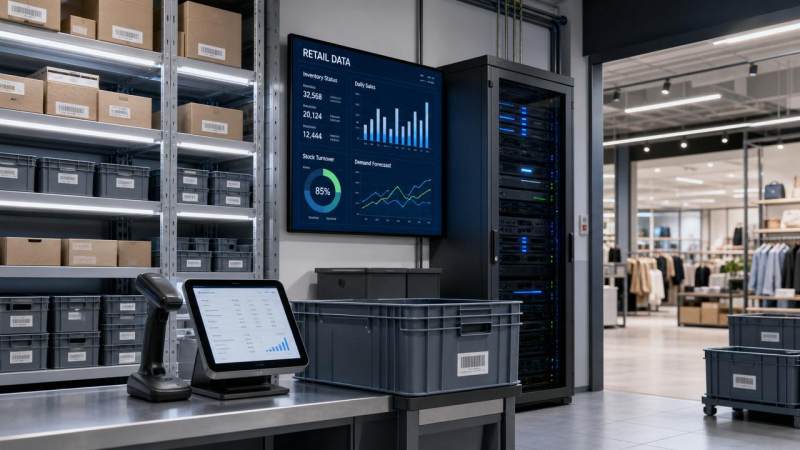
For evaluators, the question is whether data integration has controls. A dashboard is not proof of reliable data governance.
Useful checks include source lineage, exception reporting, matching rules, timestamp consistency, and clear ownership for disputed records.
Mistake 7: Failing to Separate Promotion Effects from Organic Demand
Promotions can create temporary spikes that look like sustainable demand growth. If models treat them as normal, future forecasts become inflated.
This mistake affects procurement commitments, warehouse capacity, staffing plans, and cash flow. Excess inventory often begins with misunderstood promotional uplift.
Retail data should identify promotion type, discount depth, display placement, marketing spend, channel exposure, and competitor activity during the campaign.
Evaluators should ask whether management can separate baseline demand from promotional demand. This distinction reveals the strength of the underlying business.
A company dependent on deep discounts may show volume growth while losing pricing power. Forecasts must expose that trade-off clearly.
Mistake 8: Not Accounting for Local Demand Differences
National averages can hide important regional patterns. Demand may vary by climate, income level, store format, culture, logistics access, and competitive density.
When retail data is aggregated too early, planners lose the signals needed for localized assortment, inventory allocation, and market expansion decisions.
A product with weak national performance may be highly profitable in specific regions. Conversely, national growth may conceal local saturation.
Business evaluators should examine forecasting granularity. Store-level, regional, and channel-level views provide better evidence than broad averages alone.
The goal is not endless segmentation. The goal is enough detail to support decisions about capital, supply, and commercial opportunity.
Mistake 9: Allowing Data Latency to Undermine Forecast Relevance
Some organizations still forecast with data that is weeks old. In volatile categories, delayed retail data can be nearly useless.
Late data slows reaction to demand shifts, competitor moves, supply shortages, and changing consumer sentiment. It also increases reliance on guesswork.
Latency does not always require real-time systems. The right standard depends on product velocity, replenishment cycles, and financial exposure.
Evaluators should compare data refresh rates with the pace of business decisions. A mismatch indicates operational risk.
Fast-moving categories require more frequent demand sensing. Long-cycle industrial or durable goods may need deeper context rather than constant updates.
Mistake 10: Measuring Forecast Accuracy Too Narrowly
Forecast accuracy is often reported as a single percentage. That number can be comforting, but it may hide serious planning problems.
A company may be accurate at total revenue level while consistently missing SKU-level, regional, or channel-level demand.
These hidden errors matter because procurement, production, logistics, and merchandising decisions are made below the aggregate level.
Evaluators should review forecast bias, error by category, exception frequency, and accuracy during unusual periods. Average performance is not enough.
The best organizations measure whether forecasts improve business outcomes, including lower stockouts, reduced markdowns, better service levels, and healthier inventory turns.
What Strong Retail Data Governance Looks Like
Reliable demand forecasting requires governance that connects data ownership, technical controls, and business accountability. It cannot be left only to analysts.
Strong governance defines trusted sources, product hierarchies, adjustment rules, approval workflows, and exception handling. It also documents why forecast changes occur.
Commercial teams should contribute market context, while data teams ensure consistency and traceability. Forecasting improves when both perspectives are integrated.
For business evaluators, governance quality is a proxy for management discipline. It shows whether leaders can convert information into controlled decisions.
Weak governance creates recurring surprises. Strong governance turns retail data into a practical asset for planning, risk management, and investment assessment.
How Evaluators Can Test the Reliability of Forecast Inputs
Evaluators do not need to audit every record. They need targeted questions that reveal whether forecast inputs are credible.
Start by asking how the company distinguishes sales, demand, shipments, and replenishment orders. Confusion between these terms is a common risk.
Next, review how stockouts, promotions, returns, substitutions, and channel shifts are represented. These factors often explain forecast errors.
Then examine whether historical data is adjusted for abnormal periods. Pandemic effects, supply disruptions, and major pricing changes require special treatment.
Finally, compare forecast outputs with operational outcomes. If inventory, service levels, and margin performance disagree with forecasts, investigate the data foundation.
Commercial Value of Better Retail Data Discipline
Improving retail data quality is not only about better models. It creates measurable business value across procurement, finance, operations, and strategy.
Better demand signals reduce excess inventory, improve supplier negotiations, lower emergency freight costs, and support more confident capital allocation.
They also help companies identify real growth categories, separate profitable demand from discount-driven volume, and protect customer availability.
For investors or corporate evaluators, disciplined retail data improves confidence in forecasts, budgets, synergy assumptions, and operational resilience claims.
The return on better data governance often appears through fewer surprises. In forecasting, avoided mistakes can be as valuable as new insights.
Conclusion: Better Forecasts Begin Before the Model
Retail data mistakes distort demand forecasts when organizations confuse transactions with demand, ignore inventory constraints, or fail to normalize product history.
For business evaluators, these errors are not minor data issues. They affect valuation confidence, procurement exposure, and the reliability of management plans.
The strongest companies treat retail data as a governed business asset. They connect commercial context, operational signals, and technical discipline.
Before trusting a forecast, evaluators should test the data beneath it. A sophisticated model cannot compensate for misunderstood demand signals.
Reliable forecasting begins with disciplined retail data, clear assumptions, and transparent governance. That foundation supports better commercial judgment and stronger strategic decisions.