Search News
Industry Portal
Popular Tags
Baby Clothing Safety Standards That Matter in 2026
Author
Time
Click Count
Choosing baby clothing in 2026 is about far more than cute colors and soft fabrics—it is about safety, transparency, and trust.
As global standards evolve, labels, materials, dyes, fasteners, and manufacturing claims need closer attention.
From chemical restrictions to choking hazards and skin-friendly textiles, informed decisions reduce avoidable risks in everyday baby clothing use.
This guide explains the baby clothing safety standards that matter most in 2026, with practical checks for safer buying.
Core Safety Principles Behind Baby Clothing Standards
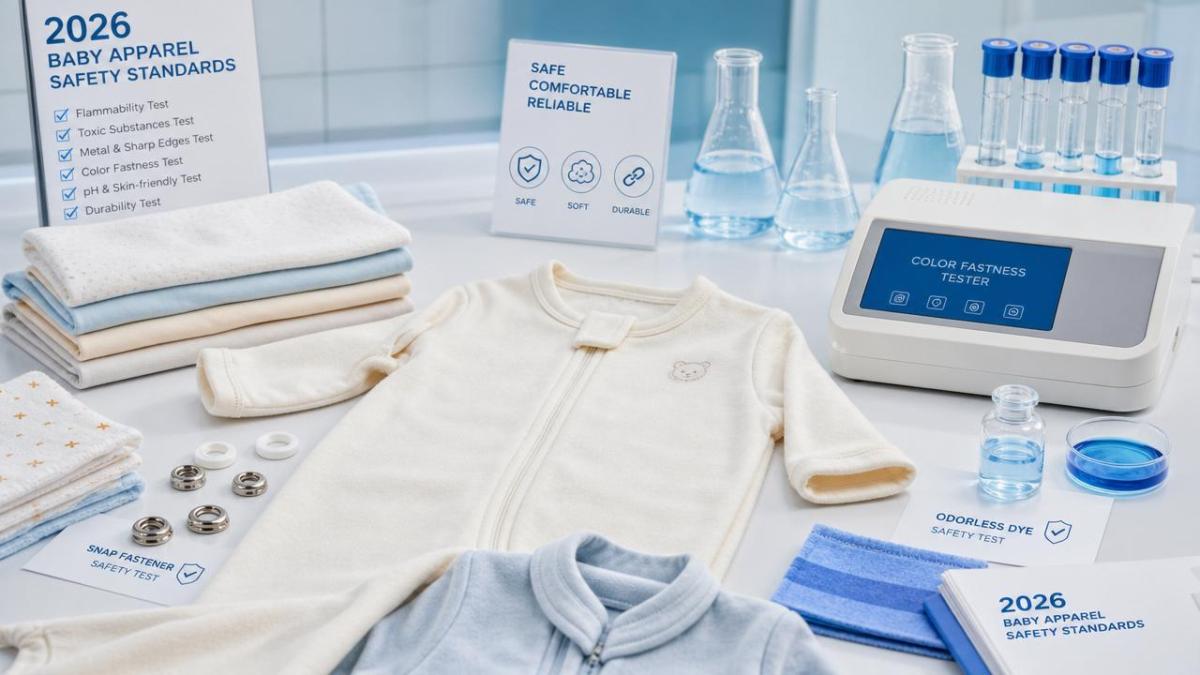
Baby clothing standards exist because infants have thinner skin, developing immune systems, and limited ability to react to discomfort.
A small design flaw can become a real hazard when garments are worn during sleep, crawling, feeding, or travel.
In 2026, safety is increasingly measured across the full product lifecycle, not only at the retail shelf.
Responsible baby clothing evaluation includes raw materials, dye chemistry, seam strength, labeling accuracy, packaging, and traceable production records.
Three safety principles matter most: chemical safety, physical safety, and performance safety under real use conditions.
Chemical safety limits harmful substances in fabrics, prints, snaps, coatings, elastic, and decorative parts.
Physical safety controls choking, strangulation, sharp edges, loose attachments, and restricted movement.
Performance safety verifies that baby clothing remains safe after washing, stretching, rubbing, sweating, and normal wear.
Regulatory Landscape and Current Safety Signals
Baby clothing safety in 2026 is shaped by overlapping national regulations, voluntary certifications, and retailer compliance programs.
No single label explains everything, so combining standards gives a clearer view of garment reliability.
Common reference points include CPSIA in the United States, REACH in the European Union, and textile-specific safety standards.
OEKO-TEX Standard 100, GOTS, ISO textile methods, and EN guidance often support chemical and material claims.
These frameworks are not identical, but they help identify safer baby clothing through measurable testing and documentation.
The strongest safety signal is consistency between label claims, third-party certificates, care instructions, and visible garment construction.
A vague “natural” or “non-toxic” claim is less useful than a named standard with a valid scope.
Chemical Safety Requirements for Baby Clothing
Chemical safety is one of the most important baby clothing topics because garments touch skin for long periods.
In 2026, attention is moving beyond traditional restricted substances toward persistent and bioaccumulative chemicals.
PFAS-free claims are becoming more common, especially for water-resistant bibs, outerwear, and treated fabrics.
For everyday baby clothing, fewer treatments are often preferable when stain resistance is not essential.
Formaldehyde limits matter because it may appear in wrinkle-resistant finishes or fabric stabilization processes.
Azo dye restrictions target colorants that can break down into harmful aromatic amines.
Heavy metals may be present in pigments, screen prints, buttons, snaps, or decorative coatings.
Phthalates are especially relevant in plasticized prints, flexible patches, and some synthetic trim components.
Safer baby clothing usually avoids strong chemical smells, sticky prints, unclear finishes, and excessive decorative treatments.
Washing before first wear remains a useful habit, but it cannot replace compliant materials and proper testing.
Material Choices and Skin Compatibility
Cotton, bamboo viscose, modal, wool, polyester, and blends can all be safe when properly processed.
The safer choice depends on certification, finishing chemistry, breathability, wash durability, and the baby’s skin response.
Organic fibers can reduce agricultural chemical concerns, but organic labeling does not automatically prove finished garment safety.
For baby clothing, the finished product should be assessed, not only the original fiber source.
Physical Hazards in Design, Fasteners, and Fit
Physical design is just as important as fabric content when evaluating baby clothing safety.
Small detachable items can become choking hazards if they loosen during washing, tugging, or chewing.
Buttons, bows, beads, sequins, patches, and decorative charms require close inspection before purchase and after laundering.
Drawstrings around the neck should be avoided, especially in hoodies, sleepwear, and outer layers.
Long waist cords, loose loops, and unsecured ties can catch on furniture, strollers, or playground equipment.
Zippers should have protective covers to prevent skin pinching, scratching, or contact with rough metal edges.
Snaps should close firmly without sharp rims, exposed prongs, or cracking after repeated use.
Baby clothing should allow natural movement without tight necklines, restrictive sleeves, or pressure around the abdomen.
- Check whether decorations can be pulled, twisted, or scratched loose.
- Avoid loose cords near the neck, chest, and hood area.
- Choose flat seams for newborns and sensitive skin.
- Inspect snaps and zippers after every few washes.
- Select the correct size instead of buying overly large sleepwear.
Sleepwear, Flame Safety, and Thermal Comfort
Sleepwear has stricter safety expectations because babies may wear it for many uninterrupted hours.
Baby clothing used for sleep should balance flame safety, fit, breathability, and overheating prevention.
Some regions require children’s sleepwear to meet flammability rules through snug fit or flame-resistant performance.
Snug-fitting sleepwear reduces loose fabric exposure, but it should not restrict circulation or movement.
Flame-resistant claims deserve careful review, particularly when chemical treatments are involved.
Labels should explain whether the garment is snug-fitting or flame resistant, and provide clear care instructions.
Fabric softeners, high heat drying, and improper washing can affect performance in some baby clothing categories.
Thermal comfort also matters because overheating can create discomfort and increase risk during sleep.
Layer breathable baby clothing according to room temperature, rather than relying on heavy garments indoors.
Labels, Certifications, and Product Transparency
A good label should provide more than size, color, and brand identity.
Reliable baby clothing labels include fiber content, care instructions, country of origin, manufacturer identity, and warnings when required.
Certifications help when they are specific, current, and relevant to the finished garment.
OEKO-TEX Standard 100 is commonly used to indicate testing for selected harmful substances.
GOTS focuses on organic textile processing, environmental criteria, and social compliance across certified supply chains.
CPSIA compliance is critical for baby clothing sold in the United States, especially for lead and phthalate limits.
REACH compliance supports chemical safety expectations across European markets and influences global product design.
Digital product passports and QR-based traceability are becoming more visible in textile supply chains.
These tools can connect baby clothing to test reports, material origins, and responsible manufacturing claims.
Transparency is useful only when the information is verifiable, readable, and connected to the exact product.
Typical Baby Clothing Categories and Safety Priorities
Different garment types create different risks, so safety checks should match the intended use.
A newborn bodysuit does not need the same evaluation as a rain jacket, costume, or winter romper.
This category-based approach makes baby clothing safety easier to assess during daily shopping and wardrobe rotation.
Practical Buying and Care Checklist for 2026
Safe baby clothing decisions begin before checkout and continue through washing, storage, and reuse.
A garment can meet standards when new, yet become unsafe after damage or poor care.
- Read the full label, including warnings, fiber content, and care instructions.
- Look for named certifications, not vague safety language.
- Smell the garment; avoid strong chemical or plastic odors.
- Pull gently on snaps, buttons, bows, and appliqués.
- Choose breathable fabrics for long wear and sleep.
- Wash baby clothing before first use with a mild detergent.
- Follow care instructions to preserve fabric and safety performance.
- Remove damaged garments with loose parts, sharp edges, or peeling prints.
Second-hand baby clothing deserves extra inspection because labels may fade and components may weaken over time.
Avoid used sleepwear without readable labels, uncertain fit guidance, or unknown flame safety information.
For sensitive skin, introduce new baby clothing gradually and watch for redness, itching, or heat rash.
Business and Industry Value of Stronger Safety Standards
Baby clothing safety is part of a broader shift toward verified materials, intelligent compliance, and resilient supply chains.
Advanced textile production increasingly connects material science, automation, testing data, and digital traceability.
This matters because safer garments depend on repeatable processes, not only good intentions.
Clear standards help align fabric mills, dye houses, trim suppliers, laboratories, logistics partners, and retail quality systems.
When baby clothing data is structured, risks can be identified earlier and recalls can be managed more accurately.
Technical benchmarking also improves material selection, durability testing, chemical screening, and lifecycle sustainability decisions.
The result is not only safer baby clothing, but also less waste from failed batches and unreliable claims.
Next Steps for Safer Baby Clothing Decisions
In 2026, the safest approach is to combine label literacy with hands-on inspection and careful care habits.
Prioritize baby clothing with transparent materials, recognized testing, secure construction, and clear instructions.
Be cautious with excessive decoration, unclear chemical claims, strong odors, missing labels, and poor fastener quality.
Use standards as decision tools, but also trust visible evidence from stitching, prints, trims, and garment condition.
For each new purchase, check chemical claims, physical hazards, fit, sleep suitability, and washing requirements.
A simple safety routine can turn baby clothing selection into a confident, repeatable process.
Start with the garments worn longest and closest to skin, then apply the same checks across the full wardrobe.
Recommended News
 Sep 19, 2026When can a supply chain LLM reduce time spent finding shipment updates?Supply chain LLMs can cut shipment-update search time by connecting carrier events, ERP data, and documents—giving teams traceable answers and faster exception response.
 Sep 18, 2026How industrial monitoring equipment helps prevent unplanned downtimeIndustrial monitoring equipment helps teams detect early asset issues, prioritize maintenance, and prevent costly unplanned downtime. Explore practical strategies for reliable operations.
 Sep 17, 2026What next-gen harmonic drive research means for robot joint accuracyNext-gen harmonic drive research reveals how backlash, stiffness, thermal drift, and sensing shape robot joint accuracy. Explore smarter validation strategies.
 Sep 16, 2026How Southeast Asian climates affect cylinder seal frictionCylinder seal friction Southeast Asia: learn how humidity, heat, monsoons, and contamination affect motion stability, wear, and seal selection.
 Sep 15, 2026How to size DC gear motors for the required starting torqueGear motors DC sizing made practical: calculate starting torque, account for friction, gravity, inertia and voltage drop, then select a reliable motor with confidence.
 Sep 14, 2026How to verify high purity chemicals compliance before supplier approvalHigh purity chemicals compliance: learn how to verify supplier quality systems, CoAs, traceability, testing, and change control before approval.
 Sep 13, 2026What permits are needed to operate mapping drones in Europe?Mapping drones Europe: discover the permits, EASA categories, airspace approvals, site access, and GDPR checks needed for compliant aerial surveys.
 Sep 12, 2026What lead time should I expect for automatic transmission components? Planetary Gearboxes delivery forecasting for OEM planningWhat lead time should I expect for automatic transmission components? Get dynamic, AI-powered planetary gearbox delivery forecasting—designed for OEMs building next-gen hybrid & commercial powertrains.
 Sep 12, 2026Can polyamide replace metal in load-bearing components? Polymer Pulse structural performance data for 2026 applicationsCan polyamide replace metal in load-bearing components? Discover Polymer Pulse’s 2026 structural data—real-world performance, weight savings, and reliability breakthroughs.
 Sep 12, 2026How to handle a power electronics warranty claim: Harmonic Reducers documentation and escalation pathHow do I handle a power electronics warranty claim? Get a fast, intelligent, evidence-driven resolution for harmonic reducers—no bureaucracy, just precision diagnostics and real-time escalation.
 Sep 12, 2026Which motion control specifications matter most before purchase? Torque Logic selection criteria for automation engineersWhich motion control specifications are most important before purchase? Discover Torque Logic—the 4 non-negotiable, AI-aligned criteria that cut TCO by 27–41% and boost motion system availability to 99.992%.
 Sep 13, 2026Is agentic AI reliable enough for supplier screening? Supply Chain LLM validation framework for procurement teamsIs agentic AI reliable enough for supplier screening? Discover a rigorous LLM validation framework built for procurement teams—grounded in material traceability, regulatory compliance, and real-world operational constraints.
 Sep 14, 2026How to maintain edge AI systems after deployment: Predictive Maint AI operational protocols for field techniciansHow do I maintain edge AI systems after deployment? Discover predictive, physics-aware operational protocols designed for real-world field technicians—sustaining intelligence where silicon meets steel.
 Sep 15, 2026What compliance documents must a bioplastics supplier provide? Bio-Plastics regulatory checklist for procurementWhat compliance documents should a bioplastics supplier provide? Get our actionable regulatory checklist for food, medical & EU-bound applications.
 Sep 16, 2026How to prevent PET film defects during production: Barrier Films process control best practicesHow can I prevent PET film defects during production? Discover physics-driven barrier film process control—thermal precision, dynamic tension management & surface energy optimization.
 Sep 17, 2026Are thermoplastics suitable for long-term outdoor use? Engineering Resins durability assessment in 2026 UV/weather exposureAre thermoplastics suitable for long-term outdoor use? Discover 2026’s engineering resin durability insights — UV/weather resistance ranked, tested & actionable.
 Sep 18, 2026What to do when a servo motor fails during production: A Servo Actuators troubleshooting guide for maintenance teamsWhat should I do if a servo motor fails during production? Get a field-tested, AI-aware troubleshooting guide for maintenance teams—minimize downtime, maximize OEE.
 Sep 12, 2026How to compare wholesale party supplies by minimum order valueCompare wholesale party supplies by minimum order value, freight, SKU flexibility, and stock risk to choose suppliers that protect margins and simplify replenishment.
 Sep 11, 2026How proportional solenoid linearity affects precision motion controlProportional solenoid linearity directly affects precision motion control, valve metering, stability, and calibration. Learn how to evaluate performance for reliable automation.
 Sep 10, 2026When does supplier information platform automation reduce onboarding delays?Supplier information platform automation reduces onboarding delays by streamlining data collection, routing, renewals, and compliance checks—without replacing expert technical review.
 Sep 09, 2026How to size robotic motion systems for AMR payload changesRobotic motion systems for AMR payload changes: learn how to size motors, wheels, gearing, traction, and controls for safer, reliable performance.
 Sep 08, 2026How to perform a cylinder rod buckling calculation for long strokesCylinder rod buckling calculation made practical: learn how to assess effective length, end conditions, rod stiffness, load forces, and safety margins for reliable long-stroke cylinder design.
 Sep 07, 2026How to estimate the cost of industrial mechanical components before orderingIndustrial mechanical components cost: learn how to estimate material, machining, tooling, inspection, logistics, and hidden expenses before ordering. Compare quotes confidently and reduce sourcing risk.
 Sep 07, 2026What Is a Product Standards Database Used For?Product standards database guide: learn how to compare requirements, verify revisions, control specifications, and reduce compliance risks across design, sourcing, and production.