Search News
Industry Portal
Popular Tags
Electric Toothbrush OEM: Cost vs Quality Checklist
Author
Time
Click Count
Selecting an electric toothbrush oem partner is no longer a simple price comparison. It is a strategic decision affecting reliability, compliance, reputation, and margin.
The real challenge is knowing where savings are reasonable, and where quality compromises create hidden liabilities across the product life cycle.
This checklist explains how to compare electric toothbrush oem cost against manufacturing strength, component standards, certification readiness, customization flexibility, and total ownership cost.
Cost Pressure Is Rising, But Quality Expectations Are Rising Faster
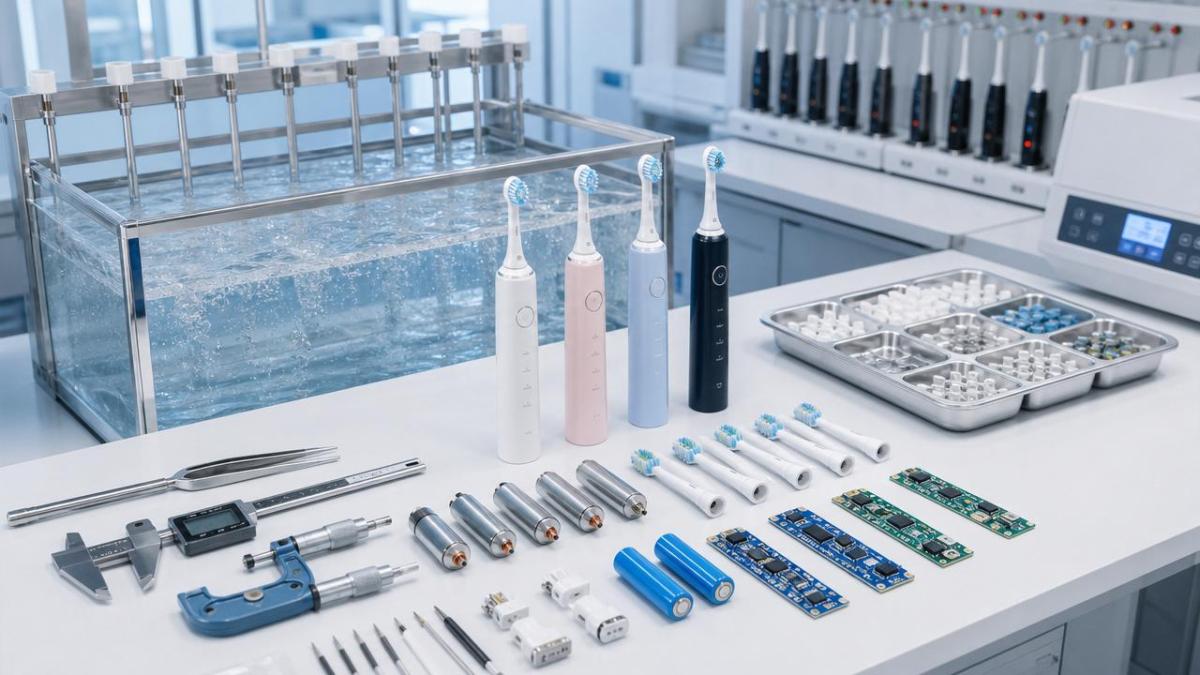
The electric toothbrush oem market is shifting from low-cost assembly toward integrated product engineering, smart control, safer batteries, and consistent oral-care performance.
Price competition remains intense, yet end users now expect quieter motors, longer runtime, waterproof bodies, multiple brushing modes, and refined surface finishing.
This creates a difficult balance. A cheaper electric toothbrush oem quote may look attractive, but weak validation can increase failure claims.
A higher unit cost may be justified when it reduces returns, protects brand trust, and improves channel acceptance across regulated markets.
Trend Signals Reshaping Electric Toothbrush OEM Decisions
Several signals show why electric toothbrush oem selection has become more technical and less transactional.
- Retail channels demand stable quality data before approving new private-label oral-care products.
- Battery safety expectations are stricter, especially for rechargeable models using lithium cells.
- Consumers compare vibration strength, noise level, charging time, and replacement brush availability.
- Sustainability pressure is moving attention toward recyclable packaging and lower-energy production.
- Digital differentiation now includes timers, pressure reminders, app connectivity, and usage memory.
These changes mean an electric toothbrush oem supplier must offer more than tooling and assembly capacity.
The supplier should demonstrate engineering discipline, traceable sourcing, test systems, and scalable process control.
Why Low-Cost Quotes Often Hide Operational Risk
A low electric toothbrush oem quotation may reduce immediate purchase cost, but it can transfer risk into later stages.
Common hidden costs include rework, delayed certification, unstable motor performance, battery complaints, packaging redesign, and inconsistent color matching.
Cost should be analyzed by function, not only by total price. Each saving should have a verified technical explanation.
Manufacturing Capability Is The First Quality Filter
An electric toothbrush oem supplier should be assessed through factory capability, not only sample appearance.
A polished sample can come from a manual process that cannot repeat at volume.
Checklist For Factory Strength
- Injection molding accuracy for handle fit, button feel, and sealing reliability.
- Automated or semi-automated assembly for repeatable internal positioning.
- Motor balancing and vibration testing before final packing.
- Battery aging, charging protection, and electronic board inspection.
- In-process quality checkpoints documented by batch and production line.
A qualified electric toothbrush oem partner should explain process controls in measurable terms.
Useful indicators include defect rate, capacity utilization, line balancing, inspection frequency, and corrective action records.
Component Standards Decide Long-Term Product Reliability
The performance of an electric toothbrush oem product depends heavily on internal component choices.
Small changes in motor grade, battery cell, shaft material, PCB protection, or gasket quality can significantly affect service life.
Component substitution is a common source of cost reduction. It should never happen without written approval and technical verification.
Critical Component Questions
- What motor type is used, and what is its tested operating life?
- Which battery cell brand, capacity, and protection design are applied?
- What waterproof rating target is validated, such as IPX7?
- Are brush heads tested for fit stability and bristle retention?
- Can material safety documents be provided for plastics and coatings?
A stronger electric toothbrush oem supplier can provide component traceability and alternative sourcing plans.
This is important when shortages affect motors, batteries, charging ICs, or packaging materials.
Certification Readiness Reduces Market Entry Delays
Compliance has become a central cost factor in electric toothbrush oem evaluation.
A supplier may offer a low price, yet lack documentation for electrical safety, EMC, chemical limits, and battery transport.
Market requirements vary, but common references include CE, FCC, RoHS, REACH, UKCA, and UN38.3 for lithium batteries.
Certification readiness does not mean every model is automatically approved.
It means the electric toothbrush oem system is designed to support testing without repeated redesign.
- Check whether previous test reports match the proposed product structure.
- Confirm that PCB layout changes are reviewed before certification submission.
- Verify battery transport documents and packaging instructions.
- Request compliance ownership for labels, manuals, and warnings.
Customization Flexibility Should Not Destroy Process Stability
Customization is a key reason to choose an electric toothbrush oem model instead of a purely standard product.
However, every customization affects tooling, materials, testing, lead time, and minimum order economics.
Common options include handle color, logo method, brush head design, vibration modes, charging base, travel case, and packaging structure.
The key is to separate cosmetic customization from functional customization.
A reliable electric toothbrush oem supplier should define which changes require new validation.
This prevents attractive design revisions from weakening waterproofing, charging reliability, or assembly yield.
Total Cost Of Ownership Gives A More Accurate Comparison
Unit price is only one part of electric toothbrush oem economics.
Total cost includes tooling, samples, certification, inspection, logistics, warranty reserves, replacement parts, and after-sales handling.
A cheaper product can become expensive when return rates rise or launch timing slips.
A better electric toothbrush oem decision compares landed cost with expected operating performance.
Practical TCO Indicators
- Estimated defect rate during mass production and after shipment.
- Spare brush head availability and replacement compatibility.
- Expected production lead time under normal and peak demand.
- Warranty claim process, responsibility boundary, and response time.
- Packaging efficiency for freight cost and shelf protection.
How The Trend Affects Product, Supply, And Brand Outcomes
The shift toward higher-quality electric toothbrush oem programs affects several business links at once.
Product development becomes more data-driven, with stronger attention to validation before market launch.
Supply planning also changes. Stable component access and production transparency become as important as nominal capacity.
Brand outcomes are increasingly connected to technical consistency.
Noise complaints, battery issues, or weak waterproofing can damage reviews faster than visual design can recover them.
- For product planning, prioritize validated features over excessive mode counts.
- For supply continuity, check dual sourcing for sensitive components.
- For quality control, use pre-shipment testing beyond cosmetic inspection.
- For market growth, protect review quality through lower early failure rates.
Decision Checklist For Balancing Cost And Quality
Before confirming an electric toothbrush oem supplier, compare proposals through a structured decision framework.
The best electric toothbrush oem choice is rarely the lowest quote.
It is the supplier that proves cost discipline without weakening safety, reliability, certification, or user experience.
Next Steps For A More Resilient OEM Program
Start by defining required performance before requesting prices.
Set targets for runtime, waterproofing, vibration strength, noise, charging method, warranty expectation, and compliance markets.
Then request a cost breakdown from each electric toothbrush oem supplier.
Ask suppliers to explain where savings come from, and what testing proves those savings are safe.
Use pilot orders to validate mass-production stability before scaling.
Inspect functional performance, not only appearance, and compare results with promised specifications.
A disciplined electric toothbrush oem evaluation protects margin in a practical way.
It reduces uncertainty, improves launch confidence, and builds a stronger foundation for long-term oral-care product growth.
Recommended News
 Sep 19, 2026When can a supply chain LLM reduce time spent finding shipment updates?Supply chain LLMs can cut shipment-update search time by connecting carrier events, ERP data, and documents—giving teams traceable answers and faster exception response.
 Sep 18, 2026How industrial monitoring equipment helps prevent unplanned downtimeIndustrial monitoring equipment helps teams detect early asset issues, prioritize maintenance, and prevent costly unplanned downtime. Explore practical strategies for reliable operations.
 Sep 17, 2026What next-gen harmonic drive research means for robot joint accuracyNext-gen harmonic drive research reveals how backlash, stiffness, thermal drift, and sensing shape robot joint accuracy. Explore smarter validation strategies.
 Sep 16, 2026How Southeast Asian climates affect cylinder seal frictionCylinder seal friction Southeast Asia: learn how humidity, heat, monsoons, and contamination affect motion stability, wear, and seal selection.
 Sep 15, 2026How to size DC gear motors for the required starting torqueGear motors DC sizing made practical: calculate starting torque, account for friction, gravity, inertia and voltage drop, then select a reliable motor with confidence.
 Sep 14, 2026How to verify high purity chemicals compliance before supplier approvalHigh purity chemicals compliance: learn how to verify supplier quality systems, CoAs, traceability, testing, and change control before approval.
 Sep 13, 2026What permits are needed to operate mapping drones in Europe?Mapping drones Europe: discover the permits, EASA categories, airspace approvals, site access, and GDPR checks needed for compliant aerial surveys.
 Sep 12, 2026What lead time should I expect for automatic transmission components? Planetary Gearboxes delivery forecasting for OEM planningWhat lead time should I expect for automatic transmission components? Get dynamic, AI-powered planetary gearbox delivery forecasting—designed for OEMs building next-gen hybrid & commercial powertrains.
 Sep 12, 2026Can polyamide replace metal in load-bearing components? Polymer Pulse structural performance data for 2026 applicationsCan polyamide replace metal in load-bearing components? Discover Polymer Pulse’s 2026 structural data—real-world performance, weight savings, and reliability breakthroughs.
 Sep 12, 2026How to handle a power electronics warranty claim: Harmonic Reducers documentation and escalation pathHow do I handle a power electronics warranty claim? Get a fast, intelligent, evidence-driven resolution for harmonic reducers—no bureaucracy, just precision diagnostics and real-time escalation.
 Sep 12, 2026Which motion control specifications matter most before purchase? Torque Logic selection criteria for automation engineersWhich motion control specifications are most important before purchase? Discover Torque Logic—the 4 non-negotiable, AI-aligned criteria that cut TCO by 27–41% and boost motion system availability to 99.992%.
 Sep 13, 2026Is agentic AI reliable enough for supplier screening? Supply Chain LLM validation framework for procurement teamsIs agentic AI reliable enough for supplier screening? Discover a rigorous LLM validation framework built for procurement teams—grounded in material traceability, regulatory compliance, and real-world operational constraints.
 Sep 14, 2026How to maintain edge AI systems after deployment: Predictive Maint AI operational protocols for field techniciansHow do I maintain edge AI systems after deployment? Discover predictive, physics-aware operational protocols designed for real-world field technicians—sustaining intelligence where silicon meets steel.
 Sep 15, 2026What compliance documents must a bioplastics supplier provide? Bio-Plastics regulatory checklist for procurementWhat compliance documents should a bioplastics supplier provide? Get our actionable regulatory checklist for food, medical & EU-bound applications.
 Sep 16, 2026How to prevent PET film defects during production: Barrier Films process control best practicesHow can I prevent PET film defects during production? Discover physics-driven barrier film process control—thermal precision, dynamic tension management & surface energy optimization.
 Sep 17, 2026Are thermoplastics suitable for long-term outdoor use? Engineering Resins durability assessment in 2026 UV/weather exposureAre thermoplastics suitable for long-term outdoor use? Discover 2026’s engineering resin durability insights — UV/weather resistance ranked, tested & actionable.
 Sep 18, 2026What to do when a servo motor fails during production: A Servo Actuators troubleshooting guide for maintenance teamsWhat should I do if a servo motor fails during production? Get a field-tested, AI-aware troubleshooting guide for maintenance teams—minimize downtime, maximize OEE.
 Sep 12, 2026How to compare wholesale party supplies by minimum order valueCompare wholesale party supplies by minimum order value, freight, SKU flexibility, and stock risk to choose suppliers that protect margins and simplify replenishment.
 Sep 11, 2026How proportional solenoid linearity affects precision motion controlProportional solenoid linearity directly affects precision motion control, valve metering, stability, and calibration. Learn how to evaluate performance for reliable automation.
 Sep 10, 2026When does supplier information platform automation reduce onboarding delays?Supplier information platform automation reduces onboarding delays by streamlining data collection, routing, renewals, and compliance checks—without replacing expert technical review.
 Sep 09, 2026How to size robotic motion systems for AMR payload changesRobotic motion systems for AMR payload changes: learn how to size motors, wheels, gearing, traction, and controls for safer, reliable performance.
 Sep 08, 2026How to perform a cylinder rod buckling calculation for long strokesCylinder rod buckling calculation made practical: learn how to assess effective length, end conditions, rod stiffness, load forces, and safety margins for reliable long-stroke cylinder design.
 Sep 07, 2026How to estimate the cost of industrial mechanical components before orderingIndustrial mechanical components cost: learn how to estimate material, machining, tooling, inspection, logistics, and hidden expenses before ordering. Compare quotes confidently and reduce sourcing risk.
 Sep 07, 2026What Is a Product Standards Database Used For?Product standards database guide: learn how to compare requirements, verify revisions, control specifications, and reduce compliance risks across design, sourcing, and production.