Search News
Industry Portal
Popular Tags
Supply Chain Orchestration Platform vs ERP
Author
Time
Click Count
As manufacturers rethink legacy ERP limitations, a supply chain orchestration platform is emerging as a smarter layer for real-time coordination, visibility, and decision-making. For teams evaluating digital supply chain solutions, smart manufacturing systems, and a supply chain intelligence platform, understanding the gap between ERP and supply chain orchestration software is essential to improving resilience, automation, and performance across modern industrial operations.
If your team is comparing a supply chain orchestration platform vs ERP, the short answer is this: ERP remains critical for recording transactions and standardizing core business processes, but it is not designed to orchestrate fast-changing, multi-enterprise supply chain decisions in real time. A supply chain orchestration platform does not replace ERP in most industrial environments. It sits above and across existing systems to connect data, coordinate actions, and help operations teams respond faster to disruptions, constraints, and shifting demand.
For information researchers and hands-on users, the real question is not which system is “better” in general. It is which system solves which problem. ERP is strong at system-of-record functions such as finance, purchasing, inventory accounting, and order processing. Supply chain orchestration software is built for end-to-end visibility, exception management, scenario-based decision support, and synchronized execution across suppliers, plants, logistics partners, and customers.
What is the real difference between a supply chain orchestration platform and ERP?
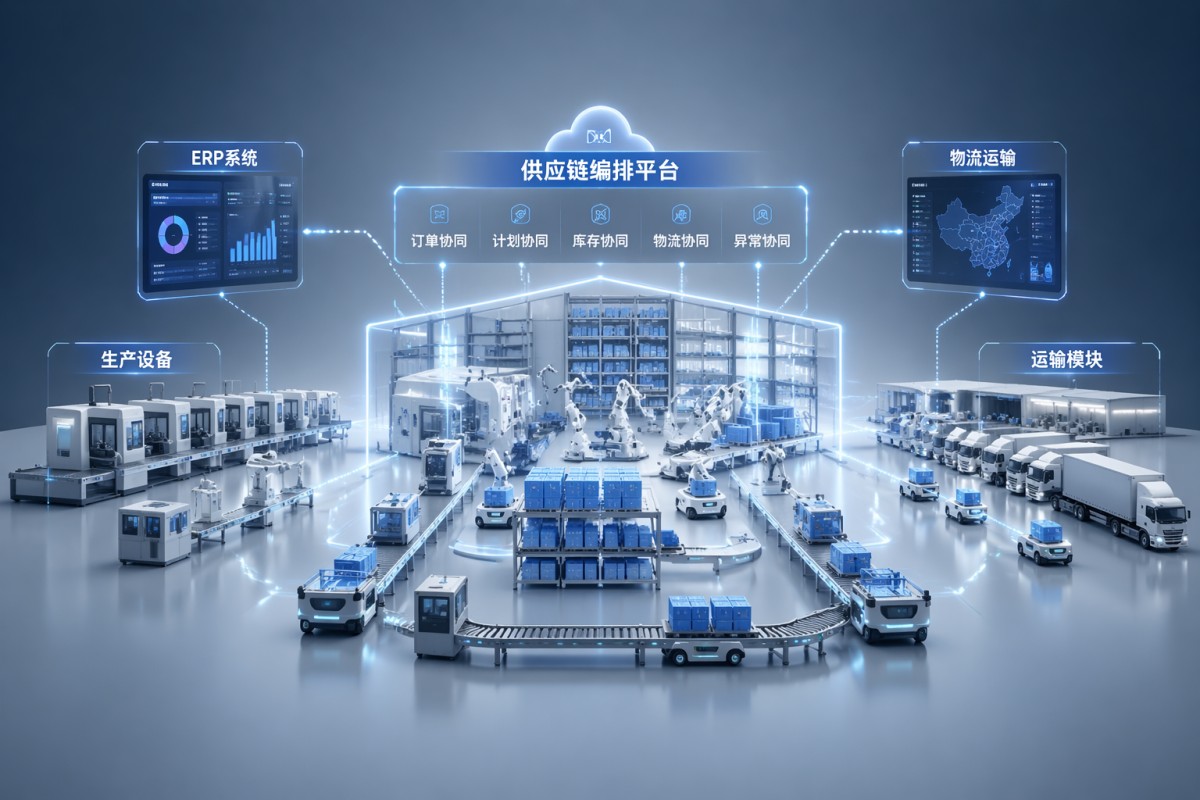
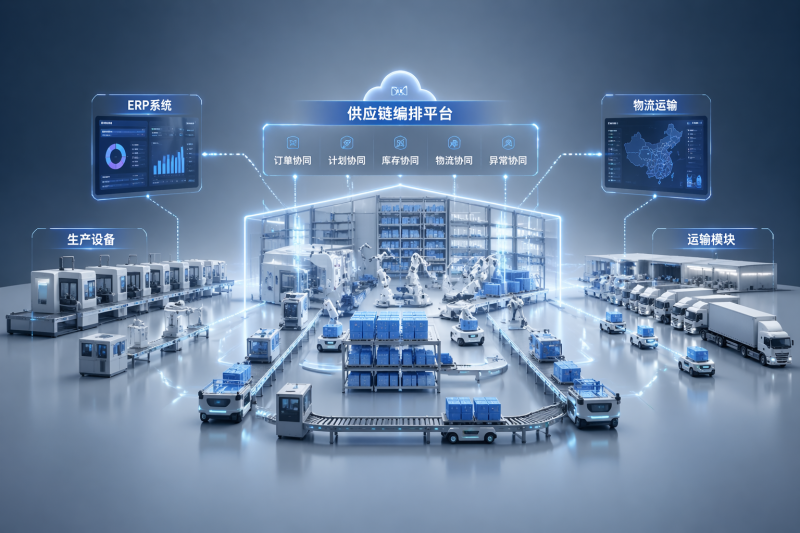
The most practical way to understand the difference is to compare their operational role.
ERP is primarily a system of record. It stores master data, processes transactions, enforces business rules, and supports internal functional workflows. It is the backbone for areas like procurement, production orders, invoicing, inventory valuation, and financial reporting.
A supply chain orchestration platform is primarily a system of coordination and decision execution. It brings together signals from ERP, MES, WMS, TMS, supplier portals, planning tools, IoT sources, and external partners. Then it helps teams detect issues early, prioritize actions, automate responses, and align execution across the network.
In industrial operations, that difference matters because modern supply chains do not fail only at the transaction level. They fail at the coordination level. A purchase order may exist correctly inside ERP, but a supplier delay, material substitution risk, logistics bottleneck, or machine constraint can still break delivery performance. ERP can record the event. Orchestration platforms are designed to help manage the response.
That is why many manufacturers now view ERP as necessary but insufficient for resilience. ERP tells you what has been entered and processed. A supply chain intelligence platform helps you understand what is happening, what will happen next, and what action should be taken now.
Why ERP alone often struggles in today’s manufacturing supply chains
For large and complex industrial ecosystems, ERP limitations usually become visible in five areas.
1. Limited cross-enterprise visibility
ERP is typically strongest within the boundaries of the enterprise. But supply chains now depend on suppliers, contract manufacturers, logistics providers, material processors, and regional distribution nodes. When disruptions occur outside your four walls, ERP often lacks the visibility depth and speed needed for proactive coordination.
2. Slow response to exceptions
Traditional ERP workflows are not optimized for rapid exception management. Users often need to extract reports, compare spreadsheets, send emails, and manually coordinate decisions. That slows down response time when demand changes, parts become constrained, or shipments slip.
3. Weak real-time decision support
ERP can store huge volumes of data, but it is not inherently built to continuously sense risk, simulate alternatives, and recommend actions across multiple nodes. In volatile environments, teams need more than static records. They need dynamic prioritization.
4. Fragmented execution across systems
Manufacturers commonly run ERP alongside APS, MES, PLM, WMS, TMS, supplier systems, and quality platforms. Each may perform well in its own domain, but without orchestration, teams still struggle to synchronize actions across the full chain.
5. Limited adaptability for network complexity
As product portfolios diversify and sourcing models become more global, rule-based, linear workflows become less effective. A modern smart manufacturing system requires a digital layer that can manage dependencies, exceptions, and trade-offs continuously.
What a supply chain orchestration platform actually does in practice
Many buyers hear the term but want to know what it means operationally. In practice, supply chain orchestration software usually delivers value through a set of capabilities that sit on top of existing enterprise systems.
End-to-end visibility
It aggregates data from internal and external sources to create a more complete operational picture. That can include purchase order status, production progress, supplier commits, shipment milestones, inventory positions, and capacity constraints.
Exception detection and prioritization
Instead of forcing users to monitor dozens of dashboards manually, the platform identifies deviations that matter most: late materials, quality events, port delays, demand spikes, component shortages, or scheduling conflicts.
Scenario analysis and decision support
Teams can compare options such as expediting shipments, reallocating inventory, switching suppliers, adjusting production sequences, or changing customer allocation rules. This is especially valuable when margin, service level, and lead time must be balanced simultaneously.
Workflow orchestration
The platform routes issues to the right stakeholders, triggers approval flows, tracks action completion, and creates a shared operating rhythm across procurement, planning, operations, logistics, and partner teams.
Automation of response
In more mature deployments, certain decisions can be automated based on predefined logic, risk thresholds, or AI-supported recommendations. That reduces manual workload and improves reaction speed.
Multi-system synchronization
A supply chain orchestration platform does not need to replace ERP, MES, or TMS. Its role is to coordinate them. That makes it particularly attractive for manufacturers with heterogeneous digital environments.
When should a manufacturer use ERP, and when is orchestration the missing layer?
For most industrial enterprises, this is not an either-or decision.
ERP is the right foundation when you need:
- Financial control and auditability
- Standardized procurement and order management
- Core inventory and production transaction management
- Master data governance
- Enterprise-wide process consistency
A supply chain orchestration platform becomes essential when you need:
- Real-time visibility across suppliers and logistics networks
- Fast response to supply disruptions and demand changes
- Cross-functional coordination across multiple systems
- Decision support for trade-offs and exception handling
- A more resilient, automated, and agile operating model
If your operation is relatively simple, highly centralized, and stable, ERP may cover much of your near-term need. But if you manage global sourcing, high-value materials, variable lead times, strict service commitments, or multi-site production networks, orchestration often becomes the missing layer between planning and execution.
How to evaluate business value: what decision-makers and users should look for
Readers comparing ERP with orchestration are usually trying to justify investment, avoid overlap, and reduce implementation risk. The most useful evaluation criteria are practical, not theoretical.
Look at time-to-decision, not only time-to-report.
Many organizations can produce reports. Fewer can shorten the cycle from disruption signal to coordinated action. That is where orchestration often creates measurable value.
Measure the cost of uncoordinated execution.
Hidden costs often include expedite fees, excess inventory, missed OTIF targets, avoidable downtime, manual replanning effort, and poor customer communication. A supply chain intelligence platform should reduce these coordination losses.
Check interoperability with your current stack.
The best-fit platform should integrate with ERP and adjacent systems rather than force unnecessary replacement. In advanced industrial environments, composability matters.
Assess usability for operators, not just dashboards for executives.
A platform only creates value if planners, buyers, logistics teams, and plant operators can use it to make better daily decisions. Workflow clarity and actionable alerts matter more than visually impressive but passive analytics.
Validate scalability for supply complexity.
The platform should handle supplier tiers, material dependencies, global trade variability, and manufacturing constraints without becoming another silo.
Demand clear outcome metrics.
Typical KPIs include improved OTIF, reduced shortage incidents, lower premium freight, faster exception resolution, better inventory positioning, and stronger supplier collaboration.
Common concerns: overlap, implementation risk, and system replacement myths
One of the biggest sources of confusion is the assumption that a supply chain orchestration platform competes directly with ERP. In reality, the more common model is coexistence.
Concern 1: “Will this replace ERP?”
Usually no. ERP still handles core transactions and enterprise process control. Orchestration extends its value by making the network more responsive and coordinated.
Concern 2: “Is this just another visibility tool?”
Not if it is a true orchestration layer. Basic visibility tools show status. Orchestration platforms connect status to action, workflow, and decision logic.
Concern 3: “Will implementation be too disruptive?”
The risk depends on scope. Many organizations start with one high-value workflow, such as inbound material risk management, constrained supply allocation, or control tower-style logistics coordination. This phased approach often reduces complexity and speeds ROI.
Concern 4: “Do we need perfect data first?”
No enterprise has perfect data. What matters is whether the platform can improve signal quality, expose gaps, and support progressive maturity. Waiting for perfect data often delays meaningful improvement.
Concern 5: “Is this only for very large enterprises?”
Not necessarily. The strongest fit is for organizations with complexity, volatility, and coordination pain. That may include mid-sized manufacturers with global suppliers just as much as multinational groups.
A practical framework for choosing between ERP optimization and orchestration investment
If your team is deciding where to invest first, use a simple diagnostic lens.
Prioritize ERP optimization first if:
- Core transaction accuracy is poor
- Master data is severely inconsistent
- Basic purchasing, inventory, and financial processes are not standardized
- Users still struggle with foundational system adoption
Prioritize supply chain orchestration if:
- ERP is functioning, but response to disruption is still too slow
- Teams rely heavily on spreadsheets, emails, and manual escalation
- Visibility across suppliers, shipments, and production dependencies is fragmented
- Business performance suffers from coordination failures more than transaction failures
- You need a smarter digital layer to support resilient operations
In advanced manufacturing settings, the highest return often comes from combining both approaches: stabilize ERP as the transaction core, then add orchestration where network complexity creates the most operational and financial risk.
Final takeaway: ERP records the business, orchestration runs the response
When evaluating a supply chain orchestration platform vs ERP, the most important insight is that they serve different purposes. ERP is indispensable for process control and transactional integrity. But modern industrial supply chains need more than records. They need synchronized action across a fast-moving, multi-enterprise ecosystem.
A supply chain orchestration platform helps manufacturers move from reactive management to proactive coordination. It improves visibility, shortens response time, supports better decisions, and connects execution across systems and partners. For organizations facing volatility, material constraints, and rising service expectations, that difference is strategic.
The best decision is rarely ERP or orchestration. It is understanding where ERP stops creating agility and where orchestration starts creating resilience. Once that boundary is clear, digital supply chain investment becomes easier to justify, sequence, and scale.
Recommended News
 May 02, 2026Choosing a Sustainable Materials Supplier for Stable Quality and Lead TimesSustainable materials supplier selection starts with quality and lead-time control. Learn a practical checklist to reduce risk, protect margins, and build a reliable supply network.
 May 02, 2026AI in Manufacturing Applications That Reduce Downtime in Daily OperationsAI in manufacturing applications help maintenance teams detect faults earlier, cut unplanned downtime, improve service response, and keep daily operations running with greater reliability.
 May 02, 2026Material Science Research Trends Shaping Better Industrial MaterialsMaterial science research is transforming industrial materials with smarter, lighter, and more sustainable solutions. Discover key trends driving performance, resilience, and competitive advantage.
 May 02, 2026Automation Technology for Factories: Key Features to Evaluate Before You InvestAutomation technology for factories: compare integration, scalability, flexibility, and lifecycle value before you invest. Learn how to reduce risk and choose the right-fit solution.
 May 02, 2026Manufacturing Technology Innovations Worth Piloting Before Full-Scale RolloutManufacturing technology innovations worth piloting first: discover practical ways to validate ROI, reduce rollout risk, and choose scalable solutions that improve quality, uptime, and efficiency.
 May 02, 2026Smart Materials Applications: Where They Solve Real Reliability ProblemsSmart materials applications help detect fatigue, vibration, heat, and corrosion earlier—learn where they solve real reliability problems and improve industrial safety.
 May 02, 2026AI in Manufacturing Benefits That Matter Most on the Factory FloorAI in manufacturing benefits include less downtime, faster troubleshooting, and stronger quality control. See how factory teams improve output, safety, and daily decision-making.
 May 02, 2026How to Compare Sustainable Materials for Construction Without Costly MistakesSustainable materials for construction: learn how to compare carbon impact, performance, supply resilience, and lifecycle cost to avoid costly mistakes and make smarter procurement decisions.
 May 02, 2026Smart Manufacturing Technology: What Actually Delivers ROI in 2026Smart manufacturing technology in 2026 is all about proven ROI. Discover which use cases boost uptime, quality, resilience, and sustainability across enterprise operations.
 May 02, 2026How Advanced Materials for Industrial Automation Improve Precision and UptimeAdvanced materials for industrial automation improve precision, reduce wear, and boost uptime. Discover how smarter material choices cut maintenance and strengthen reliable, high-output operations.
 May 02, 20262026 Global Trade & Investment Summit in Beijing: AI+Manufacturing FocusAI+Manufacturing takes center stage at the 2026 Global Trade & Investment Summit in Beijing — discover cross-border AI supply chain solutions, LLM white papers & POC matchmaking for global buyers.
 May 02, 2026Global Engineering Resins Index Up 8.2% in April; China Delivery Stability Gains FocusEngineering resins prices surge 8.2% in April—discover how rising costs and China’s 98.3% on-time delivery rate reshape global procurement strategies.
 May 02, 2026FDA Updates Bio-Plastics Food Contact Guidance: Migration Testing Deadline Nov 1, 2026FDA bio-plastics food contact guidance updated: migration testing deadline is Nov 1, 2026. Ensure compliance now to avoid U.S. market access delays.
 May 02, 20262026 China Bike Expo Focuses on Engineering Resins LightweightingEngineering resins take center stage at 2026 China Bike Expo—discover how PA66-GF30 and PPA-LCP are driving lightweighting, cost savings & export efficiency for bicycle OEMs and suppliers.
 May 02, 2026EU REACH SVHC List Adds 247 Substances Effective May 2026EU REACH SVHC List adds 247 substances effective May 2026 — critical for electronic-grade chemical exporters, SDS updates & supply chain compliance.
 May 02, 2026Vietnam Mandates Vietnamese SDS & QR Code for Industrial Catalysts from Oct 2026Vietnam SDS & QR code mandate for industrial catalysts starts Oct 2026 — ensure Vietnamese-language SDS and GS1-compliant origin labels now to avoid customs delays and supply chain disruption.
 May 02, 20262026 World Intelligent Industry Expo: Cargo Drones & Inspection UAVs in TianjinCargo drones & inspection UAVs take center stage at the 2026 World Intelligent Industry Expo in Tianjin — discover export-ready solutions, low-altitude economy innovations, and global procurement opportunities.
 May 02, 2026SABIC Mandates GCC Certification for Functional Coatings in Saudi Arabia from Q3 2026GCC certification mandatory for functional coatings in Saudi Arabia from Q3 2026 — essential for exporters, manufacturers & suppliers. Act now to ensure market access.
") May 02, 2026TÜV Rheinland Updates PV Backsheet Barrier Films Standard (V2.1)TÜV Rheinland PV Backsheet Barrier Films V2.1 now mandates UV-10000h & PID-1500V testing—key for EU, ME & LATAM solar exports. Act now to avoid project rejections.
May 02, 2026TÜV Rheinland Updates PV Backsheet Barrier Films Standard (V2.1)TÜV Rheinland PV Backsheet Barrier Films V2.1 now mandates UV-10000h & PID-1500V testing—key for EU, ME & LATAM solar exports. Act now to avoid project rejections. May 02, 2026US BIS Proposes Export Controls on Harmonic Reducers, Servo ActuatorsUS BIS proposes export controls on harmonic reducers and servo actuators—critical for robotics & embodied AI. Learn impacts, compliance steps, and strategic responses now.
 May 01, 2026AI in Manufacturing: The First Use Cases Worth TestingAI in manufacturing starts with practical pilots like visual inspection, predictive maintenance, and scheduling support. Discover the first use cases worth testing to cut risk, improve throughput, and unlock measurable ROI.
 May 01, 2026Industrial Automation Solutions That Reduce Downtime on Busy Production LinesIndustrial automation solutions reduce downtime on busy production lines with better machine visibility, faster fault response, and smarter operator support for safer, more stable output.
 May 01, 2026Choosing a Smart Materials Manufacturer Without Overlooking Scale-Up RisksSmart materials manufacturer selection goes beyond lab results. Learn how to spot scale-up risks, verify manufacturing maturity, and choose suppliers built for reliable growth.
 May 01, 2026High-Tech Industrial Projects: Where Delays Usually StartHigh-tech industrial projects often face delays long before construction begins. Discover the hidden risks in specs, interfaces, and procurement—and how to protect schedule and performance.