Search News
Industry Portal
Popular Tags
A Practical Guide to Industrial Benchmarking Standards in Complex Plants
Author
Time
Click Count
In complex plants, consistent performance, safety, and quality depend on more than internal targets—they require clear industrial benchmarking standards. For quality control and safety managers, understanding how to compare processes, assets, and compliance metrics against reliable benchmarks is essential for reducing risk and improving operational resilience. This practical guide explains how to apply industrial benchmarking standards in real-world industrial environments with greater accuracy and confidence.
What industrial benchmarking standards mean in complex plants
At a practical level, industrial benchmarking standards are structured reference points used to evaluate how well a plant, production line, utility system, or safety program performs against accepted internal, sector, or cross-industry expectations. They are not limited to product quality specifications. In modern industrial environments, they also cover equipment reliability, energy intensity, emissions, incident rates, maintenance response, digital traceability, material utilization, and process stability.
For quality control personnel, these standards help answer whether output consistency is truly competitive or only acceptable within a narrow internal view. For safety managers, they reveal whether incident prevention, permit-to-work discipline, alarm management, and exposure controls are aligned with credible performance baselines. In both cases, industrial benchmarking standards reduce decision-making based on assumptions and replace it with measurable comparison.
This is especially important in complex plants where operations involve multiple process units, contractors, legacy systems, and changing raw material conditions. A site may appear stable while still underperforming in hidden areas such as near-miss reporting quality, variation in critical control points, or maintenance backlog risk. Benchmarking makes those gaps visible.
Why the industrial sector is paying closer attention
Across the broader industrial landscape, operational leaders are under pressure to improve output, safety, sustainability, and resilience at the same time. Global supply chains are more volatile, compliance expectations are stricter, and the connection between physical assets and digital intelligence is now central to competitiveness. In this context, industrial benchmarking standards are no longer optional reporting tools; they are part of strategic plant governance.
Organizations such as G-AIE are increasingly relevant because benchmarking now requires multidisciplinary context. It is not enough to compare a defect rate or total recordable incident rate in isolation. High-performing plants compare material behavior, automation maturity, process capability, and risk controls together. That broader view helps procurement leaders, plant operators, and technical developers understand whether performance is sustainable, repeatable, and scalable.
Another reason for greater attention is the spread of intelligent monitoring. Advanced sensors, manufacturing execution systems, and analytics platforms generate more data than ever. Without industrial benchmarking standards, that data may be abundant but not decision-ready. Standards give structure to interpretation: what should be measured, how often, under what conditions, and what constitutes strong, average, or weak performance.
Core areas commonly covered by industrial benchmarking standards
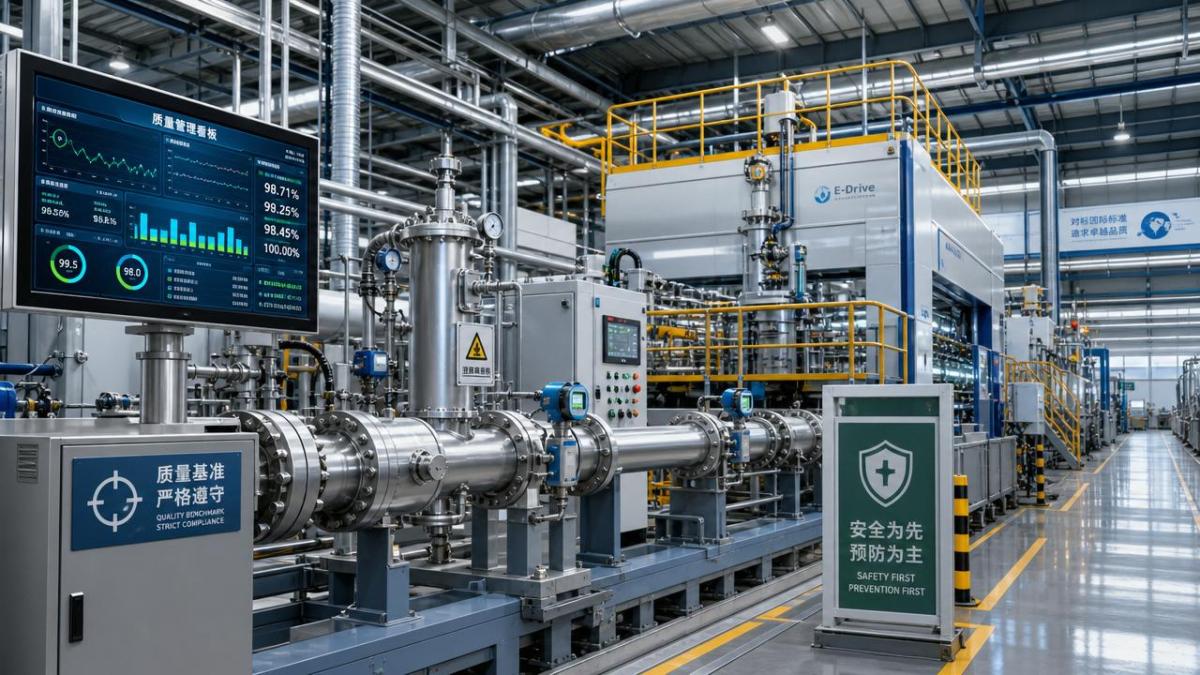
In complex plants, benchmarking should extend beyond one department. A balanced framework usually combines quality, safety, reliability, environmental, and operational indicators. The table below outlines common categories and why they matter.
Strong industrial benchmarking standards define each metric precisely. For example, if one site counts only production defects while another includes packaging deviations and customer complaints, comparison becomes misleading. Standard definitions, data boundaries, and review periods are what make benchmarking useful.
Business value for quality control and safety managers
For quality teams, industrial benchmarking standards create a more reliable basis for root-cause analysis and continuous improvement. They help identify whether variation is linked to raw material shifts, operator practice, machine condition, or control logic. Instead of reacting only to nonconformance events, teams can compare capability trends across lines, plants, and suppliers to find structural weaknesses earlier.
For safety leaders, benchmarking turns safety management from a compliance exercise into a performance discipline. Incident rates remain important, but leading indicators often provide more value in complex plants. Examples include overdue corrective actions, training effectiveness for critical tasks, inspection quality, and adherence to isolation procedures. When these are benchmarked consistently, safety managers can detect elevated risk before injuries or process events occur.
At the business level, industrial benchmarking standards also improve communication with senior management. Executives are more likely to support investment in controls, modernization, or additional monitoring when plant teams can show a credible gap between current performance and recognized benchmarks. This is where technical repositories and B2B intelligence sources add value: they help translate plant-level observations into strategic evidence.
Typical benchmarking scenarios in complex industrial environments
Not all benchmarking efforts look the same. In practice, industrial benchmarking standards are applied across several common scenarios, each with different priorities and data needs.
1. Cross-line comparison within one plant
This is often the fastest starting point. When similar lines produce different quality outcomes or show different safety observations, benchmarking can reveal controllable differences in setup discipline, maintenance practices, or process windows.
2. Multi-site harmonization
Large industrial groups often struggle because each facility measures performance differently. Common industrial benchmarking standards help unify dashboards, audit expectations, and escalation thresholds across regions.
3. Supplier and material performance evaluation
In advanced manufacturing ecosystems, material inconsistency can drive quality drift, equipment stress, and even safety exposure. Benchmarking incoming material stability, traceability, and defect impact helps procurement and plant teams work from shared facts.
4. Automation and control system maturity reviews
Plants adopting intelligent automation need standards for alarm load, sensor integrity, exception handling, and response workflows. Without these, digital upgrades may increase complexity without improving resilience.
How to apply industrial benchmarking standards effectively
The first step is to define the purpose of benchmarking. Some plants want to reduce process variation, while others aim to improve shutdown safety, contractor control, or energy efficiency. The objective determines which metrics matter and what comparison set is valid. Trying to benchmark everything at once often creates noise instead of insight.
Second, standardize data collection rules. Quality control and safety data are especially vulnerable to inconsistency if collection depends on local interpretation. Establish clear counting logic, threshold definitions, reporting frequency, and ownership. If a near miss in one area would be coded as an unsafe condition in another, the benchmark will not hold.
Third, separate lagging and leading indicators. Industrial benchmarking standards should not rely only on output results such as defects or recordable injuries. Leading indicators—inspection discipline, process parameter excursions, delayed work orders, safety critical test completion—show whether controls are weakening before major failures emerge.
Fourth, benchmark in context. A plant processing variable feedstock or operating older infrastructure may require a different interpretation than a newly built automated facility. Good benchmarking does not ignore context; it normalizes it where appropriate and explains it where not.
Fifth, turn findings into action priorities. The goal is not simply to rank sites or publish dashboards. Useful industrial benchmarking standards support targeted actions such as retraining operators, redesigning inspection routes, adjusting process limits, improving spare parts strategy, or upgrading control logic.
Common mistakes that weaken benchmarking results
A frequent mistake is using metrics that are easy to collect rather than meaningful to risk and performance. Another is comparing plants with very different operating conditions without normalization. Some organizations also focus too heavily on average values and miss variation, trend instability, or repeated deviations around critical limits.
For safety teams, a major weakness is overreliance on injury statistics while underweighting process safety, permit quality, or safeguard health. For quality teams, the equivalent problem is monitoring final defects while ignoring process capability, contamination control, or supplier drift. Effective industrial benchmarking standards should reflect how failure develops, not just how it is reported after the fact.
There is also a governance issue. If benchmark results are used only for blame, reporting quality often drops. People may underreport events, classify issues inconsistently, or resist transparency. Benchmarking works best when it is tied to learning, control improvement, and accountable problem solving.
What to evaluate when selecting or refining a benchmark framework
When reviewing industrial benchmarking standards, quality and safety managers should ask several practical questions. Are the metrics aligned with major plant risks? Are definitions stable across teams and sites? Can the data be audited? Does the framework cover both operational outcomes and control effectiveness? Can the results support decisions on training, maintenance, material sourcing, or automation investment?
A strong framework should also integrate technical depth with usability. That is one reason industrial ecosystems such as G-AIE matter: complex plants increasingly need benchmarking references that connect materials, equipment behavior, digital monitoring, and operational governance. Benchmarks become far more powerful when they reflect how modern industrial systems actually interact.
Moving from reference to operational improvement
Industrial benchmarking standards are most valuable when they move beyond comparison and become part of daily operational discipline. For quality control teams, that means using benchmark insights to tighten process windows, improve traceability, and reduce repeat nonconformities. For safety managers, it means strengthening leading indicators, clarifying control ownership, and improving intervention before weak signals become events.
In complex plants, performance rarely improves through isolated metrics alone. It improves when standards, data quality, engineering judgment, and cross-functional action work together. If your organization is refining how it compares plants, processes, or risk controls, start with a focused set of industrial benchmarking standards that are relevant, measurable, and linked to real operational decisions. That approach creates not only better reporting, but more resilient industrial performance.
Recommended News
 May 20, 2026Solenoid Valve OEM Supplier: Lead Time and Quality Trade-OffsSolenoid valve OEM supplier selection affects lead time, quality, and supply stability. Learn how distributors can reduce risk, protect margins, and choose with confidence.
 May 20, 2026Hydraulic Oil Cooler Wholesale Options for Lower Lifecycle CostHydraulic oil cooler wholesale strategies that cut lifecycle cost, reduce downtime risk, and improve asset efficiency. Explore smarter sourcing, performance checks, and supplier selection.
 May 20, 2026Hydraulic Filtration System OEM: How to Cut Contamination RiskHydraulic filtration system OEM selection starts with the real contamination risk. Learn how to cut downtime, protect components, and choose the right solution for every operating scenario.
 May 20, 2026Telescopic Cylinder Manufacturer Checklist for Field ReliabilityTelescopic cylinder manufacturer checklist for maintenance teams: compare reliability, repairability, seal life, parts support, and field safety to reduce downtime and choose with confidence.
 May 20, 2026What a Reliable Hydraulic Test Bench Factory Should OfferHydraulic test bench factory selection impacts accuracy, compliance, and ROI. Learn what a reliable supplier should offer in engineering, customization, quality control, and support.
 May 20, 2026Hydraulic Manifold Block Wholesale: Cost vs Machining ToleranceHydraulic manifold block wholesale: learn how to balance price and machining tolerance to reduce leakage, improve reliability, and choose suppliers with better long-term value.
 May 20, 2026Servo Hydraulic Valve Factory Comparison for Motion AccuracyServo hydraulic valve factory comparison for motion accuracy: learn how to evaluate precision, response, traceability, and supplier reliability to reduce risk and choose the right partner.
 May 20, 2026Miniature Hydraulic Pump OEM Selection for Compact SystemsMiniature hydraulic pump OEM selection guide for compact systems—compare pressure stability, material compatibility, lifecycle reliability, and supplier support to choose with confidence.
 May 20, 2026High Pressure Hydraulic Hose OEM: Key Failure Risks to CheckHigh pressure hydraulic hose OEM selection starts with hidden failure risks. Learn the key checks for materials, reinforcement, fittings, and traceability to reduce downtime and improve safety.
 May 20, 2026How to Evaluate a Hydraulic Accumulator Factory in 2026Hydraulic accumulator factory evaluation in 2026 starts with application fit, quality control, compliance, and delivery reliability. Learn how to reduce sourcing risk and choose a dependable supplier.
 May 20, 2026‘Fixed Income+’ Funds Surpass $300B; Polymer Pulse Funding Gains MomentumFixed Income+ funds exceed $300B as Polymer Pulse funding surges—discover how precision polymer consistency is reshaping automotive & electronics supply chains.
 May 20, 2026SAMR Launches Unified Market Action; Torque Logic Motor Exporters Gain Standard Mutual Recognition WindowSAMR's unified market action unlocks standard mutual recognition for torque logic motor exporters—gain faster ASEAN/UAE customs clearance via CNAS-IEC certification.
 May 20, 202676% of 'Two Major' Construction Funds Disbursed; Harmonic Reducers Accelerate Domestic Replacement in Robot LinesHarmonic reducers: 76% of China’s 'Two Major' construction funds disbursed—accelerating domestic replacement in robot lines. Discover impact on global supply chains & certification insights.
 May 20, 2026State Council Approves Urban Renewal '15th Five-Year' Plan, Boosting Export Demand for Engineering Resins in Municipal Pipeline UpgradesEngineering resins gain export momentum as China’s State Council approves Urban Renewal '15th Five-Year' Plan—boosting global demand for certified, corrosion-resistant municipal pipeline solutions.
 May 20, 2026Health Supplement Safety Alliance Launches with Bio-Plastics Packaging MandateHealth Supplement Safety Alliance launches with strict bio-plastics packaging mandate—ISO 17088:2025 & FDA microplastic limits. Act now to stay compliant and competitive.
 May 20, 2026IMF Warns AI Amplifies Financial Cyber Risks; Anti-Drone Gear Export Compliance TightensAI amplifies financial cyber risks—IMF warns. Anti-drone gear exporters must ensure EAR compliance for AI spectrum sensing modules now.
 May 20, 2026MIIT Launches 2026 Industrial Energy Conservation InspectionMIIT Launches 2026 Industrial Energy Conservation Inspection: Critical for functional coatings exporters targeting EU, US & ASEAN markets. Act now to ensure VOC, heavy metal & energy traceability compliance.
 May 20, 2026APEC Auto Dialogue Held in Shanghai: 57,000+ km of ICV Test Roads, Supply Chain LLMs Accelerate APAC AdaptationAPEC Auto Dialogue in Shanghai: 57,000+ km ICV test roads & Supply Chain LLMs accelerate APAC automotive compliance, logistics, and OTA readiness.
 May 20, 2026Colombia Extends Anti-Dumping Duties on Chinese Acrylic SheetsColombia extends anti-dumping duties on Chinese acrylic sheets until 2031—key implications for optical film producers, ISO 15106-3:2025–certified barrier film suppliers, and LATAM supply chains.
 May 20, 2026EU Imposes 5-Year Anti-Dumping Duty on Chinese Adipic AcidEU imposes 5-year anti-dumping duty on Chinese adipic acid — critical impact on EG Chem exporters, semiconductor packaging, and high-reliability electronics supply chains. Act now.
 May 19, 2026Material Innovation Technologies in Engineering ResinsMaterial innovation technologies are transforming engineering resins with better heat resistance, dimensional stability, and sustainability. Discover practical applications, comparison tips, and adoption strategies.
 May 19, 2026Industrial Sustainability Strategies That Lower Compliance RiskIndustrial sustainability strategies help manufacturers cut compliance risk, improve traceability, and stay audit-ready with stronger supplier, process, and data controls.
 May 19, 2026Supply Chain Intelligence Solutions for Demand SwingsSupply chain intelligence solutions help enterprises predict demand swings, reduce sourcing risk, and improve planning resilience. Discover smarter, data-driven strategies for faster decisions.
 May 19, 2026Supply Chain Orchestration Software Implementation RisksSupply chain orchestration software implementation risks can derail ROI fast. Learn the top data, integration, governance, and adoption pitfalls—and how to avoid costly rollout failures.