Search News
Industry Portal
Popular Tags
Silicone Baby Bibs OEM: Material Safety and Certification Essentials

Author
Time
Click Count
In silicone baby bibs OEM programs, material safety and certification shape far more than a compliance file. They influence product acceptance, border clearance, complaint risk, and long-term brand credibility across retail and private-label channels.
That is why safety evaluation now sits at the intersection of material science, process control, and supply chain intelligence. For organizations working in global sourcing, the question is no longer whether a bib looks functional, but whether every batch can prove it.
From the perspective of G-AIE, this topic reflects a broader industrial shift. High-performance physical products increasingly require data-backed verification, traceable inputs, and certification discipline that can withstand international scrutiny.
Why material safety is the first filter
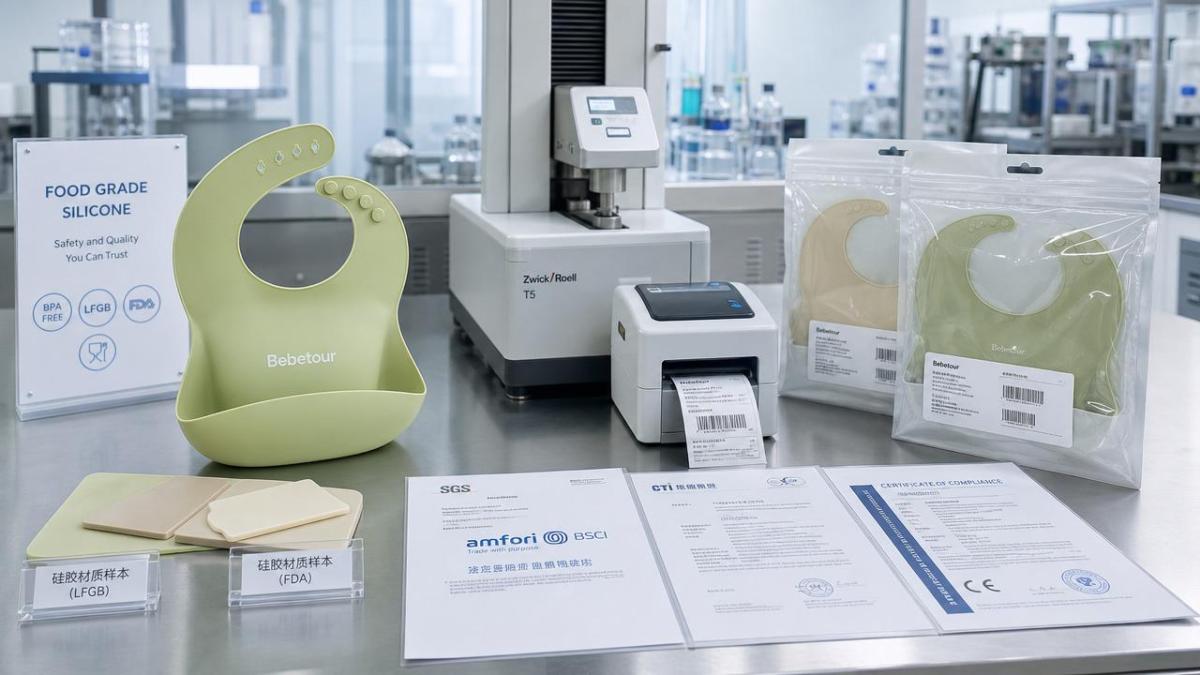
A baby bib is a simple product on the surface. In practice, it is a food-contact item, a skin-contact item, and a child-use product with strict safety expectations.
Silicone is often selected because it is flexible, durable, easy to clean, and resistant to staining. Yet those advantages only matter when the raw material and finished part remain chemically stable and consistently controlled.
In silicone baby bibs OEM production, poor material selection can introduce volatile residues, excessive extractables, heavy metal concerns, odor issues, or weak mechanical performance. These failures rarely stay isolated to one shipment.
Once a nonconforming batch enters a regulated market, the result may include retesting, customs delays, recall exposure, and supplier requalification. That makes early-stage material review more valuable than late-stage firefighting.
What food-grade silicone really means in OEM evaluation
The term “food-grade silicone” is widely used, but it is often misunderstood. It is not a marketing phrase that stands alone. It must connect to composition, processing conditions, and test evidence.
For a silicone baby bibs OEM project, the starting point is usually platinum-cured silicone. This curing route is generally preferred because it supports lower residual byproducts and cleaner sensory performance than lower-grade alternatives.
Even so, cure chemistry is only one part of the picture. Fillers, pigments, additives, mold release practices, and post-curing routines can all affect the final safety profile.
A strong supplier should be able to explain material origin, lot traceability, colorant compliance, and how formulation choices relate to the target market. If the explanation stays vague, the risk usually sits deeper than the paperwork suggests.
Core material checks before sample approval
- Base polymer grade and supplier source consistency.
- Curing system suitability for food-contact applications.
- Pigment and additive declarations for restricted substances.
- Odor, surface feel, and visible contamination after molding.
- Post-cure control, especially where migration limits matter.
Certification is not one document
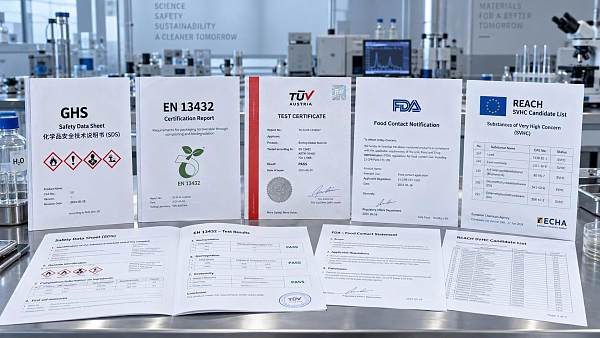
One of the most common sourcing mistakes is treating certification as a single certificate. In reality, silicone baby bibs OEM compliance is a layered system built from several types of evidence.
There are material declarations, chemical test reports, food-contact migration results, production audits, and market-specific conformity files. Each serves a different purpose.
A test report may confirm that one sample passed one standard at one time. It does not automatically prove that every future production lot will meet the same threshold.
This distinction matters in cross-border trade. Documentation should support not only product launch, but also ongoing verification when color, tooling, packaging, or raw material suppliers change.
Common compliance references in international markets
The exact combination depends on destination market and product claim. A bib sold as a basic feeding accessory may require a different documentation package than a bundled infant feeding set.
Process control often decides whether certification remains valid
Certification can be undermined by production drift. This is where many silicone baby bibs OEM programs become vulnerable after a successful pilot run.
Tool cleanliness, curing temperature, dwell time, trimming methods, and packaging environment can all influence the final result. Even approved silicone can fail if the process introduces contamination or incomplete curing.
Color changes deserve extra attention. Different pigments may require separate verification, especially when bright tones or custom shades are involved. A passed report for one color should not be assumed valid for all colors.
In a mature quality system, production records, incoming inspections, retention samples, and change control logs are treated as part of the compliance framework, not as isolated factory paperwork.
Practical control points on the factory side
- Verify raw material lot numbers against approved formulations.
- Review cure and post-cure parameters for every batch.
- Control mixed-material handling in shared production areas.
- Check burrs, tearing resistance, and pocket integrity after molding.
- Confirm packaging materials do not introduce secondary contamination.
How to read supplier documents with more precision
Document review is not only about file collection. It is about checking whether the evidence actually matches the product being sourced.
A silicone baby bibs OEM dossier should align on material grade, color, thickness range, production site, and report date. Small mismatches often point to a reused test package rather than a product-specific compliance set.
Laboratory identity also matters. Reports from recognized third-party laboratories usually offer stronger credibility in cross-regional business than internal summaries with no clear sampling details.
Just as important, declarations should be current. Regulatory lists evolve, and an old statement can quickly become weak support if substance restrictions have been updated.
Useful questions during qualification
- Does the test report describe the same item structure and color set?
- Were samples drawn from mass production or lab-made prototypes?
- What triggers retesting after formulation or process changes?
- How is lot traceability maintained from resin to finished carton?
- Which standards are covered, and which are only claimed?
Why this matters more in a data-driven industrial environment
The broader industrial context has changed. Safety review is now tied to digital traceability, supplier benchmarking, and predictive risk management.
This is where the G-AIE perspective becomes relevant. Material performance, certification reliability, and production intelligence are no longer separate topics. They form one operating model for resilient sourcing.
For silicone baby bibs OEM decisions, that means combining laboratory evidence with process visibility. A supplier with acceptable test reports but weak change control may present higher risk than one with narrower scope but stronger discipline.
The same logic supports strategic benchmarking. Comparing suppliers only by quote and sample appearance misses the variables that usually drive nonconformity costs later.
A practical path for next-stage evaluation
A useful review process begins by mapping destination markets, product claims, and acceptable material boundaries. From there, documentation can be screened against actual commercial use, not generic assumptions.
Then it helps to compare silicone baby bibs OEM candidates on four linked dimensions: raw material integrity, test coverage, process stability, and change management responsiveness.
If the program is expected to scale, reserve time for ongoing verification rather than one-time approval. Periodic retesting, supplier audits, and document refresh cycles usually cost less than reactive correction.
A well-qualified bib supplier is not simply one that provides certificates. It is one that can explain the relationship between formulation, manufacturing control, and market-specific compliance with evidence that stays consistent over time.
That is often the clearest next step: build a review matrix, challenge the supporting files, and assess whether the silicone baby bibs OEM partner can maintain safety credibility at production scale, not just at sampling stage.
Recommended News
 Sep 19, 2026When can a supply chain LLM reduce time spent finding shipment updates?Supply chain LLMs can cut shipment-update search time by connecting carrier events, ERP data, and documents—giving teams traceable answers and faster exception response.
 Sep 18, 2026How industrial monitoring equipment helps prevent unplanned downtimeIndustrial monitoring equipment helps teams detect early asset issues, prioritize maintenance, and prevent costly unplanned downtime. Explore practical strategies for reliable operations.
 Sep 17, 2026What next-gen harmonic drive research means for robot joint accuracyNext-gen harmonic drive research reveals how backlash, stiffness, thermal drift, and sensing shape robot joint accuracy. Explore smarter validation strategies.
 Sep 16, 2026How Southeast Asian climates affect cylinder seal frictionCylinder seal friction Southeast Asia: learn how humidity, heat, monsoons, and contamination affect motion stability, wear, and seal selection.
 Sep 15, 2026How to size DC gear motors for the required starting torqueGear motors DC sizing made practical: calculate starting torque, account for friction, gravity, inertia and voltage drop, then select a reliable motor with confidence.
 Sep 14, 2026How to verify high purity chemicals compliance before supplier approvalHigh purity chemicals compliance: learn how to verify supplier quality systems, CoAs, traceability, testing, and change control before approval.
 Sep 13, 2026What permits are needed to operate mapping drones in Europe?Mapping drones Europe: discover the permits, EASA categories, airspace approvals, site access, and GDPR checks needed for compliant aerial surveys.
 Sep 12, 2026What lead time should I expect for automatic transmission components? Planetary Gearboxes delivery forecasting for OEM planningWhat lead time should I expect for automatic transmission components? Get dynamic, AI-powered planetary gearbox delivery forecasting—designed for OEMs building next-gen hybrid & commercial powertrains.
 Sep 12, 2026Can polyamide replace metal in load-bearing components? Polymer Pulse structural performance data for 2026 applicationsCan polyamide replace metal in load-bearing components? Discover Polymer Pulse’s 2026 structural data—real-world performance, weight savings, and reliability breakthroughs.
 Sep 12, 2026How to handle a power electronics warranty claim: Harmonic Reducers documentation and escalation pathHow do I handle a power electronics warranty claim? Get a fast, intelligent, evidence-driven resolution for harmonic reducers—no bureaucracy, just precision diagnostics and real-time escalation.
 Sep 12, 2026Which motion control specifications matter most before purchase? Torque Logic selection criteria for automation engineersWhich motion control specifications are most important before purchase? Discover Torque Logic—the 4 non-negotiable, AI-aligned criteria that cut TCO by 27–41% and boost motion system availability to 99.992%.
 Sep 13, 2026Is agentic AI reliable enough for supplier screening? Supply Chain LLM validation framework for procurement teamsIs agentic AI reliable enough for supplier screening? Discover a rigorous LLM validation framework built for procurement teams—grounded in material traceability, regulatory compliance, and real-world operational constraints.
 Sep 14, 2026How to maintain edge AI systems after deployment: Predictive Maint AI operational protocols for field techniciansHow do I maintain edge AI systems after deployment? Discover predictive, physics-aware operational protocols designed for real-world field technicians—sustaining intelligence where silicon meets steel.
 Sep 15, 2026What compliance documents must a bioplastics supplier provide? Bio-Plastics regulatory checklist for procurementWhat compliance documents should a bioplastics supplier provide? Get our actionable regulatory checklist for food, medical & EU-bound applications.
 Sep 16, 2026How to prevent PET film defects during production: Barrier Films process control best practicesHow can I prevent PET film defects during production? Discover physics-driven barrier film process control—thermal precision, dynamic tension management & surface energy optimization.
 Sep 17, 2026Are thermoplastics suitable for long-term outdoor use? Engineering Resins durability assessment in 2026 UV/weather exposureAre thermoplastics suitable for long-term outdoor use? Discover 2026’s engineering resin durability insights — UV/weather resistance ranked, tested & actionable.
 Sep 18, 2026What to do when a servo motor fails during production: A Servo Actuators troubleshooting guide for maintenance teamsWhat should I do if a servo motor fails during production? Get a field-tested, AI-aware troubleshooting guide for maintenance teams—minimize downtime, maximize OEE.
 Sep 12, 2026How to compare wholesale party supplies by minimum order valueCompare wholesale party supplies by minimum order value, freight, SKU flexibility, and stock risk to choose suppliers that protect margins and simplify replenishment.
 Sep 11, 2026How proportional solenoid linearity affects precision motion controlProportional solenoid linearity directly affects precision motion control, valve metering, stability, and calibration. Learn how to evaluate performance for reliable automation.
 Sep 10, 2026When does supplier information platform automation reduce onboarding delays?Supplier information platform automation reduces onboarding delays by streamlining data collection, routing, renewals, and compliance checks—without replacing expert technical review.
 Sep 09, 2026How to size robotic motion systems for AMR payload changesRobotic motion systems for AMR payload changes: learn how to size motors, wheels, gearing, traction, and controls for safer, reliable performance.
 Sep 08, 2026How to perform a cylinder rod buckling calculation for long strokesCylinder rod buckling calculation made practical: learn how to assess effective length, end conditions, rod stiffness, load forces, and safety margins for reliable long-stroke cylinder design.
 Sep 07, 2026How to estimate the cost of industrial mechanical components before orderingIndustrial mechanical components cost: learn how to estimate material, machining, tooling, inspection, logistics, and hidden expenses before ordering. Compare quotes confidently and reduce sourcing risk.
 Sep 07, 2026What Is a Product Standards Database Used For?Product standards database guide: learn how to compare requirements, verify revisions, control specifications, and reduce compliance risks across design, sourcing, and production.