Search News
Industry Portal
Popular Tags
TÜV Rheinland Mandates Digital Twin Fault Injection for Servo Actuator Safety Certification
Author
Time
Click Count
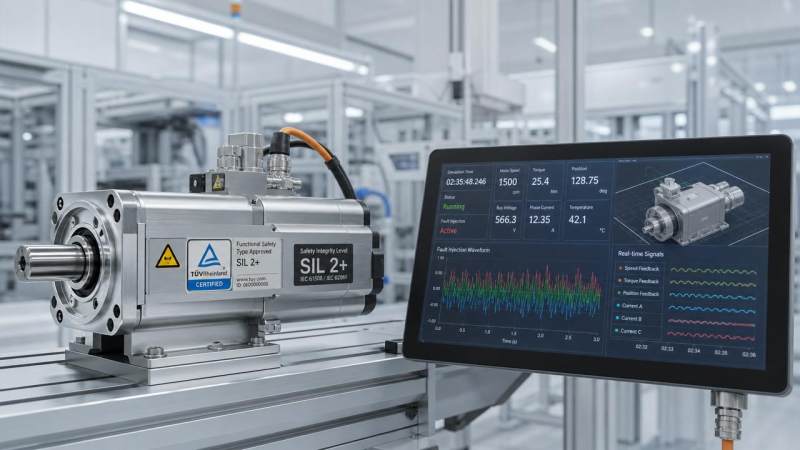
On May 16, 2026, TÜV Rheinland updated its functional safety certification process for servo actuators — introducing a mandatory ‘digital twin fault injection verification’ step. The change directly impacts global manufacturers supplying industrial automation, motion control, and safety-critical systems to EU and IEC-compliant markets, driven by tightening validation requirements under IEC 61800-5-2 for SIL2+ applications.
Event Overview
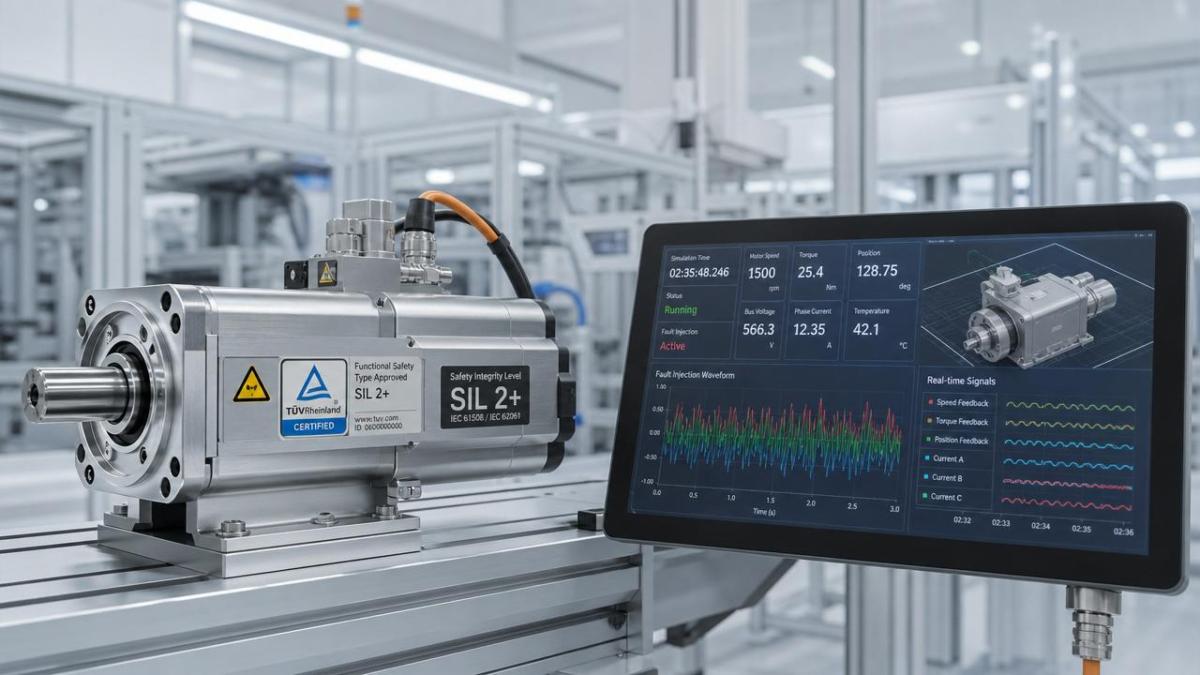
On May 16, 2026, TÜV Rheinland released Revision 4.2 of its Implementation Guide for Functional Safety Certification of Servo Actuators. Effective immediately for all new applications seeking IEC 61800-5-2 SIL2 or higher certification, applicants must submit a fault injection simulation report generated via an AI-powered digital twin platform. Additionally, the report must demonstrate closed-loop response latency resilience across at least three edge-case operational scenarios (e.g., extreme temperature gradients, voltage sags with simultaneous load spikes, and communication jitter under multi-axis coordination). The update extends average certification lead time by 22 working days. As of publication, only six Chinese manufacturers are confirmed capable of end-to-end delivery — including digital twin modeling, fault scenario definition, real-time simulation execution, and traceable test reporting.
Industries Affected
Direct Exporters & Trading Enterprises
Exporters selling servo actuators into EU, UK, and other IEC-aligned markets face immediate compliance risk. Since TÜV Rheinland certification is often contractually required in OEM procurement specifications (especially for machinery covered under EU Machinery Regulation 2023/1230), delayed or failed certification may trigger order deferrals, contractual penalties, or loss of qualification status. Impact manifests not only in timeline slippage but also in increased pre-certification engineering resource allocation — notably for technical documentation translation, audit readiness, and third-party toolchain validation.
Raw Material & Component Suppliers
Suppliers of semiconductors (e.g., gate drivers, isolated ADCs), high-reliability encoders, and functional-safety-grade power modules are indirectly affected. Their components must now be demonstrably traceable within the digital twin’s fault propagation model — meaning suppliers must provide failure mode libraries (FMEA/FMECA data), FIT rates with confidence intervals, and interface timing specifications validated under transient stress. Lack of such data forces actuator integrators to either qualify alternative parts or develop in-house failure models — both increasing cost and cycle time.
Manufacturing & System Integrators
Actuator manufacturers and automation system integrators bear the primary implementation burden. They must now embed digital twin development — including physics-based modeling, co-simulation with PLC/DCS environments, and AI-augmented fault library generation — into their V-model development lifecycle. This requires cross-functional upskilling (controls engineers + simulation specialists + functional safety managers) and investment in certified simulation platforms (e.g., MATLAB/Simulink with IEC Certification Kit, dSPACE SCALEXIO with TwinCAT integration). Notably, legacy hardware-in-the-loop (HIL) setups alone no longer satisfy the ‘digital twin’ requirement unless explicitly linked to a version-controlled, auditable twin model.
Supply Chain & Certification Support Providers
Consultancies, test labs, and certification facilitators must adapt service offerings. Demand is rising for ‘digital twin readiness audits’, fault injection test plan reviews aligned with ISO 26262/IEC 61508-derived practices, and support in mapping simulated failures to hardware-level diagnostic coverage metrics (e.g., DC, CCF, and safe failure fraction). Providers lacking expertise in model-based safety analysis (MBSA) or digital twin traceability frameworks risk losing market share to niche players with domain-specific toolchain integrations.
Key Focus Areas & Recommended Actions
Validate Digital Twin Traceability Architecture Early
Confirm that your digital twin model explicitly links each simulated fault to a defined hardware component, failure mode, and safety mechanism — with version-controlled metadata supporting ISO/IEC 17065 traceability requirements. Avoid ‘black-box’ AI simulations without explainable fault propagation paths.
Prioritize Edge-Case Scenario Selection with OEM Input
Work proactively with end customers to jointly define the three mandatory edge-case scenarios — rather than selecting them internally. This reduces rework risk during TÜV Rheinland’s review phase and strengthens alignment with actual field usage profiles (e.g., robotic welding cells vs. semiconductor wafer handling).
Audit Your Component Supplier Documentation Package
Inventory supplier-provided safety data (FIT, FMEDA, diagnostic coverage claims, and qualification reports). Identify gaps — especially missing timing constraints under fault conditions — and initiate collaborative updates before initiating full-system twin development.
Assess Internal Capability Against TÜV Rheinland’s New Toolchain Requirements
TÜV Rheinland’s Rev. 4.2 specifies minimum toolchain qualifications (e.g., solver fidelity, numerical stability under fault transients, and export formats compatible with their review platform). Conduct an internal gap assessment against these criteria — not just against general MBD best practices.
Editorial Perspective / Industry Observation
Observably, this update marks a structural shift from ‘hardware-centric’ to ‘model-integrated’ safety assurance. It is not merely a procedural addition but a signal that certification bodies are treating digital twins as first-class evidence — equal in weight to physical test reports. Analysis shows that while the immediate bottleneck lies in simulation capability, the deeper industry challenge is epistemological: establishing consensus on what constitutes a sufficiently representative, auditable, and reproducible digital twin for safety-critical motion control. Current adoption patterns suggest early movers are investing not just in tools, but in formalized twin governance — including model versioning, change control, and independent twin verification protocols. This trend is likely to cascade into adjacent standards (e.g., IEC 62443 for OT cybersecurity, where digital twins increasingly serve as attack surface simulators).
Conclusion
This revision reflects an accelerating convergence of functional safety, model-based engineering, and AI-augmented verification — moving beyond compliance toward predictive assurance. Rather than viewing the new requirement as a barrier, forward-looking enterprises are treating it as a catalyst for system-level architecture modernization. The broader implication is clear: functional safety certification is evolving from a point-in-time audit into a continuous, model-grounded capability — one that demands deeper collaboration across hardware, software, simulation, and certification domains.
Source Attribution & Ongoing Monitoring
Primary source: TÜV Rheinland Implementation Guide for Functional Safety Certification of Servo Actuators, Revision 4.2 (May 16, 2026), publicly available via tuv.com/global/en/certification/industrial-automation/servo-actuators.
Note: TÜV Rheinland has indicated that Rev. 4.2 will undergo a 90-day stakeholder feedback period; potential clarifications on acceptable digital twin platforms and edge-case definitions are expected by mid-August 2026 and remain under active observation.
Recommended News
 Jun 15, 2026EU Requires nano-TiO₂ Traceability for Coatings ImportsEU requires nano-TiO₂ traceability for coatings imports from July 1, 2026. Learn the EU-CEP filing rules, customs risks, and key compliance steps for importers and suppliers.
 Jun 15, 2026ECI-26Q2 Hits 142.3, Pressuring Electronic Grade Chem ExportsElectronic Grade Chem exports face rising pressure as ECI-26Q2 hits 142.3. Explore supply tightening, higher freight costs, quota-based supply, and what buyers and exporters should do now.
 Jun 15, 2026TÜV Rheinland Adds Nano-Migration Test for Barrier FilmsTÜV Rheinland adds mandatory nano-migration testing for Barrier Films under EN 13432:2026, impacting CE marking, EU market access, and certification timelines. Learn what exporters and manufacturers must do now.
 Jun 15, 2026U.S. Expands Export Controls on Anti-Drone GearU.S. Expands Export Controls on Anti-Drone Gear: learn how new ECCN 7A994 rules, licensing demands, and military end-use limits may disrupt exports, compliance, and delivery planning.
 Jun 15, 2026Hormuz Closure Extends EU Resin ShipmentsHormuz Closure Extends EU Resin Shipments: explore how the Strait of Hormuz shutdown is delaying EU resin deliveries, driving freight costs up, and reshaping procurement, logistics, and electronics supply-chain planning.
 Jun 14, 2026Industrial Automation Solutions: How to Balance ROI, Scalability, and DowntimeIndustrial automation solutions explained: learn how to balance ROI, scalability, and downtime risk with scenario-based strategies that improve uptime, integration, and long-term value.
 Jun 14, 2026Product Testing Methods That Reduce Failure Risk Before LaunchProduct testing methods that reduce launch risk: learn how to match functional, stress, environmental, and compliance testing to real-world conditions before release.
 Jun 14, 2026Stem Learning Kits Wholesale: Key Factors Before You Compare SuppliersStem learning kits wholesale decisions go beyond price. Compare suppliers by safety, curriculum fit, supply stability, and private-label support to protect margins and scale with confidence.
 Jun 14, 2026Consumer Development Trends Shaping Product Strategy in 2026Consumer development is reshaping product strategy in 2026 through measurable value, sustainability, digital services, and supply resilience. Explore the trends driving smarter decisions.
 Jun 14, 2026How to Evaluate Glass Christmas Ornaments OEM for Quality and Lead Timeglass christmas ornaments OEM evaluation guide: learn how to compare quality control, packaging protection, customization costs, and lead time reliability before choosing a supplier.
 Jun 14, 2026TÜV Rheinland adds nano migration test to EN 13432 barrier filmsTÜV Rheinland adds nano migration test to EN 13432 barrier films, reshaping EU certification and customs fast-track access. See what exporters, converters, and buyers must do now.
 Jun 14, 2026ECI-26Q2 Hits 142.3, Raising Export Cost PressureECI-26Q2 hits 142.3, driving export cost pressure across electronic chemicals. Learn how pricing, supplier qualification, and delivery risks are reshaping global trade decisions.
 Jun 14, 2026US Tightens Export Controls on Anti-Drone ModulesUS Tightens Export Controls on Anti-Drone Modules: learn how the BIS update affects sourcing, licensing, compliance, and joint development before the July 15 deadline.
 Jun 14, 2026Hormuz Closure Extends EU Resin Shipments by 14 DaysHormuz Closure Extends EU Resin Shipments by 14 Days: learn how longer routes, higher freight, and rising insurance costs are reshaping PEEK, PPSU, and PEI deliveries to Europe.
 Jun 14, 2026EU Requires Nano TiO₂ Traceability for Functional CoatingsEU nano TiO₂ traceability rules will reshape functional coatings exports from July 1, 2026. See who is affected, required certification, and how to prepare for EU compliance.
 Jun 13, 2026Toy Materials Guide: Safe, Durable, and Easy to SourceToy materials guide for safer, longer-lasting products: compare plastics, wood, silicone, and metals with sourcing, compliance, and durability insights to choose smarter.
 Jun 13, 2026Gift Manufacturers: MOQ, Lead Time, and Margin FactorsGift manufacturers compared the smart way: learn how MOQ, lead time, and hidden margin factors affect cost, delivery, and repeat-order success before you buy.
 Jun 13, 2026Nursery Furniture Safety Standards and Material ChoicesNursery furniture safety standards and material choices shape product trust. Learn how compliance, low-emission materials, and durable design reduce risk and improve market confidence.
 Jun 13, 2026ODM Pet Products: How to Evaluate Factory CapabilitiesODM pet sourcing starts with factory capability. Learn how to assess quality control, compliance readiness, customization, and supply resilience before choosing a reliable ODM pet partner.
 Jun 13, 2026Industrial Procurement: Cost Risks and Supplier ChecksIndustrial procurement explained: uncover hidden cost risks, verify suppliers beyond price, and compare sourcing options with practical checks that protect quality, delivery, and margins.
 Jun 13, 2026EU to Require nano-TiO₂ Traceability Reports for Functional Coatings ImportsEU to require nano-TiO₂ traceability reports for Functional Coatings imports from July 2026. Learn compliance risks, supplier checks, customs impact, and how to prepare early.
 Jun 13, 2026GAIE 2026 Opens as Humanoid Robot Prices FallGAIE 2026 opens in Shenzhen as humanoid robot prices fall below RMB 100,000. Explore what this means for manufacturing, procurement, integration, and industrial AI adoption.
 Jun 13, 2026Shenzhen Joins 6G Pilot to Expand AI-Ready NetworksShenzhen joins the 6G pilot to expand AI-ready networks, signaling new opportunities in industrial digitalization, low-latency infrastructure, smart manufacturing, and cross-border service delivery.
 Jun 13, 2026WTO Cuts 2026 Trade Growth Outlook to 1.9%WTO Cuts 2026 Trade Growth Outlook to 1.9% as Hormuz disruption delays ocean freight. See how Servo Actuators, Harmonic Reducers, and Planetary Gearboxes buyers can manage risk.