Search News
Industry Portal
Popular Tags
Nursery Furniture Safety Standards and Material Choices
Author
Time
Click Count
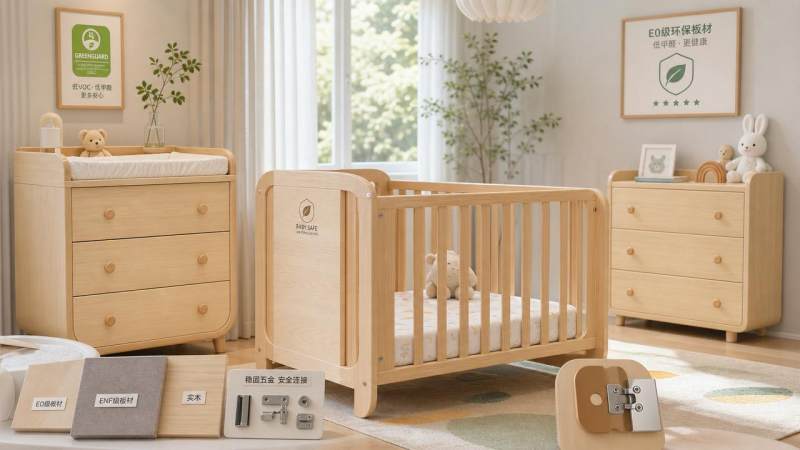
Nursery furniture safety standards and material choices sit at the intersection of child protection, product reliability, and long-term brand credibility. For industrial buyers and compliance-led teams, nursery furniture is not judged only by appearance or cost. It is evaluated by how well it resists tipping, how safely it ages, what it emits into indoor air, and whether every material choice can be defended under testing, audit, and market scrutiny.
That makes nursery furniture a useful lens for a broader industrial shift. Material science, sustainable sourcing, and data-based quality control now shape furniture decisions as much as design. In benchmarking environments such as G-AIE, this category shows how physical safety and intelligent verification increasingly move together.
Why nursery furniture safety has become a higher-stakes issue
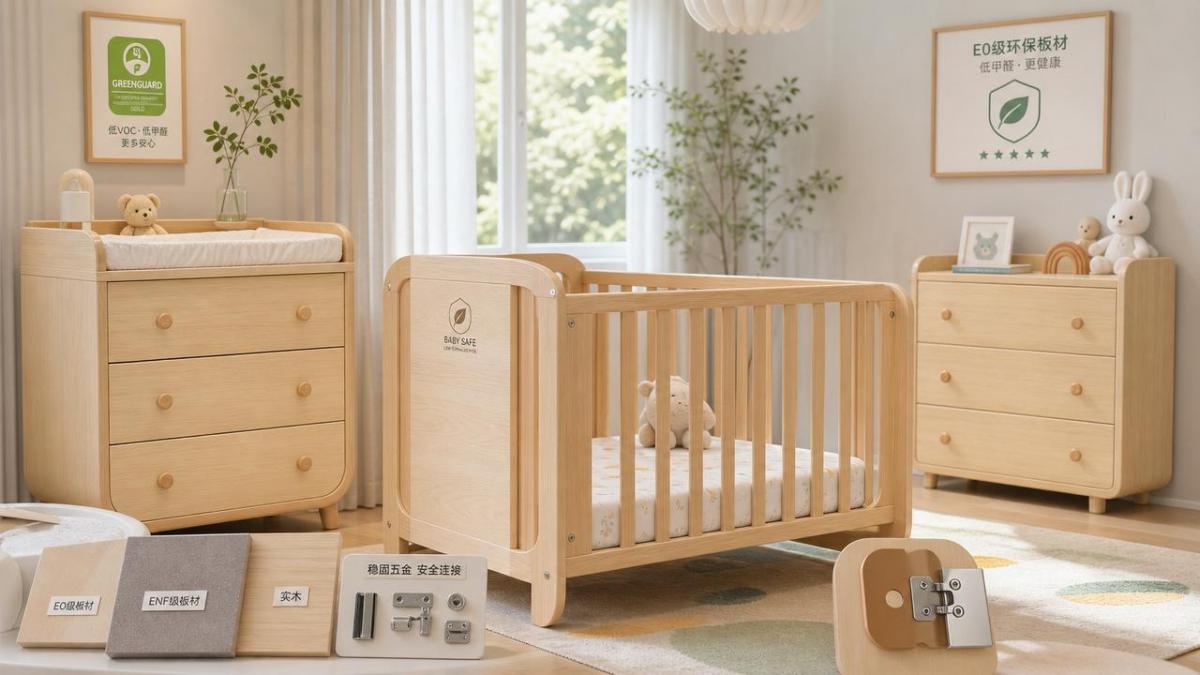
A crib, dresser, changing table, or storage unit is used close to children during sensitive developmental stages. Small design flaws can create outsized consequences. A sharp edge, unstable frame, weak fastener, or high-emission board can turn a routine product into a risk event.
Regulatory attention has also intensified. Markets now expect traceable compliance, not simple supplier declarations. Retailers, importers, and institutional buyers increasingly request documented proof for mechanical safety, chemical restrictions, labeling, and durability performance.
The result is clear: nursery furniture must perform safely in real environments, not only in ideal lab conditions. Repeated assembly, transport stress, humidity shifts, cleaning chemicals, and child interaction all matter.
What safety standards actually cover
Safety standards for nursery furniture usually combine structural, dimensional, surface, and chemical requirements. They are designed to reduce foreseeable hazards across normal use, misuse, and product aging.
Structural and mechanical performance
This area addresses load-bearing strength, joint integrity, stability, and entrapment risk. For cribs and storage units, the focus often includes side height, slat spacing, mattress support strength, anti-tip behavior, and resistance to collapse after repeated loading.
In practice, nursery furniture should remain stable even when drawers are opened, weight is unevenly applied, or the product is repositioned several times during use.
Surface safety and finish control
Edges, corners, coatings, and hardware finishes need close review. Surfaces should resist peeling, chipping, and abrasion. Exposed fasteners, rough sanding marks, and flaking paint are not minor cosmetic issues. They can indicate weak process control or create direct injury hazards.
Chemical and indoor air considerations
Chemical compliance extends beyond banned substances. Formaldehyde emissions, VOC content, heavy metals in coatings, plasticizer migration, and adhesive residue all influence product acceptance. Nursery furniture is often placed in enclosed rooms, so emission performance can carry more weight than in some other furniture categories.
How material choices influence risk and performance
Material selection is not a separate design decision. It determines whether nursery furniture can consistently meet safety targets over time. The same product geometry can behave very differently when built with solid wood, MDF, plywood, engineered composites, or mixed-material assemblies.
Solid wood and engineered wood
Solid wood is often valued for durability and repairability, but performance depends on moisture control, grain consistency, and machining quality. Warping, splitting, and inconsistent density can weaken safety if sourcing and conditioning are poorly managed.
Engineered wood offers dimensional consistency and efficient production, yet adhesive chemistry and edge sealing become critical. If the board core has high formaldehyde content or poor moisture resistance, nursery furniture may pass initial inspection but fail in use.
Metal components and hardware
Metal frames, screws, drawer slides, brackets, and anchors support long-term stability. The key issue is not only strength. Corrosion resistance, coating durability, thread retention, and tolerance consistency all affect whether the product remains safe after repeated assembly or transport.
Coatings, adhesives, and soft components
Low-emission coatings and adhesives increasingly define market access. Water-based systems are often preferred, but formulation quality still matters. A low-solvent label does not guarantee abrasion resistance, saliva safety, or long-term adhesion.
Textiles, foams, and protective pads should also be assessed for flammability, migration risk, seam strength, and cleanability. These details are easy to underrate during sourcing.
Where failures usually start in the supply chain
Many nursery furniture failures do not begin at final inspection. They start earlier, when material specifications are vague, substitution control is weak, or test methods are not aligned across development, sourcing, and production.
- Board and coating specs allow broad material substitutions without revalidation.
- Fastener quality changes between pilot and mass production.
- Packaging and shipping loads loosen joints before the product reaches the market.
- Assembly instructions are technically correct but unclear for end users.
- Chemical tests are conducted once, while incoming material batches continue to vary.
This is where a benchmarking approach becomes useful. G-AIE’s industrial perspective is relevant because nursery furniture quality now depends on linked intelligence: material data, process repeatability, supplier discipline, and digital traceability.
A practical review framework for nursery furniture
A strong review process should move from specification to in-use simulation. The goal is not only to prove compliance. It is to identify where the product is most likely to drift out of safety tolerance.
Before production approval
- Match each nursery furniture category to the correct market standard and age-use assumption.
- Freeze bill-of-material details for boards, coatings, hardware, and adhesives.
- Check dimensional tolerances tied to entrapment, gaps, and moving parts.
- Review warning language and installation guidance as safety controls, not packaging text.
During production and incoming control
- Verify substrate density, moisture content, and surface finish consistency.
- Sample hardware for torque performance and corrosion resistance.
- Monitor coating cure and adhesive application, especially on hidden interfaces.
- Maintain batch traceability for chemical compliance evidence.
After assembly and packaging
Finished nursery furniture should be evaluated for wobble, drawer behavior, edge quality, odor intensity, and packaging protection. Distribution testing matters because transport vibration can expose weaknesses not visible on the line.
What the market is rewarding now
The strongest nursery furniture programs increasingly combine three qualities: lower-emission materials, safer structural design, and clearer compliance documentation. This does not mean every premium material is automatically safer. It means verifiable performance is replacing assumption-based claims.
There is also a visible shift toward lifecycle thinking. Buyers want to know whether components can be replaced, whether finishes remain stable after cleaning, and whether sustainability claims align with actual chemical and durability performance.
In that sense, nursery furniture reflects a larger industrial reality. The market favors products that are measurable, traceable, and materially coherent from design intent to final shipment.
What to assess next
A useful next step is to review nursery furniture by failure mode rather than by department. Start with the most sensitive points: stability, emissions, finish durability, hardware retention, and assembly clarity.
Then compare test reports, material declarations, and production controls against actual use conditions. If the product will face repeated relocation, humid climates, or strict indoor air rules, those realities should shape the standard of proof.
When nursery furniture is assessed through both material science and operational discipline, safety becomes easier to defend and easier to scale. That is often the difference between passing a requirement and building a category that remains trusted over time.
Recommended News
 Sep 19, 2026When can a supply chain LLM reduce time spent finding shipment updates?Supply chain LLMs can cut shipment-update search time by connecting carrier events, ERP data, and documents—giving teams traceable answers and faster exception response.
 Sep 18, 2026How industrial monitoring equipment helps prevent unplanned downtimeIndustrial monitoring equipment helps teams detect early asset issues, prioritize maintenance, and prevent costly unplanned downtime. Explore practical strategies for reliable operations.
 Sep 17, 2026What next-gen harmonic drive research means for robot joint accuracyNext-gen harmonic drive research reveals how backlash, stiffness, thermal drift, and sensing shape robot joint accuracy. Explore smarter validation strategies.
 Sep 16, 2026How Southeast Asian climates affect cylinder seal frictionCylinder seal friction Southeast Asia: learn how humidity, heat, monsoons, and contamination affect motion stability, wear, and seal selection.
 Sep 15, 2026How to size DC gear motors for the required starting torqueGear motors DC sizing made practical: calculate starting torque, account for friction, gravity, inertia and voltage drop, then select a reliable motor with confidence.
 Sep 14, 2026How to verify high purity chemicals compliance before supplier approvalHigh purity chemicals compliance: learn how to verify supplier quality systems, CoAs, traceability, testing, and change control before approval.
 Sep 13, 2026What permits are needed to operate mapping drones in Europe?Mapping drones Europe: discover the permits, EASA categories, airspace approvals, site access, and GDPR checks needed for compliant aerial surveys.
 Sep 12, 2026What lead time should I expect for automatic transmission components? Planetary Gearboxes delivery forecasting for OEM planningWhat lead time should I expect for automatic transmission components? Get dynamic, AI-powered planetary gearbox delivery forecasting—designed for OEMs building next-gen hybrid & commercial powertrains.
 Sep 12, 2026Can polyamide replace metal in load-bearing components? Polymer Pulse structural performance data for 2026 applicationsCan polyamide replace metal in load-bearing components? Discover Polymer Pulse’s 2026 structural data—real-world performance, weight savings, and reliability breakthroughs.
 Sep 12, 2026How to handle a power electronics warranty claim: Harmonic Reducers documentation and escalation pathHow do I handle a power electronics warranty claim? Get a fast, intelligent, evidence-driven resolution for harmonic reducers—no bureaucracy, just precision diagnostics and real-time escalation.
 Sep 12, 2026Which motion control specifications matter most before purchase? Torque Logic selection criteria for automation engineersWhich motion control specifications are most important before purchase? Discover Torque Logic—the 4 non-negotiable, AI-aligned criteria that cut TCO by 27–41% and boost motion system availability to 99.992%.
 Sep 13, 2026Is agentic AI reliable enough for supplier screening? Supply Chain LLM validation framework for procurement teamsIs agentic AI reliable enough for supplier screening? Discover a rigorous LLM validation framework built for procurement teams—grounded in material traceability, regulatory compliance, and real-world operational constraints.
 Sep 14, 2026How to maintain edge AI systems after deployment: Predictive Maint AI operational protocols for field techniciansHow do I maintain edge AI systems after deployment? Discover predictive, physics-aware operational protocols designed for real-world field technicians—sustaining intelligence where silicon meets steel.
 Sep 15, 2026What compliance documents must a bioplastics supplier provide? Bio-Plastics regulatory checklist for procurementWhat compliance documents should a bioplastics supplier provide? Get our actionable regulatory checklist for food, medical & EU-bound applications.
 Sep 16, 2026How to prevent PET film defects during production: Barrier Films process control best practicesHow can I prevent PET film defects during production? Discover physics-driven barrier film process control—thermal precision, dynamic tension management & surface energy optimization.
 Sep 17, 2026Are thermoplastics suitable for long-term outdoor use? Engineering Resins durability assessment in 2026 UV/weather exposureAre thermoplastics suitable for long-term outdoor use? Discover 2026’s engineering resin durability insights — UV/weather resistance ranked, tested & actionable.
 Sep 18, 2026What to do when a servo motor fails during production: A Servo Actuators troubleshooting guide for maintenance teamsWhat should I do if a servo motor fails during production? Get a field-tested, AI-aware troubleshooting guide for maintenance teams—minimize downtime, maximize OEE.
 Sep 12, 2026How to compare wholesale party supplies by minimum order valueCompare wholesale party supplies by minimum order value, freight, SKU flexibility, and stock risk to choose suppliers that protect margins and simplify replenishment.
 Sep 11, 2026How proportional solenoid linearity affects precision motion controlProportional solenoid linearity directly affects precision motion control, valve metering, stability, and calibration. Learn how to evaluate performance for reliable automation.
 Sep 10, 2026When does supplier information platform automation reduce onboarding delays?Supplier information platform automation reduces onboarding delays by streamlining data collection, routing, renewals, and compliance checks—without replacing expert technical review.
 Sep 09, 2026How to size robotic motion systems for AMR payload changesRobotic motion systems for AMR payload changes: learn how to size motors, wheels, gearing, traction, and controls for safer, reliable performance.
 Sep 08, 2026How to perform a cylinder rod buckling calculation for long strokesCylinder rod buckling calculation made practical: learn how to assess effective length, end conditions, rod stiffness, load forces, and safety margins for reliable long-stroke cylinder design.
 Sep 07, 2026How to estimate the cost of industrial mechanical components before orderingIndustrial mechanical components cost: learn how to estimate material, machining, tooling, inspection, logistics, and hidden expenses before ordering. Compare quotes confidently and reduce sourcing risk.
 Sep 07, 2026What Is a Product Standards Database Used For?Product standards database guide: learn how to compare requirements, verify revisions, control specifications, and reduce compliance risks across design, sourcing, and production.