Search News
Industry Portal
Popular Tags
ISO 4406 Explained: Reading Hydraulic Contamination Codes
Author
Time
Click Count
Why does ISO 4406 matter so much in hydraulic maintenance?
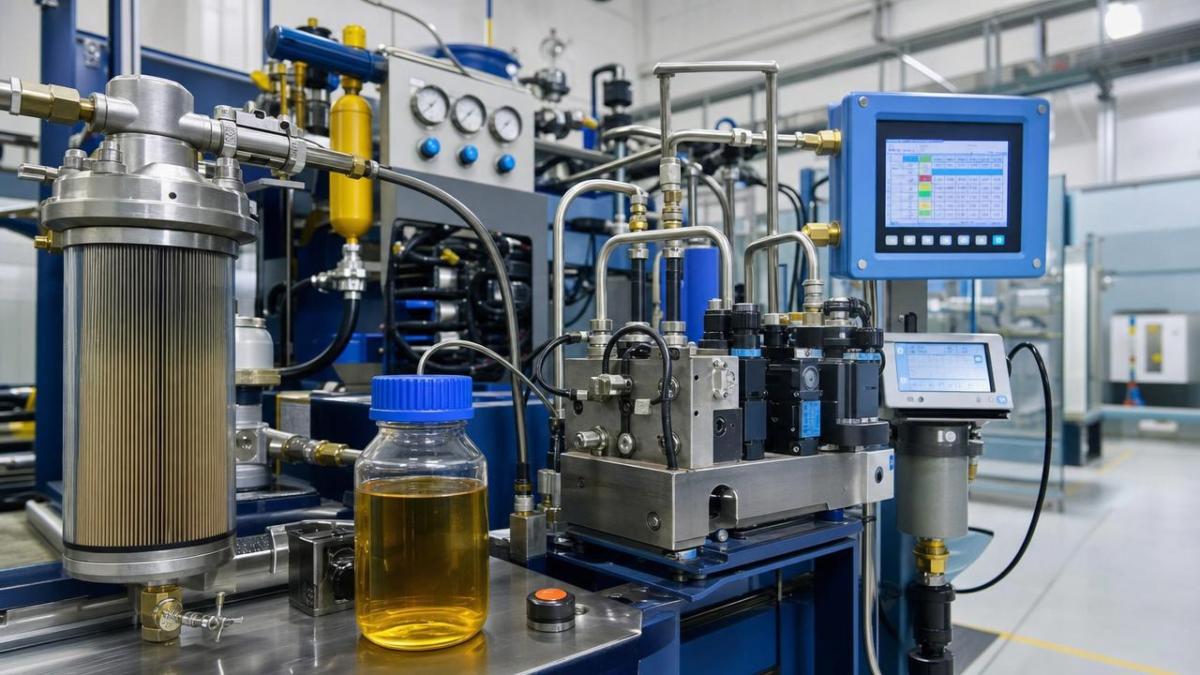
Hydraulic failures often begin with particles too small to notice, yet large enough to damage precision surfaces.
That is why hydraulic system contamination standards (ISO 4406) remain central to condition control, troubleshooting, and service planning.
In simple terms, ISO 4406 gives a coded way to describe how dirty a hydraulic fluid sample is.
Instead of vague notes like “slightly contaminated,” teams can compare particle levels through a repeatable format.
This matters across mobile equipment, factory automation, forming lines, marine systems, turbines, and material handling assets.
The standard becomes even more useful when maintenance records, fluid analysis, and digital benchmarks are reviewed together.
That aligns with the G-AIE approach: combining physical asset performance with technical intelligence that improves industrial decisions.
So the real value is not the code alone. The value comes from reading the code correctly and acting on it early.
What exactly does an ISO 4406 contamination code mean?
A typical ISO 4406 code looks like this: 18/16/13.
Those three numbers represent particle counts in three size ranges within one milliliter of fluid.
Under the current method, the ranges are particles larger than 4 microns, 6 microns, and 14 microns.
Each number is not the particle count itself. It is a code band based on doubling concentration levels.
So if one code rises by one level, the particle concentration has roughly doubled in that size range.
That is why a shift from 18/16/13 to 19/17/14 is not minor. It signals a meaningful cleanliness change.
The first number reflects fine particle loading. The last number points more directly to larger wear-causing debris.
In actual service work, the pattern across all three numbers usually tells more than one number alone.
A quick reading example
If a system reports 20/18/15, the fluid contains more particles than a system reading 17/15/12.
It also suggests that both fine contamination and larger damaging particles are present at higher levels.
For servo valves, proportional valves, and piston pumps, that difference can be operationally significant.
How do you judge whether a code is acceptable or already risky?
This is where many people hesitate, because ISO 4406 describes contamination level, not pass-or-fail limits by itself.
The acceptable code depends on component sensitivity, duty cycle, pressure level, and failure consequences.
A hydraulic press, an offshore winch, and a precision electro-hydraulic control unit may need very different cleanliness targets.
More commonly, acceptable limits are set by the OEM, fluid supplier, reliability program, or internal contamination control plan.
The table below helps translate readings into practical next steps.
The key point is that hydraulic system contamination standards (ISO 4406) support decision quality when paired with target limits and trends.
A single reading is useful. A sequence of readings is far more valuable.
Why do some contamination codes change after maintenance or filter replacement?
This is a common and often misunderstood situation.
A fresh filter does not always produce an immediate cleanliness improvement on the next sample.
If debris already circulates in the loop, it may take time for the system to stabilize.
In some cases, maintenance work itself introduces particles through hoses, connectors, reservoirs, or refill containers.
That is why post-service sampling should be timed carefully and compared with operating conditions.
Another issue is filter selection. A filter with the wrong beta rating may not control the particle sizes driving wear.
More importantly, ISO 4406 codes do not identify particle type. Metal, silica, fibers, and soft contaminants can look similar in the code.
So when hydraulic system contamination standards (ISO 4406) show deterioration, further analysis may still be needed.
- Confirm the sample point was upstream or downstream as intended.
- Check whether the system was at normal temperature and flow.
- Review if fluid transfer equipment was cleaned and capped.
- Look for evidence of breather failure or seal damage.
- Compare with wear metal analysis if large particle codes increase.
Is ISO 4406 enough on its own, or should it be combined with other checks?
ISO 4406 is essential, but it should not be treated as a complete fluid health diagnosis.
A clean particle code does not guarantee the oil is chemically healthy or water-free.
Likewise, a poor code does not automatically prove component failure without context.
In practice, better decisions come from combining hydraulic system contamination standards (ISO 4406) with supporting indicators.
Useful checks beside the code
- Water content, because moisture changes lubrication behavior and accelerates corrosion.
- Viscosity, because wrong viscosity affects film strength and control response.
- Acid number or oxidation condition, especially in long-life industrial fluids.
- Wear debris analysis, when component distress is suspected.
- Pressure ripple, temperature, and alarm history from connected monitoring systems.
This broader view is increasingly important in digitally managed operations.
Within advanced industrial ecosystems, contamination data becomes more powerful when matched to maintenance events and equipment behavior.
That is where benchmarking platforms such as G-AIE add practical value: they help turn measurements into comparable technical insight.
What mistakes cause people to misread hydraulic contamination codes?
The first mistake is assuming lower numbers always mean the system is safe enough for every application.
Different components have different cleanliness requirements, so “clean” is always application specific.
Another mistake is comparing data from inconsistent sampling methods.
A sample from a reservoir drain can tell a different story than one from a live pressure line.
People also confuse code movement with exact particle count change.
Because ISO 4406 uses code bands, a one-step change can represent a large contamination increase.
One more trap is reacting only to high readings and ignoring trend direction.
A stable but slightly elevated code may be less urgent than a fast-rising code still below alarm level.
In real operations, the most reliable interpretation comes from standard sampling, documented targets, and repeatable review intervals.
A practical checklist before acting on a code
- Verify the sample location and system operating state.
- Compare the reading with component cleanliness targets.
- Review the last maintenance intervention and fluid top-up history.
- Check whether the trend is isolated or repeated.
- Escalate to deeper analysis when large particles increase unexpectedly.
How should ISO 4406 readings guide the next maintenance decision?
The best use of hydraulic system contamination standards (ISO 4406) is not simply recording a number in a report.
It is using the reading to decide whether to monitor, correct, inspect, or investigate further.
When codes stay inside target ranges, the next step may be to preserve sampling discipline and avoid unnecessary intervention.
When fine particles rise, attention should turn to ingress control, storage hygiene, and filtration efficiency.
When larger particles rise, the decision often shifts toward wear confirmation and component inspection.
That distinction saves time and prevents the common mistake of changing filters while missing the root cause.
A sensible next step is to define cleanliness targets by equipment criticality, then align sampling frequency to actual risk.
It also helps to connect contamination records with failure history, oil condition, and service events in one review process.
That is ultimately how ISO 4406 becomes more than a lab number.
It becomes a decision tool for protecting pumps, valves, actuators, and uptime across demanding industrial environments.
If the goal is better reliability, start by standardizing sampling, validating cleanliness targets, and reviewing trends with context rather than in isolation.
Recommended News
 Sep 19, 2026When can a supply chain LLM reduce time spent finding shipment updates?Supply chain LLMs can cut shipment-update search time by connecting carrier events, ERP data, and documents—giving teams traceable answers and faster exception response.
 Sep 18, 2026How industrial monitoring equipment helps prevent unplanned downtimeIndustrial monitoring equipment helps teams detect early asset issues, prioritize maintenance, and prevent costly unplanned downtime. Explore practical strategies for reliable operations.
 Sep 17, 2026What next-gen harmonic drive research means for robot joint accuracyNext-gen harmonic drive research reveals how backlash, stiffness, thermal drift, and sensing shape robot joint accuracy. Explore smarter validation strategies.
 Sep 16, 2026How Southeast Asian climates affect cylinder seal frictionCylinder seal friction Southeast Asia: learn how humidity, heat, monsoons, and contamination affect motion stability, wear, and seal selection.
 Sep 15, 2026How to size DC gear motors for the required starting torqueGear motors DC sizing made practical: calculate starting torque, account for friction, gravity, inertia and voltage drop, then select a reliable motor with confidence.
 Sep 14, 2026How to verify high purity chemicals compliance before supplier approvalHigh purity chemicals compliance: learn how to verify supplier quality systems, CoAs, traceability, testing, and change control before approval.
 Sep 13, 2026What permits are needed to operate mapping drones in Europe?Mapping drones Europe: discover the permits, EASA categories, airspace approvals, site access, and GDPR checks needed for compliant aerial surveys.
 Sep 12, 2026What lead time should I expect for automatic transmission components? Planetary Gearboxes delivery forecasting for OEM planningWhat lead time should I expect for automatic transmission components? Get dynamic, AI-powered planetary gearbox delivery forecasting—designed for OEMs building next-gen hybrid & commercial powertrains.
 Sep 12, 2026Can polyamide replace metal in load-bearing components? Polymer Pulse structural performance data for 2026 applicationsCan polyamide replace metal in load-bearing components? Discover Polymer Pulse’s 2026 structural data—real-world performance, weight savings, and reliability breakthroughs.
 Sep 12, 2026How to handle a power electronics warranty claim: Harmonic Reducers documentation and escalation pathHow do I handle a power electronics warranty claim? Get a fast, intelligent, evidence-driven resolution for harmonic reducers—no bureaucracy, just precision diagnostics and real-time escalation.
 Sep 12, 2026Which motion control specifications matter most before purchase? Torque Logic selection criteria for automation engineersWhich motion control specifications are most important before purchase? Discover Torque Logic—the 4 non-negotiable, AI-aligned criteria that cut TCO by 27–41% and boost motion system availability to 99.992%.
 Sep 13, 2026Is agentic AI reliable enough for supplier screening? Supply Chain LLM validation framework for procurement teamsIs agentic AI reliable enough for supplier screening? Discover a rigorous LLM validation framework built for procurement teams—grounded in material traceability, regulatory compliance, and real-world operational constraints.
 Sep 14, 2026How to maintain edge AI systems after deployment: Predictive Maint AI operational protocols for field techniciansHow do I maintain edge AI systems after deployment? Discover predictive, physics-aware operational protocols designed for real-world field technicians—sustaining intelligence where silicon meets steel.
 Sep 15, 2026What compliance documents must a bioplastics supplier provide? Bio-Plastics regulatory checklist for procurementWhat compliance documents should a bioplastics supplier provide? Get our actionable regulatory checklist for food, medical & EU-bound applications.
 Sep 16, 2026How to prevent PET film defects during production: Barrier Films process control best practicesHow can I prevent PET film defects during production? Discover physics-driven barrier film process control—thermal precision, dynamic tension management & surface energy optimization.
 Sep 17, 2026Are thermoplastics suitable for long-term outdoor use? Engineering Resins durability assessment in 2026 UV/weather exposureAre thermoplastics suitable for long-term outdoor use? Discover 2026’s engineering resin durability insights — UV/weather resistance ranked, tested & actionable.
 Sep 18, 2026What to do when a servo motor fails during production: A Servo Actuators troubleshooting guide for maintenance teamsWhat should I do if a servo motor fails during production? Get a field-tested, AI-aware troubleshooting guide for maintenance teams—minimize downtime, maximize OEE.
 Sep 12, 2026How to compare wholesale party supplies by minimum order valueCompare wholesale party supplies by minimum order value, freight, SKU flexibility, and stock risk to choose suppliers that protect margins and simplify replenishment.
 Sep 11, 2026How proportional solenoid linearity affects precision motion controlProportional solenoid linearity directly affects precision motion control, valve metering, stability, and calibration. Learn how to evaluate performance for reliable automation.
 Sep 10, 2026When does supplier information platform automation reduce onboarding delays?Supplier information platform automation reduces onboarding delays by streamlining data collection, routing, renewals, and compliance checks—without replacing expert technical review.
 Sep 09, 2026How to size robotic motion systems for AMR payload changesRobotic motion systems for AMR payload changes: learn how to size motors, wheels, gearing, traction, and controls for safer, reliable performance.
 Sep 08, 2026How to perform a cylinder rod buckling calculation for long strokesCylinder rod buckling calculation made practical: learn how to assess effective length, end conditions, rod stiffness, load forces, and safety margins for reliable long-stroke cylinder design.
 Sep 07, 2026How to estimate the cost of industrial mechanical components before orderingIndustrial mechanical components cost: learn how to estimate material, machining, tooling, inspection, logistics, and hidden expenses before ordering. Compare quotes confidently and reduce sourcing risk.
 Sep 07, 2026What Is a Product Standards Database Used For?Product standards database guide: learn how to compare requirements, verify revisions, control specifications, and reduce compliance risks across design, sourcing, and production.