Search News
Industry Portal
Popular Tags
Flight Hydraulic System Warnings: Causes and Next Checks

Author
Time
Click Count
When a flight hydraulic system warning appears, how serious is it?
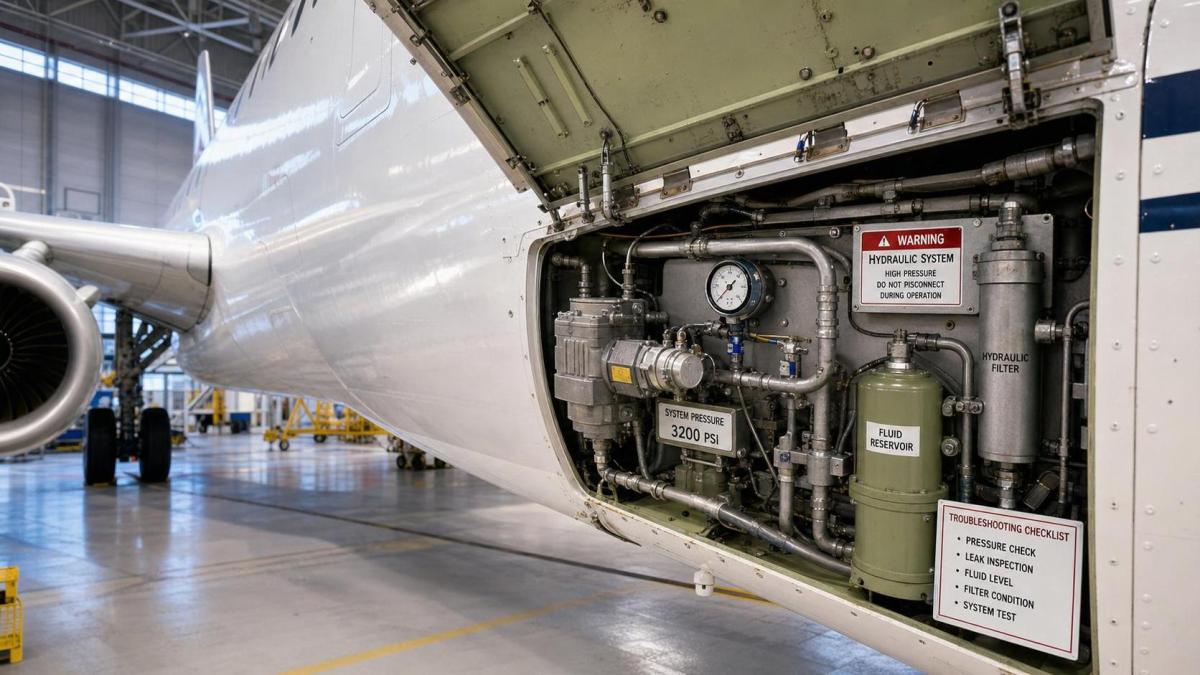
Flight hydraulic system warnings should never be treated as a generic nuisance alert.
In practice, the warning may point to a small indication issue, or to a developing hydraulic fault with direct operational risk.
That range is exactly why early interpretation matters.
A low-pressure message, reservoir quantity alert, pump overheat indication, or filter bypass warning can all look similar at first glance.
The maintenance consequence is very different, though.
Some events come from temporary temperature effects or sensor drift.
Others signal leakage, air ingestion, fluid contamination, worn seals, or pump degradation that will return after reset.
For industrial aviation support organizations, consistent diagnosis also affects turnaround time, parts use, and repeat removals.
That is where a benchmarking mindset helps.
Within technical ecosystems such as G-AIE, the useful approach is not only fixing one event, but comparing patterns across fleets, environments, and component histories.
So the first answer is simple.
A flight hydraulic system warning is serious enough to trigger structured checks, even when the aircraft still shows normal response.
What usually causes flight hydraulic system warnings?
Most flight hydraulic system warnings fall into five fault families.
Understanding the family before touching hardware saves time.
- Fluid quantity problems, including low reservoir level, trapped air, or fluid migration after servicing.
- Pressure generation faults, often linked to engine-driven pumps, electric pumps, relief valves, or internal leakage.
- Temperature-related issues, such as overheated fluid, restricted cooling, or excessive pump load.
- Contamination events, including clogged filters, varnish buildup, metallic debris, or water intrusion.
- Indication and control faults, where the system is healthy but sensors, wiring, or logic create the warning.
More often than expected, warnings are not caused by a single failed part.
A marginal pump may run hotter because contamination raised system resistance.
A quantity alert may follow minor seepage plus improper refill practice.
This is why replacing the first suspect component can miss the real chain.
When reviewing flight hydraulic system warnings, technicians usually get better results by checking event timing, ambient conditions, recent maintenance, and recurring write-ups together.
A quick reference before deeper troubleshooting
The table below helps connect the warning symptom with the most useful next checks.
Which checks should come first after the warning is recorded?
The best first checks are the ones that separate real hydraulic degradation from false indication.
That sounds obvious, yet many delays start with disassembly before basic validation.
A practical sequence usually looks like this.
- Review the exact warning wording, phase of flight, and whether the alert cleared or repeated.
- Check maintenance history for recent fluid servicing, component replacement, or recurring hydraulic write-ups.
- Verify reservoir quantity and visible condition of the fluid before adding or draining anything.
- Inspect lines, couplings, actuators, pump area, and belly zones for seepage, staining, or spray patterns.
- Download fault data and compare cockpit indications with maintenance computer values.
- If pressure or temperature is involved, run the approved ground test and trend results against known normal values.
What matters here is sequence discipline.
If fluid is topped off before the source of loss is confirmed, evidence disappears.
If a sensor is replaced before wiring checks, the warning may return unchanged.
In actual service networks, the fastest teams are usually the ones with cleaner diagnostic order, not just more spare parts.
How do you tell sensor trouble from a real hydraulic fault?
This is one of the most common questions around flight hydraulic system warnings.
A warning that appears briefly, then disappears, often pushes suspicion toward indication hardware.
Still, intermittent real faults exist, especially with heat-related expansion, vibration, or marginal pump output.
The better judgment method is comparison.
- If the warning shows low pressure, compare transducer data, system response, and test gauge results.
- If quantity reads low, compare reservoir indication to physical level and fluid behavior over time.
- If temperature appears high, check whether return lines, cooler surfaces, or pump housing support that reading.
- If the event repeats only during one phase, inspect connectors and harness routing in that vibration or thermal zone.
A true hydraulic problem usually leaves supporting evidence.
That evidence may be leakage, noise, heat, debris, slow actuator response, or repeated trend deterioration.
A pure sensing issue more often fails to align with physical behavior.
Where digital monitoring tools are available, event correlation helps even more.
This is consistent with the G-AIE view of industrial diagnostics.
Better maintenance decisions come from connecting physical asset signals with reliable data context, not from isolated part swaps.
What mistakes make flight hydraulic system warnings come back?
Repeat events usually trace back to incomplete fault closure rather than bad luck.
Several patterns show up again and again.
- Resetting the warning without identifying whether the root cause was mechanical, fluid-related, or electrical.
- Replacing a pump or sensor without checking contamination, return flow, and associated valves.
- Ignoring small leaks because the quantity drop seems minor after one event.
- Using fluid that meets the basic spec, but overlooking cleanliness or storage condition.
- Skipping trend review, so a slow decline is treated as a random isolated fault.
Another common issue is poor documentation depth.
“Hydraulic warning checked OK” does not help the next station.
A useful record should include ambient conditions, system readings, leak findings, test method, and replaced items.
That level of detail supports technical benchmarking across facilities and reduces unnecessary duplication.
How should long-term maintenance planning change after repeated warnings?
If flight hydraulic system warnings repeat on the same aircraft or subsystem, the question changes.
It is no longer only about clearing the next event.
It becomes a reliability management issue.
At that point, a broader review usually pays off.
- Trend fluid consumption, temperature behavior, and pressure stability over several cycles.
- Compare component age, overhaul history, and operating environment across similar assets.
- Review whether contamination control, flushing practice, and storage discipline are consistent.
- Evaluate whether repeated alerts cluster around one vendor batch, one line-replaceable unit, or one software baseline.
This is also where cross-industry intelligence becomes useful.
In advanced industrial environments, recurring warning analysis often improves when maintenance records, material behavior, and automation data are reviewed together.
That perspective fits the G-AIE framework, where asset performance is judged through both engineering evidence and decision-quality data.
When the warning pattern is understood at system level, planning gets sharper.
Spare holdings improve, repeat inspections become more targeted, and avoidable removals start to fall.
What is the smartest next step when the cause is still unclear?
Unclear does not mean unmanageable.
It usually means the case needs tighter evidence, not broader guessing.
Start by separating observable facts from assumptions.
List the warning type, timing, repeat rate, associated symptoms, maintenance history, and verified measurements.
Then compare those facts against the approved troubleshooting path and known fleet patterns.
If the evidence still points in two directions, focus on the check that removes the most uncertainty with the least disruption.
That may be fluid analysis, pressure comparison, leak isolation, or electrical integrity testing.
The practical takeaway is straightforward.
Flight hydraulic system warnings are best handled through disciplined verification, not speed alone.
A clear record, a structured check order, and comparison with broader technical benchmarks will usually shorten troubleshooting and improve reliability afterward.
For the next maintenance cycle, review recurring signals, confirm test thresholds, and tighten inspection standards where the warning first emerged.
That is often the point where one warning stops becoming a repeating operational problem.
Recommended News
 Sep 19, 2026When can a supply chain LLM reduce time spent finding shipment updates?Supply chain LLMs can cut shipment-update search time by connecting carrier events, ERP data, and documents—giving teams traceable answers and faster exception response.
 Sep 18, 2026How industrial monitoring equipment helps prevent unplanned downtimeIndustrial monitoring equipment helps teams detect early asset issues, prioritize maintenance, and prevent costly unplanned downtime. Explore practical strategies for reliable operations.
 Sep 17, 2026What next-gen harmonic drive research means for robot joint accuracyNext-gen harmonic drive research reveals how backlash, stiffness, thermal drift, and sensing shape robot joint accuracy. Explore smarter validation strategies.
 Sep 16, 2026How Southeast Asian climates affect cylinder seal frictionCylinder seal friction Southeast Asia: learn how humidity, heat, monsoons, and contamination affect motion stability, wear, and seal selection.
 Sep 15, 2026How to size DC gear motors for the required starting torqueGear motors DC sizing made practical: calculate starting torque, account for friction, gravity, inertia and voltage drop, then select a reliable motor with confidence.
 Sep 14, 2026How to verify high purity chemicals compliance before supplier approvalHigh purity chemicals compliance: learn how to verify supplier quality systems, CoAs, traceability, testing, and change control before approval.
 Sep 13, 2026What permits are needed to operate mapping drones in Europe?Mapping drones Europe: discover the permits, EASA categories, airspace approvals, site access, and GDPR checks needed for compliant aerial surveys.
 Sep 12, 2026What lead time should I expect for automatic transmission components? Planetary Gearboxes delivery forecasting for OEM planningWhat lead time should I expect for automatic transmission components? Get dynamic, AI-powered planetary gearbox delivery forecasting—designed for OEMs building next-gen hybrid & commercial powertrains.
 Sep 12, 2026Can polyamide replace metal in load-bearing components? Polymer Pulse structural performance data for 2026 applicationsCan polyamide replace metal in load-bearing components? Discover Polymer Pulse’s 2026 structural data—real-world performance, weight savings, and reliability breakthroughs.
 Sep 12, 2026How to handle a power electronics warranty claim: Harmonic Reducers documentation and escalation pathHow do I handle a power electronics warranty claim? Get a fast, intelligent, evidence-driven resolution for harmonic reducers—no bureaucracy, just precision diagnostics and real-time escalation.
 Sep 12, 2026Which motion control specifications matter most before purchase? Torque Logic selection criteria for automation engineersWhich motion control specifications are most important before purchase? Discover Torque Logic—the 4 non-negotiable, AI-aligned criteria that cut TCO by 27–41% and boost motion system availability to 99.992%.
 Sep 13, 2026Is agentic AI reliable enough for supplier screening? Supply Chain LLM validation framework for procurement teamsIs agentic AI reliable enough for supplier screening? Discover a rigorous LLM validation framework built for procurement teams—grounded in material traceability, regulatory compliance, and real-world operational constraints.
 Sep 14, 2026How to maintain edge AI systems after deployment: Predictive Maint AI operational protocols for field techniciansHow do I maintain edge AI systems after deployment? Discover predictive, physics-aware operational protocols designed for real-world field technicians—sustaining intelligence where silicon meets steel.
 Sep 15, 2026What compliance documents must a bioplastics supplier provide? Bio-Plastics regulatory checklist for procurementWhat compliance documents should a bioplastics supplier provide? Get our actionable regulatory checklist for food, medical & EU-bound applications.
 Sep 16, 2026How to prevent PET film defects during production: Barrier Films process control best practicesHow can I prevent PET film defects during production? Discover physics-driven barrier film process control—thermal precision, dynamic tension management & surface energy optimization.
 Sep 17, 2026Are thermoplastics suitable for long-term outdoor use? Engineering Resins durability assessment in 2026 UV/weather exposureAre thermoplastics suitable for long-term outdoor use? Discover 2026’s engineering resin durability insights — UV/weather resistance ranked, tested & actionable.
 Sep 18, 2026What to do when a servo motor fails during production: A Servo Actuators troubleshooting guide for maintenance teamsWhat should I do if a servo motor fails during production? Get a field-tested, AI-aware troubleshooting guide for maintenance teams—minimize downtime, maximize OEE.
 Sep 12, 2026How to compare wholesale party supplies by minimum order valueCompare wholesale party supplies by minimum order value, freight, SKU flexibility, and stock risk to choose suppliers that protect margins and simplify replenishment.
 Sep 11, 2026How proportional solenoid linearity affects precision motion controlProportional solenoid linearity directly affects precision motion control, valve metering, stability, and calibration. Learn how to evaluate performance for reliable automation.
 Sep 10, 2026When does supplier information platform automation reduce onboarding delays?Supplier information platform automation reduces onboarding delays by streamlining data collection, routing, renewals, and compliance checks—without replacing expert technical review.
 Sep 09, 2026How to size robotic motion systems for AMR payload changesRobotic motion systems for AMR payload changes: learn how to size motors, wheels, gearing, traction, and controls for safer, reliable performance.
 Sep 08, 2026How to perform a cylinder rod buckling calculation for long strokesCylinder rod buckling calculation made practical: learn how to assess effective length, end conditions, rod stiffness, load forces, and safety margins for reliable long-stroke cylinder design.
 Sep 07, 2026How to estimate the cost of industrial mechanical components before orderingIndustrial mechanical components cost: learn how to estimate material, machining, tooling, inspection, logistics, and hidden expenses before ordering. Compare quotes confidently and reduce sourcing risk.
 Sep 07, 2026What Is a Product Standards Database Used For?Product standards database guide: learn how to compare requirements, verify revisions, control specifications, and reduce compliance risks across design, sourcing, and production.