
Search News
Industry Portal
Popular Tags
How to verify an engineering specification reference is current

Author
Time
Click Count
To verify that an engineering specification reference is current, identify the exact document and edition, check its status with the issuing authority or an authorized source, and account for any amendments, corrigenda, or supplements. Then establish whether that edition is the one required for the work. The latest published revision and the contractually or legally applicable revision can be different.
A date on a document cover is a starting point, not proof of currency. A specification may have been revised, reaffirmed, withdrawn, replaced, or modified by an amendment issued separately. For a technical evaluator, the useful outcome is a traceable decision: which requirements apply, what evidence supports that decision, and whether any difference needs resolution before evaluation proceeds.
Start with the complete reference
Before searching a standards catalogue or document system, capture the reference exactly as it appears in the drawing, purchase specification, test plan, or other controlling document. A title alone is rarely sufficient. Similar titles can describe different parts of a series, national adoptions, or test methods with materially different scopes.
Record as much of the following as the source provides:
- Issuing organization and document identifier: Include prefixes, part numbers, suffixes, and any letters that distinguish one document from another.
- Edition, revision, or year: Preserve the notation used in the reference rather than assuming that every date represents a revision.
- Title and scope: Check that the document addresses the material, product, process, test, or system being evaluated.
- Referenced clauses or tables: A requirement may invoke only part of a document or modify how it applies.
- Amendments and supplements: Note any explicitly named additions, including their identifiers and dates.
- Source of the requirement: Identify the contract, regulation, customer specification, drawing, or internal procedure that calls it up.
Also check whether the reference is dated or undated. A dated citation points to a specified edition; an undated citation may be intended to follow later editions, but its effect depends on the wording and rules of the document making the reference. Do not infer a universal rule from the absence of a date.
For internal specifications, the document owner and revision-control system matter as much as the number. Two organizations can use similar identifiers, and a supplier’s copy may include customer-specific changes that do not appear in a public catalogue.
Check status at the issuing source
Use the issuing body’s official catalogue or document portal where available. For a company, customer, or project specification, use the designated document-control system or request the status from the document owner. An authorized distributor’s catalogue can also help identify editions, although the issuing body or controlling owner remains the best source for resolving ambiguous status information.
Search by the complete identifier first, then compare the title, scope, part, and edition against the reference in hand. A matching number in a search result is not enough if the result refers to a different part, adoption, or version. Where a national or regional adoption of a standard is cited, check that adoption specifically; its designation, publication history, and modifications may differ from those of the underlying document.
Record the status shown by the source and inspect any linked revision history. Depending on the issuing system, a record may indicate that the document is active, revised, reaffirmed, withdrawn, superseded, or replaced. These labels are useful, but their meanings and consequences depend on the issuing organization. A reaffirmed document, for example, may retain its existing technical text and edition designation. A withdrawn document may have no direct replacement.
Do not treat a catalogue entry as a substitute for the document itself when the evaluation depends on technical requirements. Metadata can establish identity and status, but it may not show the full scope, normative provisions, or changes introduced by an amendment. Obtain the controlled text through an appropriate authorized channel and check that it matches the identified edition.
Look beyond the base publication
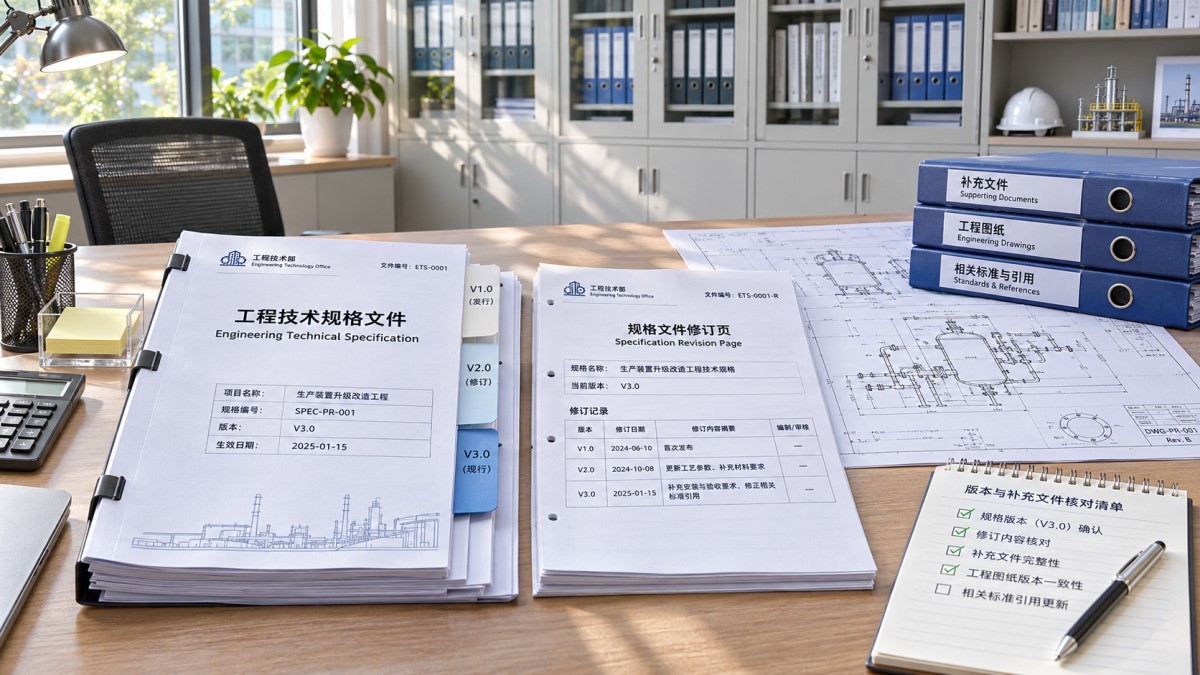
A base document can still be listed as active while separate material affects its use. Check for amendments, corrigenda, supplements, and other officially associated publications. Confirm which edition each item applies to: an amendment for a later edition should not automatically be attached to an earlier one.
Where a consolidated edition is available, determine whether it incorporates the relevant changes and whether it is accepted for the purpose at hand. If the evaluation file contains a base edition plus separate amendments, identify the complete set and avoid applying a change twice. For a test method, even a small correction to a calculation, conditioning requirement, or reporting instruction can affect comparability of results.
Technical committee drafts, consultation copies, and preview pages may be useful for identifying a document, but they should not be mistaken for the published requirements. Likewise, a file found in a shared folder may have an official-looking cover while missing later corrections or carrying no reliable revision history.
Separate publication status from applicability
Once the publication record is clear, return to the document that invokes the specification. The question changes from “What is the latest edition?” to “Which edition governs this evaluation?” The answer may depend on a contract, approved design baseline, purchase order, customer requirement, applicable regulation, or a combination of them.
A contract might name a particular edition to keep a project baseline stable. A later edition can exist without automatically replacing the one agreed by the parties. Conversely, a contract clause may incorporate revisions under defined conditions, or an applicable regulation may require a particular version. Read the relevant wording and its effective context rather than substituting a general rule.
The distinction also matters for regulatory references. A standard can be revised by its publisher while a law or regulatory instrument continues to cite an earlier edition. Being the newest publication does not by itself establish regulatory acceptance, and complying with a cited standard does not automatically establish compliance with every applicable legal obligation. Check the relevant authority’s requirements for the jurisdiction, product, and time period concerned.
If documents conflict, follow the governing order of precedence where one is established and refer unresolved issues to the responsible authority, contract owner, or engineering function. Do not silently choose the newest edition simply because it appears more rigorous. A change can alter test methods, acceptance limits, qualification evidence, or compatibility with an approved design.
Handle nested references deliberately
A specification may cite other standards for testing, terminology, materials, or inspection. Those references deserve the same attention when they affect the decision. First identify whether the parent document specifies a dated edition or uses an undated reference, then apply the parent document’s stated rules and any governing contractual or legal requirements.
For example, a procurement specification may require a material to meet a named product standard and require testing under a separate method. If the product standard fixes an edition of that test method, using a later method without review could produce results that are not directly comparable to the specified acceptance criteria. If the parent reference is undated, the applicable edition still needs to be determined in context; it should not be assumed from a search result alone.
Prioritize nested references that control acceptance criteria, test conditions, calculations, or qualification. A complete dependency review can become substantial, so document the boundaries of the review and escalate references whose status could change the technical decision.
Decide what to do when the reference has changed
A revised or superseded reference is a signal to assess impact, not an instruction to replace the cited document automatically. Compare the applicable edition with the later publication where access and authority permit. Focus on provisions that govern the work: scope, definitions, performance requirements, sampling, test methods, acceptance criteria, and reporting.
The status of the original reference determines the next step:
- The specified edition remains applicable: Retain it in the evaluation baseline, including applicable amendments. Record the later revision as a change to assess if the project’s change-control process requires it.
- The governing requirement calls for a newer edition: Obtain the correct text, identify affected requirements, and determine whether existing evidence remains valid under that edition.
- The reference is withdrawn or has no clear successor: Ask the document owner or responsible technical authority how the requirement should be interpreted. A similarly titled publication is not necessarily an equivalent replacement.
- The governing documents disagree or are ambiguous: Resolve the conflict through the contract or engineering change process before treating either edition as authoritative.
Where a change affects testing or certification evidence, compare the requirements behind the evidence, not just the document numbers printed on a report. A report prepared to one edition may or may not support a decision under another; the answer depends on the differences and the authority accepting the evidence. A certificate’s scope, edition, validity conditions, and any transition arrangements should likewise be checked with the relevant scheme or issuing body.
For an internal specification, a revision can also change referenced external standards without changing every affected drawing or work instruction immediately. Verify that the document set used for evaluation is an approved, consistent baseline. If an older purchase order is being fulfilled against a frozen revision, preserve that context alongside any later engineering changes.
Leave a verification trail
A useful record allows another evaluator to reconstruct the decision without repeating the search. It does not need to be lengthy, but it should distinguish what was found from what was authorized for use.
- Record the full designation, title, edition, and applicable amendments or corrigenda.
- Identify the issuing body or document owner and the source used to check status.
- Capture the status observed and the date of the check, with a catalogue link or controlled record where access permits.
- Identify the contract, regulation, drawing, or other requirement that establishes the applicable edition.
- Document discrepancies, technical impact assessments, and the person or function that approved their resolution.
For long-running projects, set a review point around events that can change the decision: a design release, a purchase commitment, a qualification test, a regulatory submission, or an approved change to the baseline. An earlier status check remains evidence of what was known at that time; it does not guarantee that the publication record or governing requirements are unchanged later.
The final evaluation should name the exact document set used, rather than simply stating that it follows “the current standard.” That wording makes the result reproducible and exposes a difference between publication status and project applicability while there is still time to resolve it.
Recommended News
 Nov 04, 2026How to verify an engineering specification reference is currentVerify an engineering specification reference with confidence. Learn how to check editions, amendments, official status, and which requirements apply.
 Nov 03, 2026How to calculate hydraulic cylinder load rating from pressureCalculate hydraulic cylinder load rating from pressure and piston area. Explore extension and retraction formulas, worked examples, and key safety limits.
 Nov 03, 2026US Navy Seeks Cargo Drones for TRUAS II Tactical Resupply DemonstrationUS Navy seeks cargo drones for the TRUAS II tactical resupply demonstration. Discover the payload, range and application requirements for suppliers.
 Nov 02, 2026Which industrial standards apply to electronic grade chemicals?Industrial standards guidance for electronics: discover how SEMI, ISO and chemical safety rules apply to electronic-grade chemicals.
 Nov 02, 2026FEMA Sets November 16 Deadline for $250 Million Counter-UAS GrantFEMA’s $250 million Counter-UAS grant closes November 16, 2026. Explore eligible uses and potential opportunities for counter-drone suppliers.
 Nov 01, 2026What drives semiconductor automation costs in a wafer fab?Semiconductor automation cost depends on fab layout, integration, installation, and downtime. Discover how to compare proposals and build a stronger investment case.
 Nov 01, 2026Pentagon Commits $1.1 Billion to Drone Dominance ProgramPentagon Drone Dominance program: Explore the reported $1.1 billion commitment, the 2027 drone target and what it could mean for manufacturers and suppliers.
 Oct 31, 2026How much does a custom mechatronic system cost?Understand mechatronic systems cost, from engineering and software to testing and support. Learn how to scope your project and compare quotes with confidence.
 Oct 31, 2026EHang Establishes Thailand Hub to Advance eVTOL Deployment in Southeast AsiaEHang’s Thailand hub advances eVTOL projects in Southeast Asia. Explore what the AAM sandbox could mean for operators, suppliers and market access.
 Oct 30, 2026How to size high-torque robotic joints for a given payloadSizing robotic joints high torque applications demands more than payload ratings. Learn to calculate torque, assess duty cycles, and select the right actuator.
 Oct 30, 2026Taizhou Bay Drone Standards Pilot Passes Review After Developing 29 StandardsTaizhou Bay drone standards pilot passes review after developing 29 standards. Explore potential impacts on testing, certification and procurement.
 Oct 29, 2026How to size the drive motor for a hydraulic pump test benchSize your hydraulic pump test bench drive motor with confidence. Explore power calculations, torque checks, and duty-cycle guidance to avoid overheating, control costs, and ensure reliable testing.
 Oct 29, 2026FCC Advances Final Rules on Drone Dominance and Advanced Air MobilityExplore proposed FCC drone spectrum rules for 5030–5091 MHz and advanced air mobility. Learn what operators and suppliers should watch before making compliance and procurement decisions.
 Oct 28, 2026Are natural rubber pet toys suitable for aggressive chewers?Are natural rubber pet toys right for aggressive chewers? Discover how to choose durable designs, spot unsafe wear, and make smarter buying decisions for safer playtime.
 Oct 28, 2026Percepto Launches Axion Hardware-Agnostic AI Platform for Infrastructure InspectionsPercepto Axion brings hardware-agnostic AI to infrastructure inspections with 160+ models. Explore how third-party drone and sensor data could enable more flexible inspection workflows.
 Oct 27, 2026How to size power electronics for peak loads in industrial servo drivesSize power electronics for industrial equipment with confidence. Learn to verify peak current, voltage headroom, braking energy, and thermal limits to prevent servo drive trips.
 Oct 27, 2026BAE Systems Adapts T-150 Cargo Drone into TRV-150 Counter-Drone PlatformBAE Systems’ TRV-150 adapts the T-150 cargo drone for counter-drone missions using APKWS rockets. Explore its reported 100% test hit rate, potential cost benefits and key limits.
 Oct 26, 2026How to choose automatic pet feeders for a multi-cat householdChoose automatic pet feeders for your multi-cat home with confidence. Compare portion accuracy, microchip access, and reliability to prevent food theft and simplify mealtimes.
 Oct 26, 2026Shenbei Low-Altitude Equipment Cluster Named to National Public Notice ListShenbei’s low-altitude equipment cluster joins China’s national SME cluster public notice list. Explore what the proposed designation could mean for manufacturers and supply-chain partners.
 Oct 25, 2026How to test trace metals in high-purity chemicals for electronicsTesting high purity chemicals for electronics? Learn how ICP-MS, clean sampling, and validated QC deliver reliable trace-metal results for confident batch release.
 Oct 25, 2026Neuron Digital Becomes First Company to Earn BSI Digital Twin KitemarkNeuron Digital becomes the first company to earn BSI Digital Twin Kitemark certification. Discover what this independent assurance means for security, reliability and buyer confidence.
 Oct 24, 2026How to verify API 6DX compliance for hydraulic valve actuatorsVerify hydraulic API compliance for valve actuators with this API 6DX guide. Learn how to review sizing, traceability, and test records to uncover gaps before acceptance.
 Oct 24, 2026Parallel Flight Partners with Drone Forge to Bring Firefly to Asia-PacificParallel Flight partners with Drone Forge to bring the Firefly heavy-lift hybrid drone to Asia-Pacific. Explore its capabilities for logistics and inspection missions.
 Oct 23, 2026How electrification shapes the hydraulic equipment investment outlookExplore the hydraulic equipment investment outlook as electrification reshapes demand. Compare retrofit options, energy savings, and lifecycle costs to make smarter capital decisions.