Search News
Industry Portal
Popular Tags
Which industrial standards apply to electronic grade chemicals?
Author
Time
Click Count
Electronic-grade chemicals are governed by overlapping requirements, not by a single universal certification. SEMI chemical specifications address product purity and test methods for covered materials; ISO standards can support laboratory competence, quality management and cleanroom control; and chemical safety laws govern classification, communication, storage, transport and workplace exposure according to jurisdiction.
The governing combination depends on the chemical, its intended process, the point of use and the countries through which it moves. A supplier’s “electronic grade” label or ISO certificate is not, by itself, evidence that a particular lot meets a semiconductor manufacturer’s impurity limits or that the chemical is being handled safely.
How the main requirements fit together
These layers answer different questions. A material can conform to an agreed purity specification yet still require controls for corrosivity, toxicity or flammability. Equally, a legally compliant safety data sheet does not demonstrate that trace metals, particles or organic residues are acceptable for wafer processing.
SEMI specifications: start with the exact material and grade
SEMI publishes standards used across semiconductor manufacturing, including specifications and analytical methods for electronic-grade chemicals. The relevant document must be identified by the actual substance and application. Requirements for a mineral acid, solvent, process gas or another chemical should not be assumed to be interchangeable.
For a covered chemical, a SEMI specification can define properties such as assay, limits for selected impurities and referenced analytical procedures. Depending on the material and document, it may distinguish grades with different impurity limits. The purchaser and supplier should identify the applicable document designation, revision and grade in the agreed specification rather than relying on an unqualified statement such as “SEMI compliant.”
That distinction matters because a published specification is not necessarily the complete acceptance criterion for a particular process. A manufacturing step may be sensitive to an impurity not listed in the selected document, or it may require a tighter limit for a listed contaminant. Particle size, dissolved gases, moisture or container extractables can also be relevant to the application. Such requirements should be added explicitly to the purchasing specification and supported by an agreed test method.
SEMI standards are generally voluntary unless incorporated into a contract or otherwise made applicable by a binding requirement. A claim of conformity should therefore be read against its precise scope: which document, which revision, which grade, and whether the claim covers the delivered lot. SEMI is the source for the authoritative text; summaries and certificates should not replace the applicable standard.
Purity results are only meaningful with a defined test
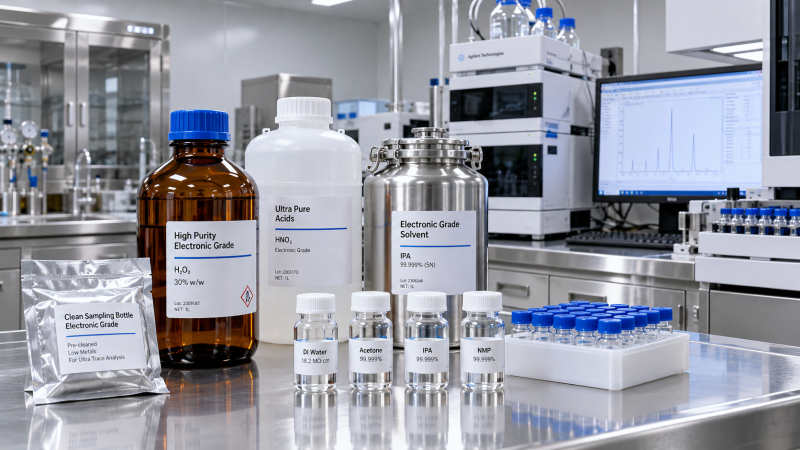
Low impurity limits create a measurement problem as well as a production problem. At trace levels, contamination can enter through sampling equipment, containers, reagents, laboratory air or instrument preparation. A reported value therefore needs context: the sample matrix, analytical method, reporting limit, units and the point at which the sample was taken.
Inductively coupled plasma mass spectrometry, for example, can be used to measure trace metals in suitable chemical matrices, while ion chromatography can be used for selected ionic impurities. The suitability of either approach depends on the substance, sample preparation, target analytes and required reporting limits. A method capable of measuring a metal in water cannot automatically be assumed to achieve the same performance in a concentrated acid or organic solvent.
“Below detection” is not the same as zero. If the acceptance limit is lower than the laboratory’s reporting limit, the result cannot establish conformance to that limit. The same issue arises when a certificate reports a broad group result but the specification requires individual analytes. Agreements should state how non-detects are reported and how results close to a limit are evaluated, including any agreed treatment of measurement uncertainty.
ISO/IEC 17025 is relevant when assessing the laboratory behind the result. Accreditation is granted for a defined scope, so the useful question is whether the chemical matrix, analyte and method—or an appropriately described range of activities—fall within the laboratory’s accredited scope. Accreditation of a laboratory does not mean that every test it performs is accredited. Where a particular analysis is outside scope, the method’s validation and quality controls still need to be assessed on their merits.
What ISO management and cleanroom standards do—and do not—prove
ISO 9001 certification can provide evidence that an organization’s quality management system has been assessed against that standard within the certificate’s stated scope. It is useful when reviewing document control, change management, corrective action and traceability. It does not set electronic-grade impurity limits and does not certify an individual shipment as fit for use.
The ISO 14644 series addresses cleanrooms and associated controlled environments. ISO 14644-1 classifies air cleanliness by particle concentration; other parts address matters such as testing, monitoring and operational control. A controlled filling environment can reduce contamination risk, but its air classification is not a substitute for testing the chemical in its final package. Surface condition, packaging materials and transfer equipment remain separate contamination sources.
Cleanroom requirements should be linked to the operation being assessed. A certificate or classification for one room does not automatically describe conditions at every filling line, storage location or transfer point. The relevant evidence includes the location, operational state, monitoring approach and relationship between the controlled area and the chemical’s exposure to the environment.
Chemical safety rules apply independently of purity
A highly purified chemical can still present a severe hazard. Electronic-grade hydrofluoric acid, for instance, requires controls based on its hazardous properties; a lower concentration of trace impurities does not make exposure safe. Hazard classification, emergency arrangements and equipment compatibility must be assessed separately from product quality.
In the United States, relevant federal requirements can include the Occupational Safety and Health Administration’s Hazard Communication Standard, 29 CFR 1910.1200, and applicable chemical-specific or process-safety requirements. Employers must determine which provisions apply to their operations, including any applicable state requirements. A safety data sheet supports hazard communication, but it does not replace a workplace-specific exposure assessment or operating procedure.
In the European Union, REACH and the CLP Regulation are central to chemical compliance. REACH addresses obligations including registration, evaluation, authorization and restriction where applicable; CLP governs classification, labelling and packaging of substances and mixtures. The responsible party’s duties depend on its role, the substance and the circumstances of placing it on the market or using it. Rules in other markets must be checked separately, even when they use the Globally Harmonized System of Classification and Labelling of Chemicals as a basis.
Safety data sheets should be assessed for the destination market and supplied language requirements. The chemical identity, concentration, hazards, incompatible materials, exposure controls and emergency measures should correspond to the product being delivered. For mixtures, a commercially described grade may not provide enough information to determine safe handling without the accompanying documentation.
Packaging and transport connect quality with safety
Packaging is both a containment system and a potential source of contamination. A container may be chemically resistant yet contribute trace metals, organic compounds or particles at levels relevant to the process. Conversely, packaging selected for low extractables must still meet applicable dangerous-goods requirements. Quality and transport suitability need to be evaluated together.
Transport requirements depend on the substance, concentration, package and mode of transport. International frameworks include the UN Model Regulations as implemented through applicable modal rules, such as the IMDG Code for maritime transport, the ICAO Technical Instructions for air transport and ADR for road transport in participating jurisdictions. Domestic legislation and carrier requirements also apply. A classification appropriate to one mixture or concentration should not be copied to another without assessment.
For quality acceptance, the agreed package specification should identify the container material, closure, cleanliness requirements, sealing arrangement and any controls on reuse. The certificate of analysis should also make clear whether the tested sample represents material before filling or the final packaged lot. A pre-fill result alone may not reveal contamination introduced during filling or by the container.
Turning standards into an enforceable acceptance specification
The practical difficulty is not finding a standard number; it is connecting the right requirements to a delivered chemical. An effective specification makes the following points explicit:
- Identity and intended use: chemical name, concentration or assay, relevant grade and process application.
- Reference documents: applicable SEMI document and revision, any contractual deviations, and the analytical methods to be used.
- Critical limits: individual impurity and particle requirements, units, sampling conditions, reporting limits and acceptance rules.
- Lot evidence: lot identification, certificate of analysis, test results or agreed reporting format, and traceability to production and packaging records.
- Change control: notification and approval conditions for changes to raw materials, manufacturing location, analytical methods, containers or other agreed parameters.
- Safety and logistics: current safety data sheet, applicable transport classification, packaging requirements, storage conditions and emergency information.
A certificate of analysis is strongest when it reports actual lot results against the agreed limits and identifies the methods used. Statements such as “passes specification” may be contractually acceptable for some characteristics, but they provide less information for investigating drift or comparing lots. The agreement should distinguish tests performed on each lot from periodic, representative or supplier-controlled tests.
Where a result fails, falls near an acceptance limit or conflicts with a receiving test, the disposition process should already be defined. That includes sample retention, chain of custody, the method used for any retest and whether the material remains on hold. Simply repeating an analysis until one result passes can obscure contamination or sampling problems.
Where conformity claims need closer examination
Several common claims describe only part of the requirement. “Electronic grade” is a commercial description unless tied to a defined specification. “Made in an ISO-classified cleanroom” describes an environment, not the purity of a packaged chemical. “ISO 9001 certified” concerns a management system, not a laboratory’s measurement capability. Even a reference to a SEMI specification is incomplete without the relevant grade, revision and evidence that the lot conforms.
The most defensible compliance position is a documented link between the process requirement, the selected material specification, a capable measurement method and the actual shipment. Safety obligations run alongside that chain: the same chemical must be correctly classified, packaged, communicated and controlled for the places where it is transported, stored and used.
Recommended News
 Nov 03, 2026How to calculate hydraulic cylinder load rating from pressureCalculate hydraulic cylinder load rating from pressure and piston area. Explore extension and retraction formulas, worked examples, and key safety limits.
 Nov 03, 2026US Navy Seeks Cargo Drones for TRUAS II Tactical Resupply DemonstrationUS Navy seeks cargo drones for the TRUAS II tactical resupply demonstration. Discover the payload, range and application requirements for suppliers.
 Nov 02, 2026Which industrial standards apply to electronic grade chemicals?Industrial standards guidance for electronics: discover how SEMI, ISO and chemical safety rules apply to electronic-grade chemicals.
 Nov 02, 2026FEMA Sets November 16 Deadline for $250 Million Counter-UAS GrantFEMA’s $250 million Counter-UAS grant closes November 16, 2026. Explore eligible uses and potential opportunities for counter-drone suppliers.
 Nov 01, 2026What drives semiconductor automation costs in a wafer fab?Semiconductor automation cost depends on fab layout, integration, installation, and downtime. Discover how to compare proposals and build a stronger investment case.
 Nov 01, 2026Pentagon Commits $1.1 Billion to Drone Dominance ProgramPentagon Drone Dominance program: Explore the reported $1.1 billion commitment, the 2027 drone target and what it could mean for manufacturers and suppliers.
 Oct 31, 2026How much does a custom mechatronic system cost?Understand mechatronic systems cost, from engineering and software to testing and support. Learn how to scope your project and compare quotes with confidence.
 Oct 31, 2026EHang Establishes Thailand Hub to Advance eVTOL Deployment in Southeast AsiaEHang’s Thailand hub advances eVTOL projects in Southeast Asia. Explore what the AAM sandbox could mean for operators, suppliers and market access.
 Oct 30, 2026How to size high-torque robotic joints for a given payloadSizing robotic joints high torque applications demands more than payload ratings. Learn to calculate torque, assess duty cycles, and select the right actuator.
 Oct 30, 2026Taizhou Bay Drone Standards Pilot Passes Review After Developing 29 StandardsTaizhou Bay drone standards pilot passes review after developing 29 standards. Explore potential impacts on testing, certification and procurement.
 Oct 29, 2026How to size the drive motor for a hydraulic pump test benchSize your hydraulic pump test bench drive motor with confidence. Explore power calculations, torque checks, and duty-cycle guidance to avoid overheating, control costs, and ensure reliable testing.
 Oct 29, 2026FCC Advances Final Rules on Drone Dominance and Advanced Air MobilityExplore proposed FCC drone spectrum rules for 5030–5091 MHz and advanced air mobility. Learn what operators and suppliers should watch before making compliance and procurement decisions.
 Oct 28, 2026Are natural rubber pet toys suitable for aggressive chewers?Are natural rubber pet toys right for aggressive chewers? Discover how to choose durable designs, spot unsafe wear, and make smarter buying decisions for safer playtime.
 Oct 28, 2026Percepto Launches Axion Hardware-Agnostic AI Platform for Infrastructure InspectionsPercepto Axion brings hardware-agnostic AI to infrastructure inspections with 160+ models. Explore how third-party drone and sensor data could enable more flexible inspection workflows.
 Oct 27, 2026How to size power electronics for peak loads in industrial servo drivesSize power electronics for industrial equipment with confidence. Learn to verify peak current, voltage headroom, braking energy, and thermal limits to prevent servo drive trips.
 Oct 27, 2026BAE Systems Adapts T-150 Cargo Drone into TRV-150 Counter-Drone PlatformBAE Systems’ TRV-150 adapts the T-150 cargo drone for counter-drone missions using APKWS rockets. Explore its reported 100% test hit rate, potential cost benefits and key limits.
 Oct 26, 2026How to choose automatic pet feeders for a multi-cat householdChoose automatic pet feeders for your multi-cat home with confidence. Compare portion accuracy, microchip access, and reliability to prevent food theft and simplify mealtimes.
 Oct 26, 2026Shenbei Low-Altitude Equipment Cluster Named to National Public Notice ListShenbei’s low-altitude equipment cluster joins China’s national SME cluster public notice list. Explore what the proposed designation could mean for manufacturers and supply-chain partners.
 Oct 25, 2026How to test trace metals in high-purity chemicals for electronicsTesting high purity chemicals for electronics? Learn how ICP-MS, clean sampling, and validated QC deliver reliable trace-metal results for confident batch release.
 Oct 25, 2026Neuron Digital Becomes First Company to Earn BSI Digital Twin KitemarkNeuron Digital becomes the first company to earn BSI Digital Twin Kitemark certification. Discover what this independent assurance means for security, reliability and buyer confidence.
 Oct 24, 2026How to verify API 6DX compliance for hydraulic valve actuatorsVerify hydraulic API compliance for valve actuators with this API 6DX guide. Learn how to review sizing, traceability, and test records to uncover gaps before acceptance.
 Oct 24, 2026Parallel Flight Partners with Drone Forge to Bring Firefly to Asia-PacificParallel Flight partners with Drone Forge to bring the Firefly heavy-lift hybrid drone to Asia-Pacific. Explore its capabilities for logistics and inspection missions.
 Oct 23, 2026How electrification shapes the hydraulic equipment investment outlookExplore the hydraulic equipment investment outlook as electrification reshapes demand. Compare retrofit options, energy savings, and lifecycle costs to make smarter capital decisions.
 Oct 23, 2026IDSA Highlights NTT DATA’s Data Space Approach to a Balearic Islands Digital TwinExplore NTT DATA’s Balearic Islands digital twin, highlighted by IDSA, and see how data spaces connect shared data with predictive modeling to inform regional decisions.