Search News
Industry Portal
Popular Tags
How to Choose an Eyeshadow Palette Manufacturer

Author
Time
Click Count
Choosing the right eyeshadow palette manufacturer is a strategic procurement decision that affects product quality, brand reputation, compliance, cost control, and supply chain resilience.
The challenge is not only finding attractive formulas and packaging.
It is also verifying manufacturing capability, regulatory standards, customization flexibility, lead times, and long-term reliability.
This guide outlines the key criteria needed to identify an eyeshadow palette manufacturer that can support scalable, consistent, and market-ready production.
Why a Checklist Matters When Selecting an Eyeshadow Palette Manufacturer
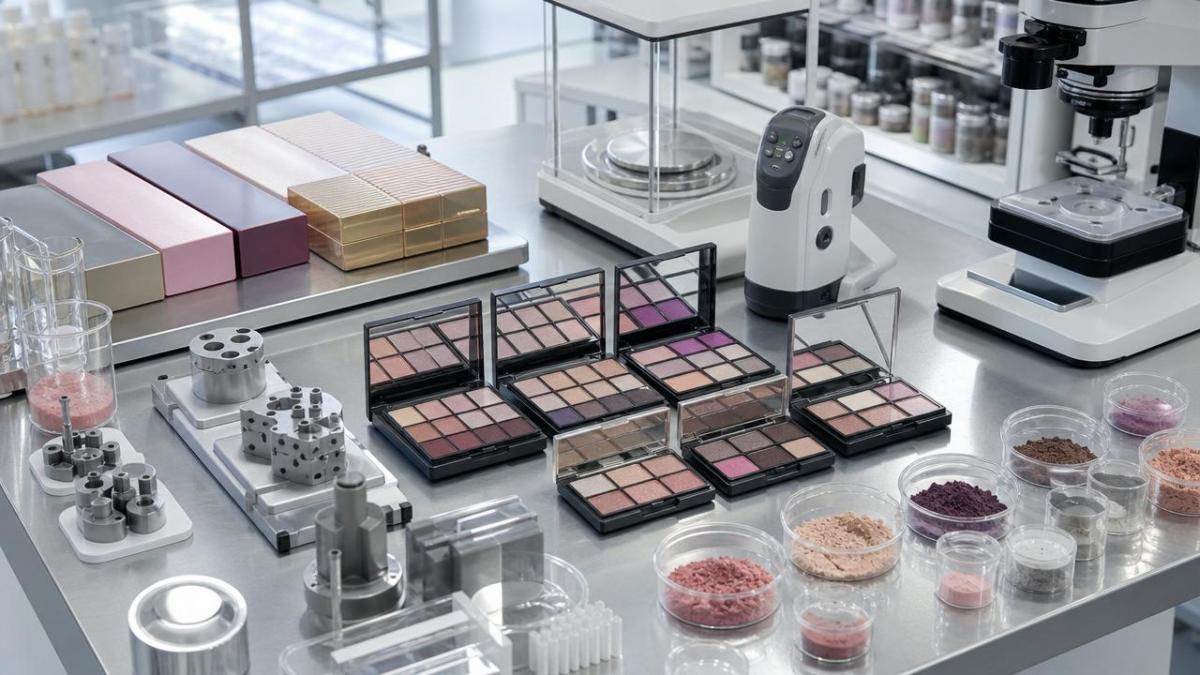
Color cosmetics combine chemistry, sensory performance, packaging engineering, and brand positioning.
A weak supplier decision can cause shade inconsistency, fallout, hard pan, broken powders, delayed launches, or compliance disputes.
A checklist creates a repeatable way to compare each eyeshadow palette manufacturer on evidence, not presentation quality alone.
It also helps align formula expectations, order volumes, packaging requirements, testing procedures, and commercial terms before sampling begins.
Core Checklist for Choosing an Eyeshadow Palette Manufacturer
Use the following checkpoints to evaluate an eyeshadow palette manufacturer before moving from inquiry to quotation, sample approval, and mass production.
- Verify cosmetic manufacturing licenses, GMP practices, quality certifications, and inspection records before reviewing shade cards or packaging concepts.
- Request formula capability details, including matte, shimmer, metallic, glitter, baked, pressed powder, cream, and hybrid eyeshadow formats.
- Assess pigment dispersion, payoff, blendability, adhesion, fallout control, and wear time through standardized sample testing.
- Check whether the eyeshadow palette manufacturer can meet target market rules for ingredients, labeling, allergens, claims, and safety documentation.
- Compare minimum order quantities across stock palettes, semi-custom designs, and fully customized private label eyeshadow palettes.
- Evaluate packaging options, including magnetic pans, paperboard, plastic cases, mirrors, applicators, sleeve boxes, and sustainable materials.
- Confirm pan pressing consistency, drop-test performance, sealing methods, batch coding, and protection against powder breakage during shipping.
- Review shade development workflows, artwork proofing, color matching tolerances, pre-production samples, and approval checkpoints.
- Ask for production capacity data, seasonal lead times, reorder speed, and contingency plans for material shortages.
- Examine communication speed, technical documentation quality, corrective action procedures, and willingness to support long-term product upgrades.
Manufacturing Capability and Formula Performance
The best eyeshadow palette manufacturer should demonstrate both laboratory creativity and production discipline.
A beautiful lab sample is not enough if mass production cannot reproduce the same texture, color, and pan stability.
Request controlled samples from different batches, not only one presentation sample.
Compare pressed density, surface finish, pigmentation, fragrance level, and powder pickup with a brush and fingertip.
For premium products, focus on smooth application, minimal kickback, buildable color, and crease resistance.
For mass-market products, balance performance, cost, shade variety, and fast repeat production.
Questions to Ask About Formulation
- Ask which binders, oils, pearls, and treated pigments are used to improve texture, payoff, and adhesion.
- Confirm whether vegan, cruelty-free, talc-free, fragrance-free, or clean beauty claims are supported by documentation.
- Test dark mattes, pale mattes, and high-pearl shimmers because these shades often reveal formulation weaknesses.
Compliance, Safety, and Documentation
Compliance should be treated as a core selection factor, not a final paperwork step.
An eyeshadow palette manufacturer must understand the destination market before recommending ingredients or claims.
Important documents may include ingredient lists, COA, MSDS, microbial testing, heavy metal testing, stability testing, and packaging compatibility reports.
For global distribution, review rules related to colorants, glitter particles, animal testing, restricted substances, and warning statements.
Strong suppliers maintain traceable raw material records and clear batch documentation.
This reduces risk when quality questions, customs checks, or retailer audits occur.
Customization, Packaging, and Brand Fit
Customization affects cost, lead time, and market differentiation.
A capable eyeshadow palette manufacturer should explain the trade-offs between stock molds and fully customized tooling.
Stock palettes move faster and suit pilot launches.
Custom palettes allow unique pan shapes, special finishes, embossed logos, and premium storytelling.
Packaging should protect the product and reinforce the positioning.
Check mirror quality, hinge strength, magnet hold, carton fit, printing accuracy, surface coating, and barcode placement.
Sustainable packaging options can add value, but they require testing for durability, moisture resistance, and transportation performance.
Application Scenarios to Consider
For a fast trend launch, choose an eyeshadow palette manufacturer with stock formulas, ready molds, low development complexity, and short approval cycles.
For a prestige collection, prioritize custom shade development, premium packaging, stricter sensory evaluation, and enhanced quality control at every stage.
For e-commerce distribution, test drop resistance, powder containment, carton compression, and temperature exposure during long-distance shipment.
Cost, MOQ, Lead Time, and Supply Chain Reliability
Price comparison should include more than unit cost.
A low quote may exclude tooling, sample revisions, testing, packaging upgrades, freight protection, or documentation support.
Ask the eyeshadow palette manufacturer to separate formula cost, component cost, filling cost, assembly cost, testing cost, and packing cost.
This makes negotiation clearer and prevents misunderstanding when requirements change.
Lead time should be mapped by stage.
Typical stages include formula development, packaging sourcing, artwork confirmation, pre-production sampling, bulk production, quality inspection, and logistics preparation.
A reliable eyeshadow palette manufacturer should provide realistic timelines and explain what may delay production.
Common Risks That Are Often Overlooked
Shade drift: Color may shift between lab samples and mass production because of pigment sourcing, pressing pressure, or base formula variation.
Packaging mismatch: Pans, trays, magnets, and outer cartons may appear compatible but fail during assembly or shipping stress.
Unclear claim support: Vegan, cruelty-free, hypoallergenic, or clean beauty claims can create exposure if the eyeshadow palette manufacturer lacks proof.
Weak reorder control: A first order may pass inspection, while repeat orders vary because specifications were not locked in detail.
Hidden logistics risk: Pressed powder palettes are fragile, so inadequate inner packing can turn acceptable production into high damage rates.
Practical Steps Before Final Selection
- Create a written specification covering shade names, textures, pan size, packaging, claims, testing, labels, and target markets.
- Compare at least three suppliers using the same evaluation sheet, samples, testing expectations, and quotation structure.
- Approve golden samples and keep signed reference units for formula, color, packaging, printing, and assembly quality.
- Run a pilot order before committing to large volume if the project includes new formulas or custom packaging.
- Define inspection standards for appearance, weight, shade accuracy, drop resistance, labeling, carton condition, and batch traceability.
The final decision should balance performance, compliance, scalability, responsiveness, and commercial transparency.
An eyeshadow palette manufacturer with strong systems will welcome detailed questions and provide verifiable answers.
Summary and Next Action
Choosing an eyeshadow palette manufacturer requires structured evaluation across formula performance, safety, packaging, cost, lead time, and supply reliability.
The strongest partner is not always the lowest bidder or the most visually impressive sample provider.
It is the supplier that can reproduce quality, document compliance, protect shipment integrity, and support future product expansion.
Start by preparing a clear project brief, requesting comparable samples, and scoring each eyeshadow palette manufacturer against the same checklist.
Then move forward only when technical evidence, commercial terms, and production controls are aligned.
Recommended News
 Sep 19, 2026When can a supply chain LLM reduce time spent finding shipment updates?Supply chain LLMs can cut shipment-update search time by connecting carrier events, ERP data, and documents—giving teams traceable answers and faster exception response.
 Sep 18, 2026How industrial monitoring equipment helps prevent unplanned downtimeIndustrial monitoring equipment helps teams detect early asset issues, prioritize maintenance, and prevent costly unplanned downtime. Explore practical strategies for reliable operations.
 Sep 17, 2026What next-gen harmonic drive research means for robot joint accuracyNext-gen harmonic drive research reveals how backlash, stiffness, thermal drift, and sensing shape robot joint accuracy. Explore smarter validation strategies.
 Sep 16, 2026How Southeast Asian climates affect cylinder seal frictionCylinder seal friction Southeast Asia: learn how humidity, heat, monsoons, and contamination affect motion stability, wear, and seal selection.
 Sep 15, 2026How to size DC gear motors for the required starting torqueGear motors DC sizing made practical: calculate starting torque, account for friction, gravity, inertia and voltage drop, then select a reliable motor with confidence.
 Sep 14, 2026How to verify high purity chemicals compliance before supplier approvalHigh purity chemicals compliance: learn how to verify supplier quality systems, CoAs, traceability, testing, and change control before approval.
 Sep 13, 2026What permits are needed to operate mapping drones in Europe?Mapping drones Europe: discover the permits, EASA categories, airspace approvals, site access, and GDPR checks needed for compliant aerial surveys.
 Sep 12, 2026What lead time should I expect for automatic transmission components? Planetary Gearboxes delivery forecasting for OEM planningWhat lead time should I expect for automatic transmission components? Get dynamic, AI-powered planetary gearbox delivery forecasting—designed for OEMs building next-gen hybrid & commercial powertrains.
 Sep 12, 2026Can polyamide replace metal in load-bearing components? Polymer Pulse structural performance data for 2026 applicationsCan polyamide replace metal in load-bearing components? Discover Polymer Pulse’s 2026 structural data—real-world performance, weight savings, and reliability breakthroughs.
 Sep 12, 2026How to handle a power electronics warranty claim: Harmonic Reducers documentation and escalation pathHow do I handle a power electronics warranty claim? Get a fast, intelligent, evidence-driven resolution for harmonic reducers—no bureaucracy, just precision diagnostics and real-time escalation.
 Sep 12, 2026Which motion control specifications matter most before purchase? Torque Logic selection criteria for automation engineersWhich motion control specifications are most important before purchase? Discover Torque Logic—the 4 non-negotiable, AI-aligned criteria that cut TCO by 27–41% and boost motion system availability to 99.992%.
 Sep 13, 2026Is agentic AI reliable enough for supplier screening? Supply Chain LLM validation framework for procurement teamsIs agentic AI reliable enough for supplier screening? Discover a rigorous LLM validation framework built for procurement teams—grounded in material traceability, regulatory compliance, and real-world operational constraints.
 Sep 14, 2026How to maintain edge AI systems after deployment: Predictive Maint AI operational protocols for field techniciansHow do I maintain edge AI systems after deployment? Discover predictive, physics-aware operational protocols designed for real-world field technicians—sustaining intelligence where silicon meets steel.
 Sep 15, 2026What compliance documents must a bioplastics supplier provide? Bio-Plastics regulatory checklist for procurementWhat compliance documents should a bioplastics supplier provide? Get our actionable regulatory checklist for food, medical & EU-bound applications.
 Sep 16, 2026How to prevent PET film defects during production: Barrier Films process control best practicesHow can I prevent PET film defects during production? Discover physics-driven barrier film process control—thermal precision, dynamic tension management & surface energy optimization.
 Sep 17, 2026Are thermoplastics suitable for long-term outdoor use? Engineering Resins durability assessment in 2026 UV/weather exposureAre thermoplastics suitable for long-term outdoor use? Discover 2026’s engineering resin durability insights — UV/weather resistance ranked, tested & actionable.
 Sep 18, 2026What to do when a servo motor fails during production: A Servo Actuators troubleshooting guide for maintenance teamsWhat should I do if a servo motor fails during production? Get a field-tested, AI-aware troubleshooting guide for maintenance teams—minimize downtime, maximize OEE.
 Sep 12, 2026How to compare wholesale party supplies by minimum order valueCompare wholesale party supplies by minimum order value, freight, SKU flexibility, and stock risk to choose suppliers that protect margins and simplify replenishment.
 Sep 11, 2026How proportional solenoid linearity affects precision motion controlProportional solenoid linearity directly affects precision motion control, valve metering, stability, and calibration. Learn how to evaluate performance for reliable automation.
 Sep 10, 2026When does supplier information platform automation reduce onboarding delays?Supplier information platform automation reduces onboarding delays by streamlining data collection, routing, renewals, and compliance checks—without replacing expert technical review.
 Sep 09, 2026How to size robotic motion systems for AMR payload changesRobotic motion systems for AMR payload changes: learn how to size motors, wheels, gearing, traction, and controls for safer, reliable performance.
 Sep 08, 2026How to perform a cylinder rod buckling calculation for long strokesCylinder rod buckling calculation made practical: learn how to assess effective length, end conditions, rod stiffness, load forces, and safety margins for reliable long-stroke cylinder design.
 Sep 07, 2026How to estimate the cost of industrial mechanical components before orderingIndustrial mechanical components cost: learn how to estimate material, machining, tooling, inspection, logistics, and hidden expenses before ordering. Compare quotes confidently and reduce sourcing risk.
 Sep 07, 2026What Is a Product Standards Database Used For?Product standards database guide: learn how to compare requirements, verify revisions, control specifications, and reduce compliance risks across design, sourcing, and production.