Search News
Industry Portal
Popular Tags
Baby Safety Gates Wholesale: Cost, MOQ, and Compliance Checks
Author
Time
Click Count
Sourcing baby safety gates wholesale is rarely just about finding the lowest quote. A lower unit price can quickly lose its appeal when compliance gaps, packaging damage, delayed lead times, or rigid MOQ terms start affecting sell-through and warranty costs.
A better buying decision balances landed cost, safety documentation, factory discipline, and margin stability. In practical terms, that means checking how a supplier builds, tests, packs, and supports the product at scale before placing a larger order.
From the G-AIE perspective, product benchmarking works best when physical performance and supplier process control are reviewed together. For baby safety gates wholesale, that combination helps reduce commercial risk and supports more predictable replenishment planning.
What Usually Drives Baby Safety Gates Wholesale Cost
Before comparing suppliers, it helps to understand why two similar-looking gates can have very different quotes. Cost gaps usually come from materials, test scope, hardware quality, surface finishing, and carton design rather than from factory margin alone.
The first review should focus on the cost structure behind the quote, not just the unit number on the spreadsheet.
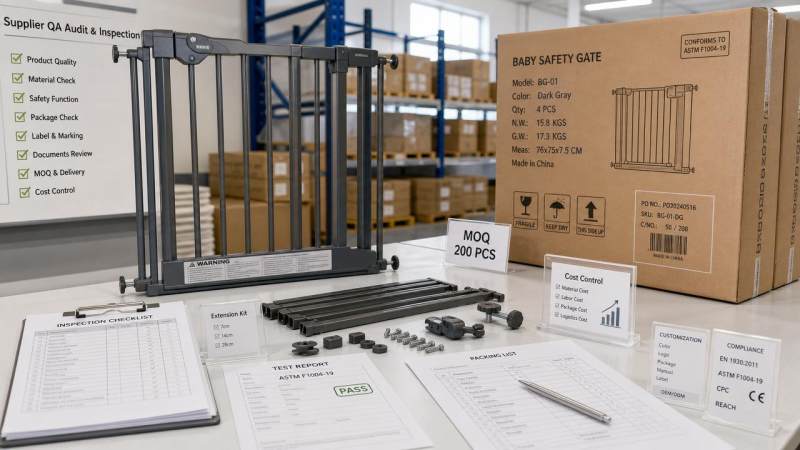
[Image 01: Baby safety gates wholesale cost breakdown, MOQ tiers, and compliance review points]
- Check frame material first. Steel usually improves durability and impact resistance, while lighter plastic-heavy designs may cut price but increase return risk in active household use.
- Review locking hardware carefully. Cheap latches, weak spring components, and poor hinge alignment often create the biggest quality complaints in baby safety gates wholesale programs.
- Compare finish specifications line by line. Powder coating, corrosion resistance, burr removal, and edge smoothing all affect both compliance outcomes and long-term customer satisfaction.
- Ask whether packaging includes corner protection, drop resistance, and barcode labeling. Better cartons cost more upfront but often lower breakage and relabeling expenses later.
- Separate ex-factory price from landed cost. Freight efficiency, carton dimensions, pallet loading, and duty classification can materially change the final economics.
- Clarify tooling and customization charges early. Width extensions, logo plates, and color changes may shift the real break-even point for each order size.
MOQ Is Not Just a Number
MOQ matters because it affects cash flow, inventory risk, and SKU strategy. In baby safety gates wholesale, a low MOQ sounds attractive, but it can hide weaker pricing, unstable raw material allocation, or limited production priority.
A more useful question is whether the MOQ fits the launch stage, regional demand pattern, and packaging mix. That is where negotiation becomes practical.
What to ask when MOQ feels too high
- Ask if the supplier can split one MOQ across colors or extension sizes. Shared components sometimes make flexible assortment planning possible without changing core production economics.
- Confirm whether plain-box orders can reduce the opening quantity. Standard packaging often helps factories support smaller pilot runs at lower setup complexity.
- Negotiate staged delivery instead of only lowering MOQ. This approach protects factory efficiency while reducing storage pressure and short-term inventory exposure.
- Request price breaks by volume band. Seeing the cost ladder makes it easier to judge whether a slightly larger order produces meaningful margin improvement.
- Check raw material reservation rules. Some factories accept smaller opening orders but require later call-offs to maintain agreed pricing for baby safety gates wholesale.
In fast-moving retail channels, a balanced MOQ can outperform the cheapest bulk deal. A slightly higher unit price may still be the better choice if it improves turnover and reduces aged stock.
Compliance Checks That Should Never Be Skipped
Safety claims are where many sourcing projects become risky. For baby safety gates wholesale, compliance should be verified with current, product-specific documents, not just a generic statement on a brochure.
Requirements vary by market, so the document pack must match the destination country, product type, and age-related safety expectations.
Core document and product checks
- Request the latest test reports from recognized labs. Verify model number, material references, photo match, issue date, and applicable safety standard before approval.
- Check warning labels and user instructions. Installation errors are common, so poor manuals can become both a liability issue and a customer service burden.
- Review small-parts, gap, pinch-point, and locking-force performance. These details matter more than broad marketing language when evaluating baby safety gates wholesale.
- Confirm coating and material restrictions where relevant. Chemical compliance, heavy metal limits, and surface safety should align with the destination market’s rules.
- Ask whether certification covers every accessory included in the carton. Extension kits and mounting hardware can create hidden compliance gaps if tested separately.
How to Read Supplier Reliability Beyond the Quotation
A polished quote does not tell the full story. In baby safety gates wholesale, reliability usually shows up in process consistency, document discipline, and responsiveness when technical questions become detailed.
This is where G-AIE-style benchmarking is useful. Looking at process maturity alongside product specs often reveals whether the supplier can support scale without quality drift.
- Ask for production photos or audit records tied to the exact model. Real manufacturing evidence is more useful than broad factory overview slides.
- Review sample consistency across two or three rounds. Variation in welds, coating texture, or latch feel can signal weak process control.
- Check response quality, not just speed. Clear answers on test scope, tolerances, and packaging usually indicate stronger operational discipline.
- Confirm spare parts and after-sales handling. Replacement hardware support can significantly reduce claim costs in long-running baby safety gates wholesale programs.
- Verify lead time stability during peak periods. A factory that ships well in low season may still struggle when material availability tightens.
Two Common Buying Situations
Launching a new SKU with uncertain demand
When demand visibility is limited, flexibility matters more than chasing the absolute lowest price. A moderate MOQ, standard finish, and simple packaging often create a safer opening position.
In this situation, it helps to prioritize current compliance files, repeatable sample quality, and carton efficiency. Those factors usually matter more than deep customization in the first order.
Expanding an established range into multiple markets
Here, document control becomes critical. One gate may require different labeling, manuals, or test references across markets, even when the hardware is almost identical.
It is also worth checking whether the same supplier can manage version control cleanly. Mixed labels or incorrect inserts can create avoidable customs, compliance, and retail problems.
Small Details That Often Get Missed
Many avoidable losses in baby safety gates wholesale come from details that seem minor during sampling but become expensive in volume.
- Measure installed width tolerance carefully. A gate that technically fits the spec may still cause field complaints if adjustment is awkward for end users.
- Inspect instruction clarity with a fresh user test. If setup feels confusing, return rates may rise even when the product itself is compliant.
- Check carton cube and pallet loading early. Freight inefficiency can quietly erase savings from a low ex-factory quote.
- Confirm metal tube thickness and actual net weight. Subtle downgrades sometimes happen when suppliers try to hold price during raw material volatility.
- Review barcode placement and master carton marking. Simple labeling errors can slow receiving and create unnecessary warehouse labor costs.
A Practical Way to Compare Offers
A clean comparison sheet should score more than price. For baby safety gates wholesale, a practical matrix usually includes unit cost, MOQ, test status, material spec, packaging, lead time, and claim support.
That approach makes negotiation easier because it shifts the discussion from vague promises to measurable trade-offs. It also helps internal approval move faster.
- Score each supplier on landed cost, not just FOB. This gives a more realistic margin view for final decision-making.
- Use pass or fail gates for compliance documents. Safety gaps should not be offset by lower pricing.
- Track sample findings in writing. Minor defects often become recurring production issues if they are not documented early.
- Build one negotiation round around facts only. Concrete observations usually produce better concessions than general pressure on price.
The most resilient baby safety gates wholesale decision is usually the one that protects compliance, preserves margin after logistics, and keeps future scaling realistic. If the next quote looks attractive, test it against those three points before moving forward.
Recommended News
 Sep 19, 2026When can a supply chain LLM reduce time spent finding shipment updates?Supply chain LLMs can cut shipment-update search time by connecting carrier events, ERP data, and documents—giving teams traceable answers and faster exception response.
 Sep 18, 2026How industrial monitoring equipment helps prevent unplanned downtimeIndustrial monitoring equipment helps teams detect early asset issues, prioritize maintenance, and prevent costly unplanned downtime. Explore practical strategies for reliable operations.
 Sep 17, 2026What next-gen harmonic drive research means for robot joint accuracyNext-gen harmonic drive research reveals how backlash, stiffness, thermal drift, and sensing shape robot joint accuracy. Explore smarter validation strategies.
 Sep 16, 2026How Southeast Asian climates affect cylinder seal frictionCylinder seal friction Southeast Asia: learn how humidity, heat, monsoons, and contamination affect motion stability, wear, and seal selection.
 Sep 15, 2026How to size DC gear motors for the required starting torqueGear motors DC sizing made practical: calculate starting torque, account for friction, gravity, inertia and voltage drop, then select a reliable motor with confidence.
 Sep 14, 2026How to verify high purity chemicals compliance before supplier approvalHigh purity chemicals compliance: learn how to verify supplier quality systems, CoAs, traceability, testing, and change control before approval.
 Sep 13, 2026What permits are needed to operate mapping drones in Europe?Mapping drones Europe: discover the permits, EASA categories, airspace approvals, site access, and GDPR checks needed for compliant aerial surveys.
 Sep 12, 2026What lead time should I expect for automatic transmission components? Planetary Gearboxes delivery forecasting for OEM planningWhat lead time should I expect for automatic transmission components? Get dynamic, AI-powered planetary gearbox delivery forecasting—designed for OEMs building next-gen hybrid & commercial powertrains.
 Sep 12, 2026Can polyamide replace metal in load-bearing components? Polymer Pulse structural performance data for 2026 applicationsCan polyamide replace metal in load-bearing components? Discover Polymer Pulse’s 2026 structural data—real-world performance, weight savings, and reliability breakthroughs.
 Sep 12, 2026How to handle a power electronics warranty claim: Harmonic Reducers documentation and escalation pathHow do I handle a power electronics warranty claim? Get a fast, intelligent, evidence-driven resolution for harmonic reducers—no bureaucracy, just precision diagnostics and real-time escalation.
 Sep 12, 2026Which motion control specifications matter most before purchase? Torque Logic selection criteria for automation engineersWhich motion control specifications are most important before purchase? Discover Torque Logic—the 4 non-negotiable, AI-aligned criteria that cut TCO by 27–41% and boost motion system availability to 99.992%.
 Sep 13, 2026Is agentic AI reliable enough for supplier screening? Supply Chain LLM validation framework for procurement teamsIs agentic AI reliable enough for supplier screening? Discover a rigorous LLM validation framework built for procurement teams—grounded in material traceability, regulatory compliance, and real-world operational constraints.
 Sep 14, 2026How to maintain edge AI systems after deployment: Predictive Maint AI operational protocols for field techniciansHow do I maintain edge AI systems after deployment? Discover predictive, physics-aware operational protocols designed for real-world field technicians—sustaining intelligence where silicon meets steel.
 Sep 15, 2026What compliance documents must a bioplastics supplier provide? Bio-Plastics regulatory checklist for procurementWhat compliance documents should a bioplastics supplier provide? Get our actionable regulatory checklist for food, medical & EU-bound applications.
 Sep 16, 2026How to prevent PET film defects during production: Barrier Films process control best practicesHow can I prevent PET film defects during production? Discover physics-driven barrier film process control—thermal precision, dynamic tension management & surface energy optimization.
 Sep 17, 2026Are thermoplastics suitable for long-term outdoor use? Engineering Resins durability assessment in 2026 UV/weather exposureAre thermoplastics suitable for long-term outdoor use? Discover 2026’s engineering resin durability insights — UV/weather resistance ranked, tested & actionable.
 Sep 18, 2026What to do when a servo motor fails during production: A Servo Actuators troubleshooting guide for maintenance teamsWhat should I do if a servo motor fails during production? Get a field-tested, AI-aware troubleshooting guide for maintenance teams—minimize downtime, maximize OEE.
 Sep 12, 2026How to compare wholesale party supplies by minimum order valueCompare wholesale party supplies by minimum order value, freight, SKU flexibility, and stock risk to choose suppliers that protect margins and simplify replenishment.
 Sep 11, 2026How proportional solenoid linearity affects precision motion controlProportional solenoid linearity directly affects precision motion control, valve metering, stability, and calibration. Learn how to evaluate performance for reliable automation.
 Sep 10, 2026When does supplier information platform automation reduce onboarding delays?Supplier information platform automation reduces onboarding delays by streamlining data collection, routing, renewals, and compliance checks—without replacing expert technical review.
 Sep 09, 2026How to size robotic motion systems for AMR payload changesRobotic motion systems for AMR payload changes: learn how to size motors, wheels, gearing, traction, and controls for safer, reliable performance.
 Sep 08, 2026How to perform a cylinder rod buckling calculation for long strokesCylinder rod buckling calculation made practical: learn how to assess effective length, end conditions, rod stiffness, load forces, and safety margins for reliable long-stroke cylinder design.
 Sep 07, 2026How to estimate the cost of industrial mechanical components before orderingIndustrial mechanical components cost: learn how to estimate material, machining, tooling, inspection, logistics, and hidden expenses before ordering. Compare quotes confidently and reduce sourcing risk.
 Sep 07, 2026What Is a Product Standards Database Used For?Product standards database guide: learn how to compare requirements, verify revisions, control specifications, and reduce compliance risks across design, sourcing, and production.