Search News
Industry Portal
Popular Tags
What drives high pressure hydraulic hose price differences?
Author
Time
Click Count
A quotation for a hydraulic hose assembly can look deceptively simple: bore size, length, end fittings, quantity, and unit price. Yet two offers that appear comparable on paper may carry very different risks, service lives, and replacement costs once they enter a high-pressure circuit. That is why high pressure hydraulic hose price differences cannot be explained by diameter and length alone.
For procurement teams, the real question is not “Which hose is cheapest?” It is “Which specification is genuinely equivalent, traceable, available when needed, and appropriate for the duty cycle?” A low initial purchase price can be attractive during a budget review, but a premature hose failure may bring unplanned downtime, fluid loss, safety exposure, cleanup costs, and difficult conversations with operations.
High-pressure hose sourcing therefore benefits from a benchmarking mindset. Buyers need to separate visible cost drivers from hidden ones, compare offers on a like-for-like basis, and recognize when a supplier is pricing a robust engineered product rather than a nominally similar commodity.
Why the same-looking hose can be priced so differently
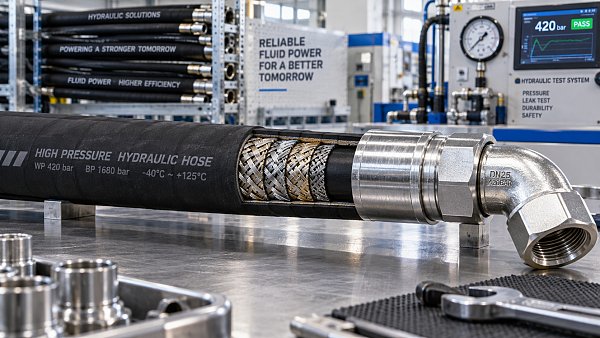
Hydraulic hoses are layered products. The outer cover may look similar across brands, but performance is determined by the interaction of the inner tube, reinforcement package, cover compound, manufacturing control, and compatibility with fittings. A hose that works reliably in a mobile machine operating outdoors may not be suitable for a steel mill, injection molding line, offshore deck, mining application, or automated production cell.
Price gaps often emerge because suppliers are not quoting the same construction. One may offer a conventional braided hose, while another proposes a spiral-reinforced option designed for higher pressure impulses. One may include an abrasion-resistant cover; another may use a standard synthetic rubber cover. Both descriptions may mention “high pressure,” but that phrase alone does not establish equivalence.
Before comparing unit prices, procurement should ask for the exact hose designation, applicable performance standard, working pressure by hose size, temperature range, reinforcement type, and recommended fitting series. These details turn a vague comparison into a technically meaningful one.
The cost structure behind a high pressure hydraulic hose price
1. Tube compound and fluid compatibility
The inner tube must resist the fluid being conveyed without swelling, hardening, cracking, or contaminating the system. Standard petroleum-based hydraulic oils are one requirement; biodegradable fluids, water-glycol media, phosphate ester fluids, compressed air, fuel, or chemical-adjacent applications may require different compounds or more careful validation.
Material formulations affect raw-material cost, processing conditions, and quality testing. A lower-priced hose may be perfectly acceptable for a conventional oil circuit, but it should not be substituted into a fluid environment outside its stated compatibility. Compatibility is not a detail to settle after the purchase order has been released.
2. Reinforcement architecture: braid versus spiral
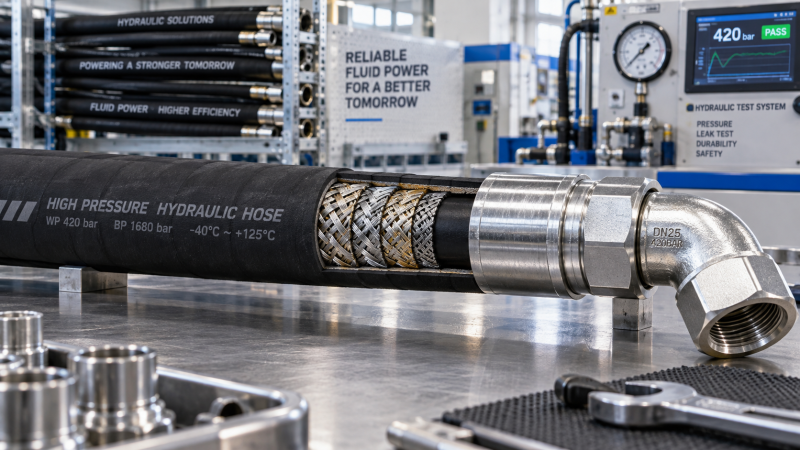
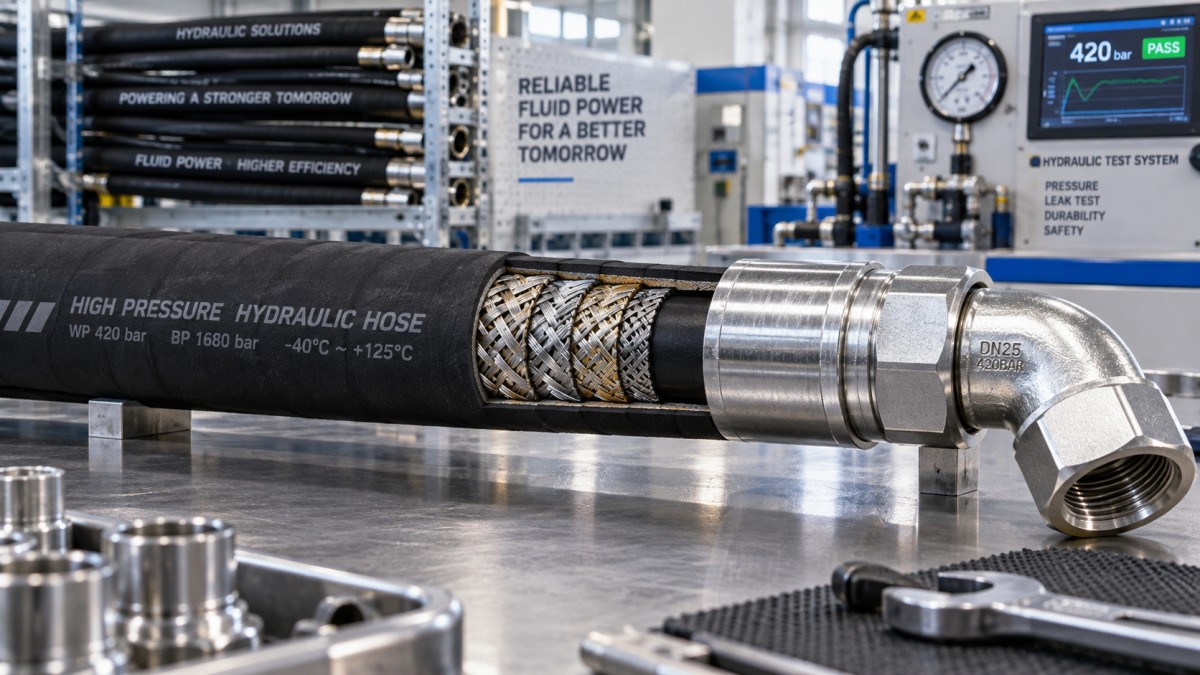
Reinforcement is among the most important reasons for price variation. Wire-braided hoses are widely used across medium- and high-pressure applications. Multiple layers of steel wire spiral reinforcement are typically used where pressure, impulse severity, hose size, or system dynamics demand greater strength and stability.
More reinforcement layers do not automatically mean “better” for every installation. They can add weight, affect flexibility, alter minimum bend radius, and increase cost. The right choice depends on actual working pressure, pressure spikes, routing constraints, motion, and pulse frequency. Buying a heavily reinforced hose for a modest duty may waste money; choosing an under-rated construction may create a much larger lifecycle expense.
3. Pressure rating is only the starting point
A published working pressure is essential, but it is not the entire operating story. Procurement comparisons should consider burst ratio, impulse performance, dynamic versus static service, bend radius under pressure, and whether the hose will be exposed to repeated flexing or vibration.
Pressure spikes are particularly easy to underestimate. A circuit with a nominal operating pressure may experience transient peaks during valve shifts, load changes, startup, or emergency stops. If the application data are incomplete, the buyer should involve the maintenance, engineering, or OEM team rather than selecting solely from a catalog pressure column.
A credible quotation should make it clear whether the stated rating applies to the requested size and construction. Pressure capability can vary significantly across bore sizes within the same hose family.
4. Cover design and environmental resistance
Hose covers protect the reinforcement from the environment. Abrasion, ozone, ultraviolet exposure, salt spray, welding spatter, cleaning agents, and contact with machine surfaces all influence cover selection. A standard cover may be economical indoors on protected equipment. In rough mobile equipment, marine conditions, or locations with persistent rubbing, a more durable cover can be worth the additional purchase cost.
Some buyers treat abrasion resistance as an optional feature because it is visible only after the hose is installed. In practice, cover damage can expose reinforcement and shorten service life long before the inner tube has reached its limit. Routing clamps, protective sleeves, and guarding are part of the answer, but they do not eliminate the value of selecting the appropriate cover compound.
Assembly quality can matter as much as hose cost
Many procurement requests are for complete hose assemblies, not bulk hose alone. In those cases, fittings, ferrules, crimp settings, cutting quality, cleanliness, and final inspection become major elements of the quoted price.
End connections may be common threaded types or specialized configurations with different sealing methods, materials, and dimensional requirements. Stainless steel, plated steel, carbon steel, and other material choices can substantially change cost, especially where corrosion resistance or fluid compatibility is critical. Angle fittings, flange connections, swivel designs, and custom orientations also require more than a simple per-meter calculation.
The hose and fitting must be approved as a matched system. Mixing components from different sources without validated crimp data can create uncertainty, even when individual parts appear dimensionally compatible. Procurement teams should be cautious when a quote is materially lower because it combines generic fittings with a hose brand or configuration for which system validation is unclear.
Assembly discipline also has practical value. Clean cutting methods reduce loose rubber and wire debris. Correct insertion depth and crimp diameter support joint integrity. Pressure testing, labeling, and inspection records add handling time, but they give maintenance teams confidence that an assembly was built to a repeatable process rather than assembled casually at the counter.
What “comparable” should mean in an RFQ review
When several suppliers respond to an RFQ, a simple price ranking is rarely enough. A practical comparison matrix should normalize the technical and commercial variables that shape total cost.
It is useful to ask suppliers to state exclusions explicitly. Does the price include caps or plugs to protect cleanliness? Are testing, certificates, tagging, or protective sleeves included? Is the quoted lead time based on stocked material or future production? These questions often explain why an apparently cheaper offer becomes less attractive once the final requirement is clarified.
Certification, traceability, and documentation are not paperwork extras
In regulated, safety-sensitive, or export-oriented environments, documentation can be a decisive cost driver. Depending on the application and region, a buyer may require conformity information, material declarations, lot traceability, pressure-test records, or evidence that a hose family is manufactured to a recognized standard. The exact requirement should be defined by the machine, customer contract, governing regulation, and engineering specification—not assumed from marketing language.
Documented manufacturing consistency generally requires investment in process control, inspection, trained personnel, and recordkeeping. That investment may be reflected in the high pressure hydraulic hose price, but it can reduce ambiguity when a field issue occurs. For a critical production line, the ability to identify the assembly, confirm its specification, and obtain a controlled replacement may have far more value than a small reduction in initial cost.
Buyers should distinguish between a certificate that applies to a product family and documentation that is relevant to the actual supplied assembly. Both can be useful, but they serve different purposes.
The overlooked variables: availability, standardization, and service response
A hose that is technically excellent but unavailable during a breakdown may not support operational resilience. This does not mean every plant should hold excessive inventory. It means stocking strategy should reflect criticality, consumption patterns, supplier lead times, and the consequences of downtime.
Standardizing on a manageable number of approved hose and fitting systems can lower procurement complexity over time. Maintenance personnel become familiar with routing and replacement practices, stores teams reduce SKU proliferation, and engineering avoids repeated requalification. Standardization should not force one hose family into every duty, but it can prevent a site from accumulating a patchwork of difficult-to-source assemblies.
Supplier capability also influences price and value. A distributor or manufacturer with local assembly capacity, technical support, documented crimp data, inventory visibility, and emergency response may quote more than a mail-order source. The premium is not always justified, particularly for planned, low-criticality purchases. For high-consequence assets, however, service capability deserves a place in the commercial evaluation.
Common buying mistakes that create false savings
Comparing price per meter when the requirement is an assembly. The fittings, crimping, testing, protection, and delivery conditions may represent a meaningful share of total cost.
Using outside diameter as a proxy for suitability. Similar dimensions do not prove equal pressure ratings, bend performance, impulse resistance, or fluid compatibility.
Ignoring routing conditions. A correct hose can still fail early if it is twisted, stretched, rubbed against a sharp edge, bent below its minimum radius, or installed without allowance for movement.
Replacing like-for-like without reviewing the failure. If an assembly failed unexpectedly, repeating the exact purchase may repeat the root cause. Investigate the failure location, abrasion pattern, fitting condition, heat exposure, and pressure history before reordering.
Over-specifying every line. Selecting the highest-rated hose for all applications raises capital and inventory costs, and may introduce avoidable routing difficulties. A tiered specification based on duty criticality is often more sensible.
A procurement method that supports lifecycle cost control
Start with the application, not with a generic hose description. Capture fluid type, normal and peak pressure, operating temperature, ambient conditions, hose movement, required length, connection standards, and expected service environment. If the information comes from an existing machine, confirm whether the original part number reflects the current duty and not merely a historical replacement choice.
Then issue an RFQ that asks suppliers to identify the offered hose series and assembly system rather than simply confirming compliance. Require deviations to be visible. This protects both sides: the supplier can price the correct construction, and the buyer can identify where alternatives involve a trade-off.
For strategic or high-volume requirements, benchmark total landed and lifecycle cost. Consider unit price, freight, inventory burden, predicted replacement frequency, failure consequence, documentation needs, and responsiveness. G-AIE’s technical benchmarking approach is built around this kind of comparison: connecting material performance and assembly consistency with the operational intelligence procurement teams need to make defensible sourcing decisions.
The best buying decision is rarely the highest-price option or the lowest-price option. It is the offer that matches the actual hydraulic duty, provides transparent technical evidence, and fits the organization’s risk tolerance and service model. When those elements are visible in the comparison, high pressure hydraulic hose price differences become easier to explain—and much easier to manage.
Recommended News
 Sep 27, 2026What drives high pressure hydraulic hose price differences?High pressure hydraulic hose price differences explained: compare materials, pressure ratings, assembly quality, traceability, and lifecycle value for smarter sourcing.
 Sep 26, 2026How to calculate hydraulic oil cooler sizing for peak heat loadHydraulic oil cooler sizing for peak heat load: calculate losses, duty cycles, temperature differences, flow, and pressure drop to select the right cooler.
 Sep 25, 2026How smart inspection technology for electronics reduces false defect callsSmart inspection technology for electronics reduces false defect calls with AI-assisted imaging, adaptive rules, and traceable quality decisions. Learn how to improve yield and trust.
 Sep 24, 2026How to qualify a protective coatings manufacturer for corrosion controlProtective coatings manufacturer qualification guide: assess corrosion performance, quality control, application support, compliance, and supply reliability for safer, longer-lasting assets.
 Sep 23, 2026Where machine vision delivers the most value in intelligent automationIntelligent automation applications with machine vision drive measurable value in quality, material handling, uptime, and traceability. Explore scalable strategies for resilient operations.
 Sep 26, 2026Choosing a low noise pump for a power unit when space is limitedLow noise pump for power unit selection made simple: compare noise paths, compact layouts, thermal limits, and service access for reliable performance.
 Sep 25, 2026What a low dBA hydraulic pump rating does and does not tell youLow dBA hydraulic pump ratings explained: compare test conditions, vibration paths, pressure ripple, and installation factors to make smarter, quieter system choices.
 Sep 24, 2026Hydraulic pump noise reduction starts with finding the dominant sourceHydraulic pump noise reduction starts with identifying the dominant source. Learn to diagnose cavitation, aeration, pulsation, and drive faults for reliable repairs.
 Sep 23, 2026When silent hydraulic pump wholesale pricing signals a quality riskSilent hydraulic pump wholesale pricing can reveal hidden quality risks. Learn how to compare specifications, testing, traceability, and support before sourcing.
 Sep 22, 2026How to assess a servo motors manufacturer’s quality control processServo motors manufacturer quality control guide: assess traceability, process capability, testing, calibration, and change control to reduce automation risk.
 Sep 21, 2026How bearing friction torque data affects servo actuator sizingBearing friction torque data is essential for accurate servo actuator sizing. Learn how preload, speed, temperature, and friction affect torque, thermal margin, and control stability.
 Sep 20, 2026How to use an electronics product reference to verify component compatibilityUse an electronics product reference to verify component compatibility with confidence. Compare electrical, pin, thermal, mechanical, firmware, and lifecycle requirements before approving replacements.
 Sep 19, 2026When can a supply chain LLM reduce time spent finding shipment updates?Supply chain LLMs can cut shipment-update search time by connecting carrier events, ERP data, and documents—giving teams traceable answers and faster exception response.
 Sep 18, 2026How industrial monitoring equipment helps prevent unplanned downtimeIndustrial monitoring equipment helps teams detect early asset issues, prioritize maintenance, and prevent costly unplanned downtime. Explore practical strategies for reliable operations.
 Sep 17, 2026What next-gen harmonic drive research means for robot joint accuracyNext-gen harmonic drive research reveals how backlash, stiffness, thermal drift, and sensing shape robot joint accuracy. Explore smarter validation strategies.
 Sep 16, 2026How Southeast Asian climates affect cylinder seal frictionCylinder seal friction Southeast Asia: learn how humidity, heat, monsoons, and contamination affect motion stability, wear, and seal selection.
 Sep 15, 2026How to size DC gear motors for the required starting torqueGear motors DC sizing made practical: calculate starting torque, account for friction, gravity, inertia and voltage drop, then select a reliable motor with confidence.
 Sep 14, 2026How to verify high purity chemicals compliance before supplier approvalHigh purity chemicals compliance: learn how to verify supplier quality systems, CoAs, traceability, testing, and change control before approval.
 Sep 13, 2026What permits are needed to operate mapping drones in Europe?Mapping drones Europe: discover the permits, EASA categories, airspace approvals, site access, and GDPR checks needed for compliant aerial surveys.
 Sep 12, 2026What lead time should I expect for automatic transmission components? Planetary Gearboxes delivery forecasting for OEM planningWhat lead time should I expect for automatic transmission components? Get dynamic, AI-powered planetary gearbox delivery forecasting—designed for OEMs building next-gen hybrid & commercial powertrains.
 Sep 12, 2026Can polyamide replace metal in load-bearing components? Polymer Pulse structural performance data for 2026 applicationsCan polyamide replace metal in load-bearing components? Discover Polymer Pulse’s 2026 structural data—real-world performance, weight savings, and reliability breakthroughs.
 Sep 12, 2026How to handle a power electronics warranty claim: Harmonic Reducers documentation and escalation pathHow do I handle a power electronics warranty claim? Get a fast, intelligent, evidence-driven resolution for harmonic reducers—no bureaucracy, just precision diagnostics and real-time escalation.
 Sep 12, 2026Which motion control specifications matter most before purchase? Torque Logic selection criteria for automation engineersWhich motion control specifications are most important before purchase? Discover Torque Logic—the 4 non-negotiable, AI-aligned criteria that cut TCO by 27–41% and boost motion system availability to 99.992%.
 Sep 13, 2026Is agentic AI reliable enough for supplier screening? Supply Chain LLM validation framework for procurement teamsIs agentic AI reliable enough for supplier screening? Discover a rigorous LLM validation framework built for procurement teams—grounded in material traceability, regulatory compliance, and real-world operational constraints.