Search News
Industry Portal
Popular Tags
IMO Approves Cargo Drones Shipboard Landing Standard
Author
Time
Click Count
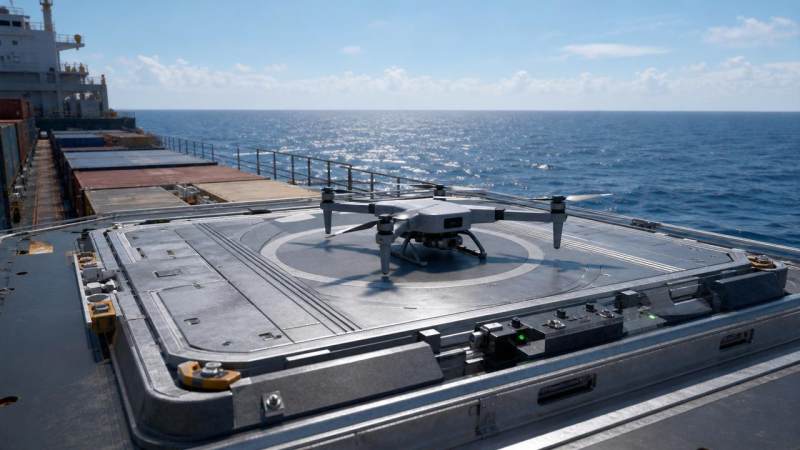
On 17 May 2026, the International Maritime Organization (IMO) formally adopted MSC.1/Circ.1682 — the first global safety guideline for integrated shipborne Cargo Drones landing systems — marking a pivotal regulatory milestone for maritime autonomy. The approval signals accelerated standardization across vessel design, equipment integration, and operational certification, with immediate implications for shipbuilders, drone logistics providers, and high-value marine transport segments.
Event Overview
On 17 May 2026, the IMO’s Maritime Safety Committee (MSC 108) approved MSC.1/Circ.1682, titled Guidelines for the Safety of Integrated Cargo Drones Landing Systems on Ships. The document establishes a three-tiered certification framework covering electromagnetic compatibility (EMC) on deck, emergency redundancy for autonomous landings, and sea-state adaptability (up to Sea State 5). Following the approval, major Chinese shipyards — including Hudong-Zhonghua and Jiangnan Shipbuilding — have implemented standardized mechanical, power, and data interface protocols. As a result, average delivery lead time for integrated Cargo Drones systems has shortened from 14 weeks to 8 weeks.

Impact on Key Industry Segments
Direct Trading Enterprises
Trading firms engaged in time-sensitive cargo — particularly LNG spot shipments, pharmaceuticals, or perishable marine supplies — face revised port call planning logic. With certified drone landing systems now deployable on newly built vessels, just-in-time resupply and documentation handover at anchorage (bypassing pilotage and berth congestion) become operationally viable. However, adoption requires alignment with port authorities’ UAV traffic management (UTM) frameworks — currently fragmented across jurisdictions.
Raw Material Procurement Enterprises
Suppliers of composite deck coatings, RF-shielded cabling, and ruggedized inertial navigation modules are experiencing demand shifts. The new EMC and sea-state requirements drive specification upgrades: e.g., corrosion-resistant antenna housings must now meet IEC 60945 Amendment 3, and power conditioning units require MIL-STD-1399 compliance. Procurement cycles for these components are tightening, but lead times remain unaligned with the 8-week system integration window — creating near-term supply bottlenecks.
Manufacturing Enterprises
Shipbuilders and offshore platform integrators benefit directly from modular, pre-certified interfaces. Yet, the compression of delivery timelines places pressure on internal QA/QC workflows: structural reinforcement verification for drone touchdown zones, thermal imaging validation of landing pad heat dissipation, and real-time telemetry integration testing must now occur within tighter milestones. Notably, this standard does not apply retroactively — retrofitting existing vessels remains subject to case-by-case flag state approval.
Supply Chain Service Providers
Classification societies and third-party certification bodies (e.g., DNV, LR, CCS) are updating their survey protocols to include drone system interoperability audits. Meanwhile, maritime insurers are drafting addenda to hull & machinery policies — explicitly defining liability boundaries between drone operator, vessel owner, and system integrator during automated landing sequences. These service layers are evolving faster than contractual templates, increasing negotiation complexity for multi-party charters.
Key Focus Areas and Recommended Actions
Verify Interface Compliance Against MSC.1/Circ.1682 Annexes
Procurement and engineering teams must cross-check all tender specifications against the three annexes of MSC.1/Circ.1682 — especially Annex 2 (EMC test matrix) and Annex 3 (sea-state simulation parameters). Non-compliant interfaces may trigger rework delays, even if physical mounting fits.
Assess Port Readiness Beyond Vessel Certification
A certified vessel does not guarantee operational readiness. Stakeholders should map local port UTM infrastructure, airspace restriction zones, and customs clearance protocols for unmanned air cargo — as these fall outside IMO’s remit and vary significantly by country.
Engage Classification Societies Early in Design Phase
Given that class approval now includes drone system integration review, initiating joint design reviews with classification societies at the concept stage — rather than post-detailed design — reduces iteration risk and avoids late-stage redesign of deck reinforcement or power distribution layouts.
Editorial Insight / Industry Observation
Analysis shows this standard is less about enabling drone flights per se, and more about institutionalizing *interoperability discipline* across traditionally siloed domains: naval architecture, avionics, and maritime regulation. Observably, the 6-week reduction in delivery cycle reflects not just technical maturity, but also procedural harmonization — suggesting future IMO guidance may prioritize process standardization over hardware prescriptions. From an industry perspective, the current pace of adoption will likely hinge less on technology readiness and more on commercial incentive structures: e.g., whether charter parties begin incorporating drone-enabled efficiency clauses (such as reduced demurrage for at-anchor deliveries).
Conclusion
This regulatory step formalizes a foundational layer for autonomous maritime logistics — not as a futuristic concept, but as a certifiable, insurable, and contractually enforceable capability. It does not eliminate operational risks, but shifts their locus: from technological uncertainty to governance coordination across ports, insurers, and regulators. A rational interpretation is that the standard lowers the barrier to entry for specialized vessel types (e.g., LNG carriers with drone-based crew transfer or polar research ships with remote sample retrieval), while raising the bar for systemic integration rigor.
Source Attribution
Official text: IMO MSC.1/Circ.1682 (adopted 17 May 2026); Public statements from China State Shipbuilding Corporation (CSSC), 20 May 2026; DNV Technical Bulletin No. TBT-2026-08 (preliminary implementation notes). Note: National maritime administrations’ implementing regulations — including those of the UK MCA, US Coast Guard, and China MSA — remain pending issuance and are under active monitoring.
Recommended News
 Sep 19, 2026When can a supply chain LLM reduce time spent finding shipment updates?Supply chain LLMs can cut shipment-update search time by connecting carrier events, ERP data, and documents—giving teams traceable answers and faster exception response.
 Sep 18, 2026How industrial monitoring equipment helps prevent unplanned downtimeIndustrial monitoring equipment helps teams detect early asset issues, prioritize maintenance, and prevent costly unplanned downtime. Explore practical strategies for reliable operations.
 Sep 17, 2026What next-gen harmonic drive research means for robot joint accuracyNext-gen harmonic drive research reveals how backlash, stiffness, thermal drift, and sensing shape robot joint accuracy. Explore smarter validation strategies.
 Sep 16, 2026How Southeast Asian climates affect cylinder seal frictionCylinder seal friction Southeast Asia: learn how humidity, heat, monsoons, and contamination affect motion stability, wear, and seal selection.
 Sep 15, 2026How to size DC gear motors for the required starting torqueGear motors DC sizing made practical: calculate starting torque, account for friction, gravity, inertia and voltage drop, then select a reliable motor with confidence.
 Sep 14, 2026How to verify high purity chemicals compliance before supplier approvalHigh purity chemicals compliance: learn how to verify supplier quality systems, CoAs, traceability, testing, and change control before approval.
 Sep 13, 2026What permits are needed to operate mapping drones in Europe?Mapping drones Europe: discover the permits, EASA categories, airspace approvals, site access, and GDPR checks needed for compliant aerial surveys.
 Sep 12, 2026What lead time should I expect for automatic transmission components? Planetary Gearboxes delivery forecasting for OEM planningWhat lead time should I expect for automatic transmission components? Get dynamic, AI-powered planetary gearbox delivery forecasting—designed for OEMs building next-gen hybrid & commercial powertrains.
 Sep 12, 2026Can polyamide replace metal in load-bearing components? Polymer Pulse structural performance data for 2026 applicationsCan polyamide replace metal in load-bearing components? Discover Polymer Pulse’s 2026 structural data—real-world performance, weight savings, and reliability breakthroughs.
 Sep 12, 2026How to handle a power electronics warranty claim: Harmonic Reducers documentation and escalation pathHow do I handle a power electronics warranty claim? Get a fast, intelligent, evidence-driven resolution for harmonic reducers—no bureaucracy, just precision diagnostics and real-time escalation.
 Sep 12, 2026Which motion control specifications matter most before purchase? Torque Logic selection criteria for automation engineersWhich motion control specifications are most important before purchase? Discover Torque Logic—the 4 non-negotiable, AI-aligned criteria that cut TCO by 27–41% and boost motion system availability to 99.992%.
 Sep 13, 2026Is agentic AI reliable enough for supplier screening? Supply Chain LLM validation framework for procurement teamsIs agentic AI reliable enough for supplier screening? Discover a rigorous LLM validation framework built for procurement teams—grounded in material traceability, regulatory compliance, and real-world operational constraints.
 Sep 14, 2026How to maintain edge AI systems after deployment: Predictive Maint AI operational protocols for field techniciansHow do I maintain edge AI systems after deployment? Discover predictive, physics-aware operational protocols designed for real-world field technicians—sustaining intelligence where silicon meets steel.
 Sep 15, 2026What compliance documents must a bioplastics supplier provide? Bio-Plastics regulatory checklist for procurementWhat compliance documents should a bioplastics supplier provide? Get our actionable regulatory checklist for food, medical & EU-bound applications.
 Sep 16, 2026How to prevent PET film defects during production: Barrier Films process control best practicesHow can I prevent PET film defects during production? Discover physics-driven barrier film process control—thermal precision, dynamic tension management & surface energy optimization.
 Sep 17, 2026Are thermoplastics suitable for long-term outdoor use? Engineering Resins durability assessment in 2026 UV/weather exposureAre thermoplastics suitable for long-term outdoor use? Discover 2026’s engineering resin durability insights — UV/weather resistance ranked, tested & actionable.
 Sep 18, 2026What to do when a servo motor fails during production: A Servo Actuators troubleshooting guide for maintenance teamsWhat should I do if a servo motor fails during production? Get a field-tested, AI-aware troubleshooting guide for maintenance teams—minimize downtime, maximize OEE.
 Sep 12, 2026How to compare wholesale party supplies by minimum order valueCompare wholesale party supplies by minimum order value, freight, SKU flexibility, and stock risk to choose suppliers that protect margins and simplify replenishment.
 Sep 11, 2026How proportional solenoid linearity affects precision motion controlProportional solenoid linearity directly affects precision motion control, valve metering, stability, and calibration. Learn how to evaluate performance for reliable automation.
 Sep 10, 2026When does supplier information platform automation reduce onboarding delays?Supplier information platform automation reduces onboarding delays by streamlining data collection, routing, renewals, and compliance checks—without replacing expert technical review.
 Sep 09, 2026How to size robotic motion systems for AMR payload changesRobotic motion systems for AMR payload changes: learn how to size motors, wheels, gearing, traction, and controls for safer, reliable performance.
 Sep 08, 2026How to perform a cylinder rod buckling calculation for long strokesCylinder rod buckling calculation made practical: learn how to assess effective length, end conditions, rod stiffness, load forces, and safety margins for reliable long-stroke cylinder design.
 Sep 07, 2026How to estimate the cost of industrial mechanical components before orderingIndustrial mechanical components cost: learn how to estimate material, machining, tooling, inspection, logistics, and hidden expenses before ordering. Compare quotes confidently and reduce sourcing risk.
 Sep 07, 2026What Is a Product Standards Database Used For?Product standards database guide: learn how to compare requirements, verify revisions, control specifications, and reduce compliance risks across design, sourcing, and production.