Search News
Industry Portal
Popular Tags
Hydraulic Fitting Torque Specifications: Common Tightening Mistakes
Author
Time
Click Count
Incorrect tightening remains one of the most overlooked causes of hydraulic failure across industrial equipment, mobile machinery, process systems, and automated production lines.
When hydraulic fitting torque specifications are ignored, connections may seem secure at installation yet fail under pressure, vibration, temperature cycling, or maintenance reuse.
Leaks, cracked adapters, distorted seats, damaged threads, and unplanned downtime often begin with a simple tightening mistake.
Understanding hydraulic fitting torque specifications helps create repeatable assembly quality, longer component life, and safer hydraulic system performance.
This article reviews the most common errors, explains why they happen, and outlines practical torque control methods for more reliable maintenance outcomes.
Hydraulic fitting torque specifications and what they actually control
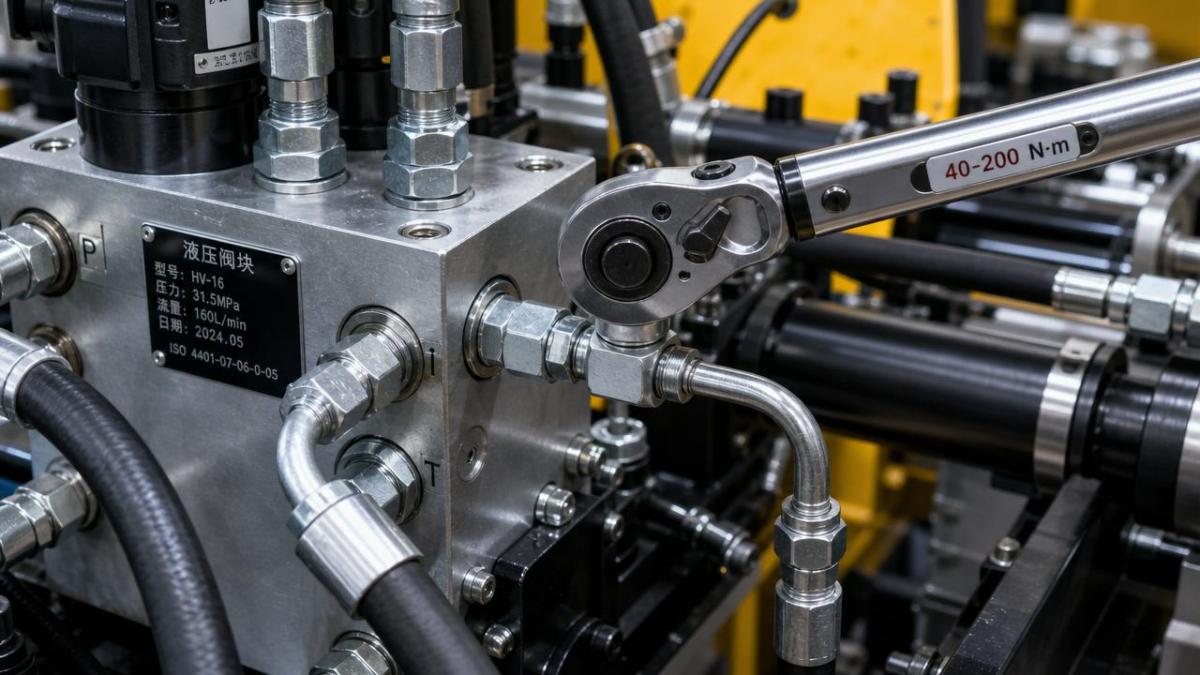
Hydraulic fitting torque specifications define the tightening force needed to create a proper seal without overstressing the fitting, port, tube, hose end, or mating surface.
They do not exist to make every connection “as tight as possible.” They exist to balance sealing, retention, and material protection.
Different fitting styles seal in different ways. JIC, ORFS, NPT, BSPP, DIN, flange, and compression fittings require distinct assembly logic.
As a result, hydraulic fitting torque specifications vary by thread size, fitting design, material, lubrication condition, and sometimes manufacturer-specific geometry.
Using a generic torque value across all connections is one of the fastest ways to create hidden reliability problems.
Key variables that influence torque
- Thread form and sealing method
- Fitting size and wall thickness
- Carbon steel, stainless steel, brass, or mixed metals
- Dry threads versus lubricated threads
- Straight thread versus tapered thread
- New assembly versus reassembly after service
Why tightening errors remain common in industrial environments
Hydraulic systems often operate in time-sensitive environments where repairs must be completed quickly and equipment returned to service without delay.
That pressure encourages shortcut behavior, especially when teams rely on feel, memory, or tool habit instead of current hydraulic fitting torque specifications.
Another issue is part substitution. Similar-looking fittings can require different torque ranges because their sealing surfaces differ.
Digital maintenance systems improve traceability, but assembly quality still depends on physical execution at the connection point.
Current operational signals worth monitoring
The most common tightening mistakes
The most frequent mistakes are simple, but their consequences can be severe. Good hydraulic fitting torque specifications only work when assembly conditions are also correct.
1. Over-tightening beyond the specified range
This is the most common error. Extra force may crush sealing surfaces, stretch threads, crack flare seats, or deform O-rings.
The connection may initially stop leaking, then fail early during pressure cycling.
2. Under-tightening because of caution or poor access
Installers sometimes stop too early, especially in cramped spaces. The result is inadequate seal compression and gradual leakage under normal operating pressure.
3. Using torque values for the wrong fitting style
A JIC fitting is not tightened like ORFS. A tapered thread is not tightened like a straight thread with an elastomeric seal.
Confusing these categories makes hydraulic fitting torque specifications meaningless.
4. Ignoring lubrication condition
Torque values are strongly affected by friction. Dry threads and lubricated threads generate different clamping results at the same wrench reading.
5. Applying sealant where it should not be used
Some connections seal on metal seats or O-rings, not on the threads. Extra sealant can alter friction, contaminate the system, or mask assembly defects.
6. Reusing damaged or deformed parts
No torque value can correct a scratched seat, flattened flare, cut O-ring, or galled thread. Reassembly with damaged parts invites repeat failure.
Operational value of correct torque practice
Correct hydraulic fitting torque specifications support more than leak prevention. They improve asset reliability across production, transport, energy, agriculture, and construction operations.
Better torque control reduces fluid loss, unplanned shutdowns, fire risk near hot surfaces, and unnecessary component replacement.
It also improves condition monitoring because chronic seepage no longer hides new faults elsewhere in the circuit.
From a lifecycle perspective, proper tightening lowers total service cost and supports more stable maintenance planning.
Where precise torque matters most
- High-pressure hose assemblies
- Pump, valve, and manifold ports
- Cylinders exposed to shock loading
- Automated lines with vibration and repetitive cycles
- Mobile equipment exposed to dirt, movement, and temperature swings
Typical fitting categories and tightening focus
Practical guidance for applying hydraulic fitting torque specifications
A controlled process is more effective than relying on individual judgment. The following steps improve consistency across most hydraulic service tasks.
- Identify the exact fitting standard, size, and material before tightening.
- Use the manufacturer or approved engineering reference for hydraulic fitting torque specifications.
- Inspect threads, seats, O-rings, and mating surfaces for wear, burrs, cracks, or contamination.
- Confirm whether the torque value assumes dry or lubricated conditions.
- Use a calibrated torque wrench when the connection design and access allow it.
- For multi-bolt joints, tighten in stages and follow a balanced sequence.
- Pressure test after assembly and inspect again after initial operating cycles.
Important caution points
- Do not chase leaks by simply adding more torque.
- Do not mix fittings that appear compatible but use different sealing principles.
- Do not overlook hose twist, side load, or poor routing that stresses the connection.
- Do not assume reused fittings still match original hydraulic fitting torque specifications.
A consistent next step for better hydraulic reliability
Improving tightening quality starts with standardizing how hydraulic fitting torque specifications are selected, documented, and verified during installation and maintenance.
Begin by reviewing the most failure-prone connections, matching each location to the correct fitting standard, and updating torque references where assumptions exist.
Then align inspection checklists, tool calibration routines, and post-assembly leak testing with those documented values.
When hydraulic fitting torque specifications become part of a disciplined maintenance process, systems operate more safely, failures become less frequent, and equipment uptime becomes easier to sustain.
Recommended News
 Sep 19, 2026When can a supply chain LLM reduce time spent finding shipment updates?Supply chain LLMs can cut shipment-update search time by connecting carrier events, ERP data, and documents—giving teams traceable answers and faster exception response.
 Sep 18, 2026How industrial monitoring equipment helps prevent unplanned downtimeIndustrial monitoring equipment helps teams detect early asset issues, prioritize maintenance, and prevent costly unplanned downtime. Explore practical strategies for reliable operations.
 Sep 17, 2026What next-gen harmonic drive research means for robot joint accuracyNext-gen harmonic drive research reveals how backlash, stiffness, thermal drift, and sensing shape robot joint accuracy. Explore smarter validation strategies.
 Sep 16, 2026How Southeast Asian climates affect cylinder seal frictionCylinder seal friction Southeast Asia: learn how humidity, heat, monsoons, and contamination affect motion stability, wear, and seal selection.
 Sep 15, 2026How to size DC gear motors for the required starting torqueGear motors DC sizing made practical: calculate starting torque, account for friction, gravity, inertia and voltage drop, then select a reliable motor with confidence.
 Sep 14, 2026How to verify high purity chemicals compliance before supplier approvalHigh purity chemicals compliance: learn how to verify supplier quality systems, CoAs, traceability, testing, and change control before approval.
 Sep 13, 2026What permits are needed to operate mapping drones in Europe?Mapping drones Europe: discover the permits, EASA categories, airspace approvals, site access, and GDPR checks needed for compliant aerial surveys.
 Sep 12, 2026What lead time should I expect for automatic transmission components? Planetary Gearboxes delivery forecasting for OEM planningWhat lead time should I expect for automatic transmission components? Get dynamic, AI-powered planetary gearbox delivery forecasting—designed for OEMs building next-gen hybrid & commercial powertrains.
 Sep 12, 2026Can polyamide replace metal in load-bearing components? Polymer Pulse structural performance data for 2026 applicationsCan polyamide replace metal in load-bearing components? Discover Polymer Pulse’s 2026 structural data—real-world performance, weight savings, and reliability breakthroughs.
 Sep 12, 2026How to handle a power electronics warranty claim: Harmonic Reducers documentation and escalation pathHow do I handle a power electronics warranty claim? Get a fast, intelligent, evidence-driven resolution for harmonic reducers—no bureaucracy, just precision diagnostics and real-time escalation.
 Sep 12, 2026Which motion control specifications matter most before purchase? Torque Logic selection criteria for automation engineersWhich motion control specifications are most important before purchase? Discover Torque Logic—the 4 non-negotiable, AI-aligned criteria that cut TCO by 27–41% and boost motion system availability to 99.992%.
 Sep 13, 2026Is agentic AI reliable enough for supplier screening? Supply Chain LLM validation framework for procurement teamsIs agentic AI reliable enough for supplier screening? Discover a rigorous LLM validation framework built for procurement teams—grounded in material traceability, regulatory compliance, and real-world operational constraints.
 Sep 14, 2026How to maintain edge AI systems after deployment: Predictive Maint AI operational protocols for field techniciansHow do I maintain edge AI systems after deployment? Discover predictive, physics-aware operational protocols designed for real-world field technicians—sustaining intelligence where silicon meets steel.
 Sep 15, 2026What compliance documents must a bioplastics supplier provide? Bio-Plastics regulatory checklist for procurementWhat compliance documents should a bioplastics supplier provide? Get our actionable regulatory checklist for food, medical & EU-bound applications.
 Sep 16, 2026How to prevent PET film defects during production: Barrier Films process control best practicesHow can I prevent PET film defects during production? Discover physics-driven barrier film process control—thermal precision, dynamic tension management & surface energy optimization.
 Sep 17, 2026Are thermoplastics suitable for long-term outdoor use? Engineering Resins durability assessment in 2026 UV/weather exposureAre thermoplastics suitable for long-term outdoor use? Discover 2026’s engineering resin durability insights — UV/weather resistance ranked, tested & actionable.
 Sep 18, 2026What to do when a servo motor fails during production: A Servo Actuators troubleshooting guide for maintenance teamsWhat should I do if a servo motor fails during production? Get a field-tested, AI-aware troubleshooting guide for maintenance teams—minimize downtime, maximize OEE.
 Sep 12, 2026How to compare wholesale party supplies by minimum order valueCompare wholesale party supplies by minimum order value, freight, SKU flexibility, and stock risk to choose suppliers that protect margins and simplify replenishment.
 Sep 11, 2026How proportional solenoid linearity affects precision motion controlProportional solenoid linearity directly affects precision motion control, valve metering, stability, and calibration. Learn how to evaluate performance for reliable automation.
 Sep 10, 2026When does supplier information platform automation reduce onboarding delays?Supplier information platform automation reduces onboarding delays by streamlining data collection, routing, renewals, and compliance checks—without replacing expert technical review.
 Sep 09, 2026How to size robotic motion systems for AMR payload changesRobotic motion systems for AMR payload changes: learn how to size motors, wheels, gearing, traction, and controls for safer, reliable performance.
 Sep 08, 2026How to perform a cylinder rod buckling calculation for long strokesCylinder rod buckling calculation made practical: learn how to assess effective length, end conditions, rod stiffness, load forces, and safety margins for reliable long-stroke cylinder design.
 Sep 07, 2026How to estimate the cost of industrial mechanical components before orderingIndustrial mechanical components cost: learn how to estimate material, machining, tooling, inspection, logistics, and hidden expenses before ordering. Compare quotes confidently and reduce sourcing risk.
 Sep 07, 2026What Is a Product Standards Database Used For?Product standards database guide: learn how to compare requirements, verify revisions, control specifications, and reduce compliance risks across design, sourcing, and production.