Search News
Industry Portal
Popular Tags
Toy Industry Trends 2026: What Will Shape Demand Next
Author
Time
Click Count
The toy industry is entering 2026 with a different demand logic
The toy industry is no longer shaped by novelty alone.
Demand heading into 2026 reflects a wider reset in consumer priorities, retail economics, and industrial capability.
What stands out is not one dramatic disruption.
It is the way several forces now reinforce each other across design, sourcing, production, and inventory planning.
From recent market shifts, the clearest signal is that toy demand is becoming more selective.
Consumers still respond to emotion and entertainment, but they are also screening for safety, sustainability, learning value, and brand trust.
At the same time, the toy industry faces tighter cost pressure and faster demand swings.
That combination changes how growth should be read.
For organizations tracking industrial signals through platforms such as G-AIE, the toy industry offers a useful view of a broader pattern.
Material science, intelligent automation, and data-led planning are no longer back-end improvements.
They are becoming demand-shaping variables in their own right.
Why the toy industry is seeing sharper shifts in demand
One reason is demographic fragmentation.
The toy industry now serves multiple micro-markets with very different expectations.
Parents may prioritize development and durability.
Teen and collector segments often value licensing, scarcity, and design identity.
Educational channels look for learning outcomes, compliance confidence, and long product life.
Another driver is the normalization of digital comparison.
Customers can now evaluate toy features, reviews, unboxing quality, and material claims almost instantly.
This shortens the distance between product promise and market judgment.
It also means weak differentiation is exposed faster.
A third factor is operational.
The toy industry has become more sensitive to disruptions in resin supply, packaging inputs, freight timing, and regulatory testing cycles.
In practice, this pushes demand planning closer to engineering and sourcing decisions.
Taken together, these shifts show why the toy industry in 2026 will reward responsiveness more than scale alone.
Smarter products matter, but smarter production may matter more
There is growing interest in connected play, STEM formats, and hybrid physical-digital experiences.
Yet the bigger structural change may sit behind the product itself.
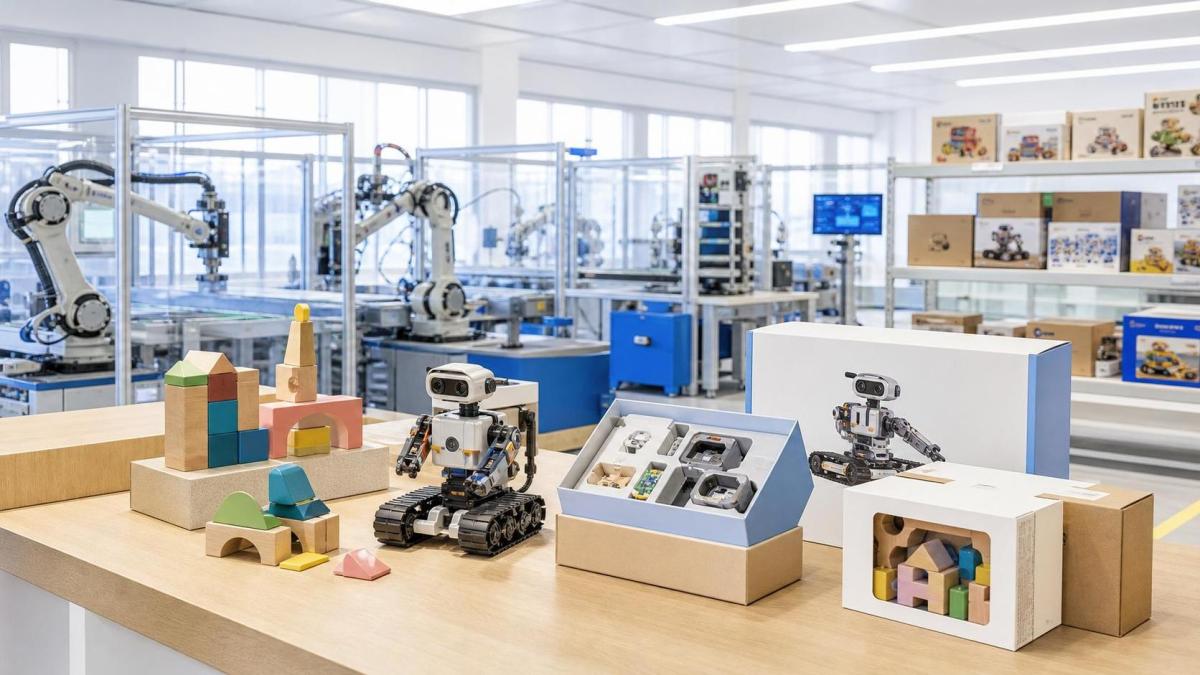
The toy industry is moving toward manufacturing systems that can support smaller runs, faster iteration, and more precise quality control.
This is where intelligent automation becomes strategically relevant.
A flexible production line can absorb licensed surges, regional packaging differences, and compliance variation more effectively than a rigid high-volume model.
That capability influences what products can be launched profitably.
It also affects how quickly the toy industry can react when demand moves unexpectedly.
More advanced operators are also using data to benchmark defect patterns, mold performance, assembly consistency, and packaging efficiency.
This resembles the wider industrial shift tracked by G-AIE.
Physical products increasingly compete through digital intelligence layered onto operational assets.
In the toy industry, that can reduce lead-time volatility and preserve margin in a price-sensitive environment.
Where this shift becomes visible
- Prototype cycles are shortening because trend windows are less predictable.
- Batch planning is becoming more dynamic across channels and regions.
- Quality systems are moving earlier into the design and tooling phase.
- Automation investments are judged by agility, not only labor savings.
Sustainable materials are shifting from brand story to demand filter
Sustainability in the toy industry is becoming less symbolic and more practical.
Buyers increasingly notice packaging waste, material feel, repairability, and the credibility of environmental claims.
Regulatory pressure adds another layer.
Testing requirements, recycled content questions, and chemical safety standards can reshape product economics before a launch even begins.
For the toy industry, this creates a delicate balance.
Lower-impact materials must still support color quality, durability, tactile appeal, and child safety.
That is why material innovation matters more than marketing language.
The “Economy of Atoms” perspective is useful here.
When material inputs become part of competitive positioning, supply chains need proof, consistency, and measurable trade-offs.
In the toy industry, sustainable substitution is rarely a one-step swap.
It often changes tooling behavior, finish quality, packaging design, and return rates.
That is why 2026 demand may favor brands that connect material choices with performance, not just claims.
Demand signals are moving closer to real time
One of the most important changes in the toy industry is the speed of feedback.
Retail data, search behavior, social content, and post-purchase reviews now shape market perception within days.
This compresses the time available to respond.
It also makes historical demand curves less reliable on their own.
More noticeably, the toy industry is dealing with sharper divergence between viral interest and repeat demand.
A product can surge online without sustaining reorder strength.
That makes signal quality more important than signal volume.
Decision frameworks built around Vertical AI are increasingly useful in this environment.
Not because algorithms replace judgment, but because they improve pattern recognition across fragmented channels.
The toy industry can benefit when market sensing, production planning, and replenishment logic are connected rather than isolated.
What deserves closer monitoring through 2026
- Whether educational and developmental claims convert into sustained premium pricing.
- How licensed toys perform after the initial media cycle fades.
- Which material innovations hold quality consistency at scale.
- How regional compliance changes affect launch timing and assortment depth.
The impact will not stay in one part of the toy industry
These trends do not operate in isolation.
They change decision-making across the full toy industry value chain.
Product portfolios may narrow around stronger concepts, while adjacent variants expand through packaging, age grading, or digital extensions.
Sourcing strategies may shift toward partners with better traceability and process stability.
Inventory strategy may become more layered, with core volume protected and trend-sensitive items handled with greater caution.
The toy industry will likely see competitive advantage accrue to businesses that connect commercial planning with industrial execution.
That connection is often overlooked.
Yet in volatile categories, resilient demand capture depends on it.
What a stronger 2026 response looks like
The immediate priority is not to chase every signal.
It is to build a clearer view of which signals are structurally changing the toy industry.
A practical response starts with three areas.
- Reassess demand assumptions using shorter planning cycles and more granular channel data.
- Review material and packaging choices against both performance and credibility risk.
- Benchmark production flexibility, not just unit cost, before expanding a product line.
Beyond that, it makes sense to compare market opportunity with operational readiness.
Some toy industry segments will show attractive demand on the surface but remain difficult to serve profitably.
Others may look mature, yet gain momentum because they fit new safety, education, and sustainability expectations better.
Looking ahead, the toy industry in 2026 will not be defined by a single blockbuster format.
It will be shaped by how well organizations read converging signals and respond with disciplined speed.
The next useful step is to map where demand has changed, where production assumptions still lag, and where evidence supports a staged response.
That is where stronger positioning usually begins.
Recommended News
 Sep 19, 2026When can a supply chain LLM reduce time spent finding shipment updates?Supply chain LLMs can cut shipment-update search time by connecting carrier events, ERP data, and documents—giving teams traceable answers and faster exception response.
 Sep 18, 2026How industrial monitoring equipment helps prevent unplanned downtimeIndustrial monitoring equipment helps teams detect early asset issues, prioritize maintenance, and prevent costly unplanned downtime. Explore practical strategies for reliable operations.
 Sep 17, 2026What next-gen harmonic drive research means for robot joint accuracyNext-gen harmonic drive research reveals how backlash, stiffness, thermal drift, and sensing shape robot joint accuracy. Explore smarter validation strategies.
 Sep 16, 2026How Southeast Asian climates affect cylinder seal frictionCylinder seal friction Southeast Asia: learn how humidity, heat, monsoons, and contamination affect motion stability, wear, and seal selection.
 Sep 15, 2026How to size DC gear motors for the required starting torqueGear motors DC sizing made practical: calculate starting torque, account for friction, gravity, inertia and voltage drop, then select a reliable motor with confidence.
 Sep 14, 2026How to verify high purity chemicals compliance before supplier approvalHigh purity chemicals compliance: learn how to verify supplier quality systems, CoAs, traceability, testing, and change control before approval.
 Sep 13, 2026What permits are needed to operate mapping drones in Europe?Mapping drones Europe: discover the permits, EASA categories, airspace approvals, site access, and GDPR checks needed for compliant aerial surveys.
 Sep 12, 2026What lead time should I expect for automatic transmission components? Planetary Gearboxes delivery forecasting for OEM planningWhat lead time should I expect for automatic transmission components? Get dynamic, AI-powered planetary gearbox delivery forecasting—designed for OEMs building next-gen hybrid & commercial powertrains.
 Sep 12, 2026Can polyamide replace metal in load-bearing components? Polymer Pulse structural performance data for 2026 applicationsCan polyamide replace metal in load-bearing components? Discover Polymer Pulse’s 2026 structural data—real-world performance, weight savings, and reliability breakthroughs.
 Sep 12, 2026How to handle a power electronics warranty claim: Harmonic Reducers documentation and escalation pathHow do I handle a power electronics warranty claim? Get a fast, intelligent, evidence-driven resolution for harmonic reducers—no bureaucracy, just precision diagnostics and real-time escalation.
 Sep 12, 2026Which motion control specifications matter most before purchase? Torque Logic selection criteria for automation engineersWhich motion control specifications are most important before purchase? Discover Torque Logic—the 4 non-negotiable, AI-aligned criteria that cut TCO by 27–41% and boost motion system availability to 99.992%.
 Sep 13, 2026Is agentic AI reliable enough for supplier screening? Supply Chain LLM validation framework for procurement teamsIs agentic AI reliable enough for supplier screening? Discover a rigorous LLM validation framework built for procurement teams—grounded in material traceability, regulatory compliance, and real-world operational constraints.
 Sep 14, 2026How to maintain edge AI systems after deployment: Predictive Maint AI operational protocols for field techniciansHow do I maintain edge AI systems after deployment? Discover predictive, physics-aware operational protocols designed for real-world field technicians—sustaining intelligence where silicon meets steel.
 Sep 15, 2026What compliance documents must a bioplastics supplier provide? Bio-Plastics regulatory checklist for procurementWhat compliance documents should a bioplastics supplier provide? Get our actionable regulatory checklist for food, medical & EU-bound applications.
 Sep 16, 2026How to prevent PET film defects during production: Barrier Films process control best practicesHow can I prevent PET film defects during production? Discover physics-driven barrier film process control—thermal precision, dynamic tension management & surface energy optimization.
 Sep 17, 2026Are thermoplastics suitable for long-term outdoor use? Engineering Resins durability assessment in 2026 UV/weather exposureAre thermoplastics suitable for long-term outdoor use? Discover 2026’s engineering resin durability insights — UV/weather resistance ranked, tested & actionable.
 Sep 18, 2026What to do when a servo motor fails during production: A Servo Actuators troubleshooting guide for maintenance teamsWhat should I do if a servo motor fails during production? Get a field-tested, AI-aware troubleshooting guide for maintenance teams—minimize downtime, maximize OEE.
 Sep 12, 2026How to compare wholesale party supplies by minimum order valueCompare wholesale party supplies by minimum order value, freight, SKU flexibility, and stock risk to choose suppliers that protect margins and simplify replenishment.
 Sep 11, 2026How proportional solenoid linearity affects precision motion controlProportional solenoid linearity directly affects precision motion control, valve metering, stability, and calibration. Learn how to evaluate performance for reliable automation.
 Sep 10, 2026When does supplier information platform automation reduce onboarding delays?Supplier information platform automation reduces onboarding delays by streamlining data collection, routing, renewals, and compliance checks—without replacing expert technical review.
 Sep 09, 2026How to size robotic motion systems for AMR payload changesRobotic motion systems for AMR payload changes: learn how to size motors, wheels, gearing, traction, and controls for safer, reliable performance.
 Sep 08, 2026How to perform a cylinder rod buckling calculation for long strokesCylinder rod buckling calculation made practical: learn how to assess effective length, end conditions, rod stiffness, load forces, and safety margins for reliable long-stroke cylinder design.
 Sep 07, 2026How to estimate the cost of industrial mechanical components before orderingIndustrial mechanical components cost: learn how to estimate material, machining, tooling, inspection, logistics, and hidden expenses before ordering. Compare quotes confidently and reduce sourcing risk.
 Sep 07, 2026What Is a Product Standards Database Used For?Product standards database guide: learn how to compare requirements, verify revisions, control specifications, and reduce compliance risks across design, sourcing, and production.