Search News
Industry Portal
Popular Tags
Telescopic Cylinder Manufacturer Selection Mistakes That Delay Field Projects
Author
Time
Click Count
Choosing the wrong telescopic cylinder manufacturer can quietly derail field projects through extended lead times, specification mismatches, weak technical support, and costly installation setbacks. For project managers and engineering leads, avoiding these selection mistakes is critical to keeping schedules, budgets, and equipment performance on track. This article outlines the most common manufacturer-related pitfalls and how to evaluate suppliers with greater confidence.
In heavy equipment programs, mobile hydraulic systems, lifting platforms, utility vehicles, waste handling units, and specialized industrial machinery, the telescopic cylinder is rarely treated as a commodity once installation begins. A sourcing decision that looked acceptable during quotation review can create 2 to 8 weeks of delay when rework, port incompatibility, stroke errors, or seal failures appear on site.
For procurement teams and field leaders working across a global industrial ecosystem, the challenge is not simply finding a supplier with production capacity. The real task is selecting a telescopic cylinder manufacturer that can align engineering, documentation, delivery discipline, and after-sales support with project execution realities. That is where many projects lose time and budget.
Why Manufacturer Selection Errors Create Field Delays
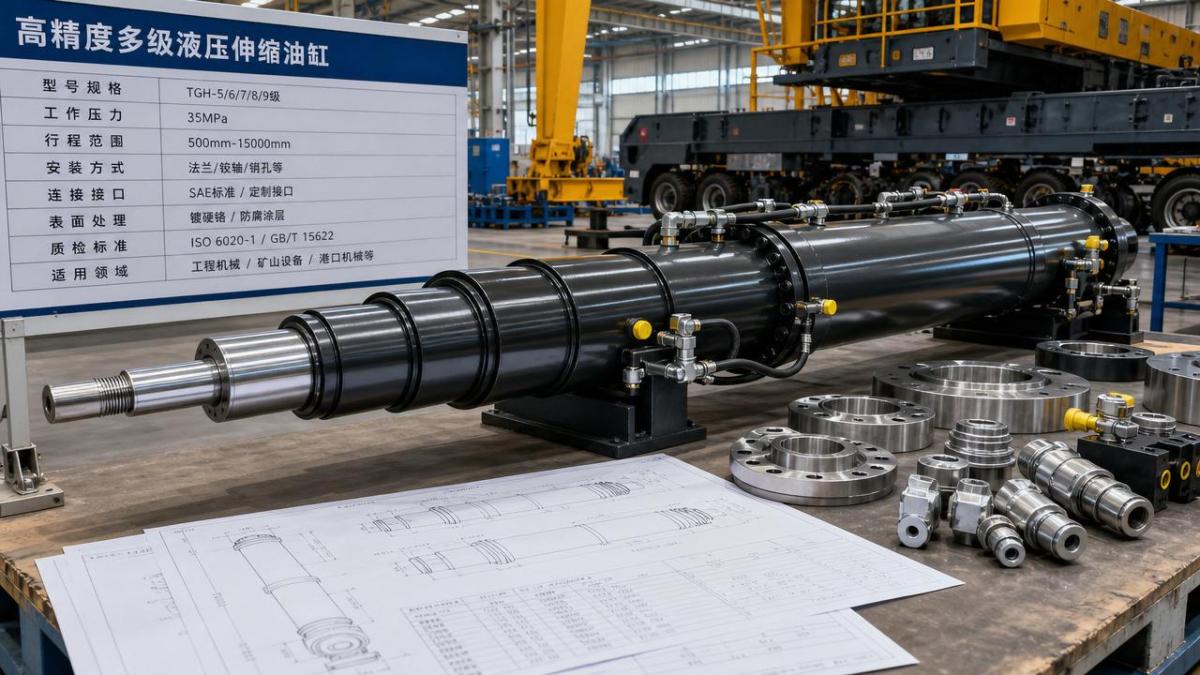
A field project usually runs on tightly linked milestones: design freeze, fabrication, shipment, installation, commissioning, and operational handover. If one hydraulic component arrives late or does not match the approved drawing, crews may stand idle for 3 to 10 days, subcontractor windows may be missed, and adjacent systems can no longer be tested in sequence.
This is why choosing a telescopic cylinder manufacturer should be treated as a project risk decision, not only a purchasing transaction. The wrong supplier often fails in four areas at once: technical validation, manufacturing consistency, documentation control, and response speed during installation.
The Hidden Cost of “Close Enough” Specifications
A cylinder that is off by even 10 to 20 mm in closed length, mounting center, or port orientation may still look usable in a factory acceptance review. In the field, however, that deviation can interfere with frame geometry, hose routing, dump angle, or clearance during full extension. The result is often bracket modification, hose replacement, or removal and reshipment.
Project managers should pay special attention to stroke length, retracted length, stage count, pressure rating, pin dimensions, port thread type, seal material, and mounting method. Missing just 1 of these 8 items can trigger a cascading delay, especially when equipment is already assembled and crane time has been booked.
Common Delay Patterns Seen in Supplier Selection
The table below outlines recurring manufacturer-related mistakes and the type of project disruption they typically create.
The pattern is clear: the largest delays rarely come from one dramatic failure. They come from small omissions during supplier evaluation. A capable telescopic cylinder manufacturer reduces those omissions by asking application questions early, documenting assumptions, and confirming details before production starts.
Where Project Teams Often Underestimate Risk
1. Lead Time Assumptions
Standard lead time for common cylinders may be 2 to 4 weeks, but custom telescopic designs with special mounts, coatings, or seal packages can extend to 6 to 10 weeks. If machining, tube sourcing, and export packaging are not clearly broken down, the quoted date may not reflect real production constraints.
2. Incomplete Hydraulic Context
Many buyers submit load and stroke, but leave out system pressure, flow rate, installation angle, side-load exposure, operating temperature, and cycle frequency. Without these details, even a competent telescopic cylinder manufacturer may quote a technically incomplete solution that struggles in service.
3. Weak Service Escalation Path
If the supplier cannot provide a response within 24 to 48 hours during installation, every on-site issue becomes expensive. A delayed answer on hose routing, bleeding procedure, or mounting tolerance can hold up not only hydraulic work but electrical checks, guarding installation, and commissioning sign-off.
How to Evaluate a Telescopic Cylinder Manufacturer Before Award
A disciplined evaluation process lowers risk more effectively than negotiating the lowest initial price. For project managers, the goal is to compare suppliers on technical fit, delivery control, communication quality, and lifecycle support. A structured 5-step review is usually enough to eliminate most preventable mistakes.
Five Essential Review Steps
- Confirm full application data: load, stroke, pressure, retracted length, mounting style, duty cycle, and environment.
- Review the supplier drawing line by line, including ports, pin size, stop dimensions, and stage sequence.
- Validate manufacturing lead time by component, not only by final promised ship date.
- Check spare parts, seal kit availability, and technical response expectations for the first 12 months.
- Align inspection, packaging, and documentation requirements before purchase order release.
This approach helps teams move beyond generic claims such as “customized service” or “fast delivery.” When comparing more than 3 suppliers, a weighted scorecard also improves internal alignment between engineering, sourcing, and site teams.
A Practical Supplier Comparison Framework
The following matrix can be used during quotation review to compare each telescopic cylinder manufacturer on factors that affect actual project execution.
This framework keeps the evaluation grounded in measurable requirements. It also prevents a familiar mistake in industrial procurement: selecting the vendor who quoted fastest, while overlooking whether that same vendor can support the job when conditions change in the field.
Questions Every Project Lead Should Ask
- What application data do you still need before finalizing the design?
- What is the difference between your standard and custom lead time?
- Which dimensions are critical for installation tolerance?
- What spare parts should be ordered with the first shipment?
- How do you handle technical issues discovered during commissioning?
If a telescopic cylinder manufacturer answers these questions vaguely, or avoids documenting assumptions, the risk profile is already visible. Strong suppliers do not just provide prices; they clarify limits, raise concerns, and make approval checkpoints explicit.
Technical and Commercial Mistakes That Buyers Should Avoid
Selection errors usually fall into two categories. The first is technical: a cylinder that does not fit the real application. The second is commercial: a supplier relationship that cannot support schedule discipline. Both categories matter equally because even a well-designed part can become a project bottleneck if communication or logistics fail.
Mistake 1: Treating All Telescopic Cylinders as Interchangeable
Two cylinders may share similar bore and stroke values but differ in stage progression, mounting geometry, wall thickness, port layout, and sealing arrangement. In mobile or off-highway equipment, these differences affect stability, extension sequence, and service access. A substitute part can introduce side loading, uneven deployment, or restricted tipping angle.
Mistake 2: Underestimating Environmental Exposure
Mud, salt spray, abrasive dust, and temperature swings from -20°C to 50°C can change the cylinder specification significantly. Rod surface protection, wiper design, and seal compound become more important as contamination risk increases. If the manufacturer is not asking about environment, the quote may not reflect actual service conditions.
Mistake 3: Overlooking Serviceability and Spare Planning
Many field teams focus on initial delivery but forget repair lead time. A seal kit that takes 3 to 5 weeks to source can be just as damaging as a late original shipment. For critical fleets or remote projects, it is often practical to order at least 1 spare seal package per 10 to 20 cylinders, depending on usage intensity and access constraints.
Mistake 4: No Defined Communication Protocol
A project may involve procurement, design engineering, a machine builder, an installer, and a site operator across 2 or 3 time zones. Without a single technical contact and a formal document approval path, revision errors are common. One outdated PDF or unconfirmed drawing note can create a fabrication mismatch that surfaces only after delivery.
Best Practices for Project Managers Working with a Telescopic Cylinder Manufacturer
The strongest procurement outcomes come from early alignment. Instead of waiting for issues during installation, project teams should build verification points into the sourcing timeline. This is especially important in complex industrial programs where hydraulic components interact with structural frames, controls, safety systems, and maintenance plans.
Build a Pre-Order Checklist
A short checklist can eliminate most preventable errors. It should include 6 key items: approved application data, final drawing sign-off, pressure and load confirmation, delivery milestones, packaging requirement, and support contact details. If any one of these is unresolved, the purchase order should not be treated as ready for release.
Match Supplier Capability to Project Complexity
A low-volume standard application may fit a basic supplier. A multi-site or engineered equipment project usually requires more. If your program has custom mounts, nonstandard retracted lengths, integrated valves, export shipping, or phased releases, choose a telescopic cylinder manufacturer with stronger project coordination and revision control, not only machining capacity.
Use Early Technical Reviews to Reduce Site Risk
A 30- to 45-minute review before production can save several days in the field. Use that session to confirm installation orientation, hose clearance, extension behavior, expected operating pressure, and maintenance access. For high-stakes equipment, a second review before shipment is also worthwhile.
Plan for the First 90 Days of Operation
Commissioning is not the end of risk. The first 60 to 90 days often reveal leakage, fitting relaxation, contamination issues, or unexpected duty cycle stress. Ask the manufacturer in advance how startup issues will be handled, what inspection points matter most, and which spare items should be stocked locally.
Choosing the right telescopic cylinder manufacturer is ultimately a schedule protection strategy as much as a hydraulic component decision. Project managers who verify specifications thoroughly, challenge unrealistic lead times, and require responsive technical support reduce the chance of rework, idle labor, and delayed commissioning.
For industrial buyers operating in complex supply networks, a dependable manufacturing partner should contribute clarity, not uncertainty. If you are evaluating suppliers for an upcoming machine build, fleet upgrade, or field installation, now is the time to review your technical checklist, compare support capability, and close specification gaps before they become site problems.
To discuss application requirements, procurement criteria, or broader industrial component benchmarking, contact us today to get a more tailored selection framework, consult product details, and explore solutions that help keep your field projects on time.
Recommended News
 Sep 22, 2026How to assess a servo motors manufacturer’s quality control processServo motors manufacturer quality control guide: assess traceability, process capability, testing, calibration, and change control to reduce automation risk.
 Sep 21, 2026How bearing friction torque data affects servo actuator sizingBearing friction torque data is essential for accurate servo actuator sizing. Learn how preload, speed, temperature, and friction affect torque, thermal margin, and control stability.
 Sep 20, 2026How to use an electronics product reference to verify component compatibilityUse an electronics product reference to verify component compatibility with confidence. Compare electrical, pin, thermal, mechanical, firmware, and lifecycle requirements before approving replacements.
 Sep 19, 2026When can a supply chain LLM reduce time spent finding shipment updates?Supply chain LLMs can cut shipment-update search time by connecting carrier events, ERP data, and documents—giving teams traceable answers and faster exception response.
 Sep 18, 2026How industrial monitoring equipment helps prevent unplanned downtimeIndustrial monitoring equipment helps teams detect early asset issues, prioritize maintenance, and prevent costly unplanned downtime. Explore practical strategies for reliable operations.
 Sep 17, 2026What next-gen harmonic drive research means for robot joint accuracyNext-gen harmonic drive research reveals how backlash, stiffness, thermal drift, and sensing shape robot joint accuracy. Explore smarter validation strategies.
 Sep 16, 2026How Southeast Asian climates affect cylinder seal frictionCylinder seal friction Southeast Asia: learn how humidity, heat, monsoons, and contamination affect motion stability, wear, and seal selection.
 Sep 15, 2026How to size DC gear motors for the required starting torqueGear motors DC sizing made practical: calculate starting torque, account for friction, gravity, inertia and voltage drop, then select a reliable motor with confidence.
 Sep 14, 2026How to verify high purity chemicals compliance before supplier approvalHigh purity chemicals compliance: learn how to verify supplier quality systems, CoAs, traceability, testing, and change control before approval.
 Sep 13, 2026What permits are needed to operate mapping drones in Europe?Mapping drones Europe: discover the permits, EASA categories, airspace approvals, site access, and GDPR checks needed for compliant aerial surveys.
 Sep 12, 2026What lead time should I expect for automatic transmission components? Planetary Gearboxes delivery forecasting for OEM planningWhat lead time should I expect for automatic transmission components? Get dynamic, AI-powered planetary gearbox delivery forecasting—designed for OEMs building next-gen hybrid & commercial powertrains.
 Sep 12, 2026Can polyamide replace metal in load-bearing components? Polymer Pulse structural performance data for 2026 applicationsCan polyamide replace metal in load-bearing components? Discover Polymer Pulse’s 2026 structural data—real-world performance, weight savings, and reliability breakthroughs.
 Sep 12, 2026How to handle a power electronics warranty claim: Harmonic Reducers documentation and escalation pathHow do I handle a power electronics warranty claim? Get a fast, intelligent, evidence-driven resolution for harmonic reducers—no bureaucracy, just precision diagnostics and real-time escalation.
 Sep 12, 2026Which motion control specifications matter most before purchase? Torque Logic selection criteria for automation engineersWhich motion control specifications are most important before purchase? Discover Torque Logic—the 4 non-negotiable, AI-aligned criteria that cut TCO by 27–41% and boost motion system availability to 99.992%.
 Sep 13, 2026Is agentic AI reliable enough for supplier screening? Supply Chain LLM validation framework for procurement teamsIs agentic AI reliable enough for supplier screening? Discover a rigorous LLM validation framework built for procurement teams—grounded in material traceability, regulatory compliance, and real-world operational constraints.
 Sep 14, 2026How to maintain edge AI systems after deployment: Predictive Maint AI operational protocols for field techniciansHow do I maintain edge AI systems after deployment? Discover predictive, physics-aware operational protocols designed for real-world field technicians—sustaining intelligence where silicon meets steel.
 Sep 15, 2026What compliance documents must a bioplastics supplier provide? Bio-Plastics regulatory checklist for procurementWhat compliance documents should a bioplastics supplier provide? Get our actionable regulatory checklist for food, medical & EU-bound applications.
 Sep 16, 2026How to prevent PET film defects during production: Barrier Films process control best practicesHow can I prevent PET film defects during production? Discover physics-driven barrier film process control—thermal precision, dynamic tension management & surface energy optimization.
 Sep 17, 2026Are thermoplastics suitable for long-term outdoor use? Engineering Resins durability assessment in 2026 UV/weather exposureAre thermoplastics suitable for long-term outdoor use? Discover 2026’s engineering resin durability insights — UV/weather resistance ranked, tested & actionable.
 Sep 18, 2026What to do when a servo motor fails during production: A Servo Actuators troubleshooting guide for maintenance teamsWhat should I do if a servo motor fails during production? Get a field-tested, AI-aware troubleshooting guide for maintenance teams—minimize downtime, maximize OEE.
 Sep 12, 2026How to compare wholesale party supplies by minimum order valueCompare wholesale party supplies by minimum order value, freight, SKU flexibility, and stock risk to choose suppliers that protect margins and simplify replenishment.
 Sep 11, 2026How proportional solenoid linearity affects precision motion controlProportional solenoid linearity directly affects precision motion control, valve metering, stability, and calibration. Learn how to evaluate performance for reliable automation.
 Sep 10, 2026When does supplier information platform automation reduce onboarding delays?Supplier information platform automation reduces onboarding delays by streamlining data collection, routing, renewals, and compliance checks—without replacing expert technical review.
 Sep 09, 2026How to size robotic motion systems for AMR payload changesRobotic motion systems for AMR payload changes: learn how to size motors, wheels, gearing, traction, and controls for safer, reliable performance.