Search News
Industry Portal
Popular Tags
Hydraulic Oil Cooler Wholesale: Cost, MOQ, and Quality Checks
Author
Time
Click Count
Why does hydraulic oil cooler wholesale deserve closer review?
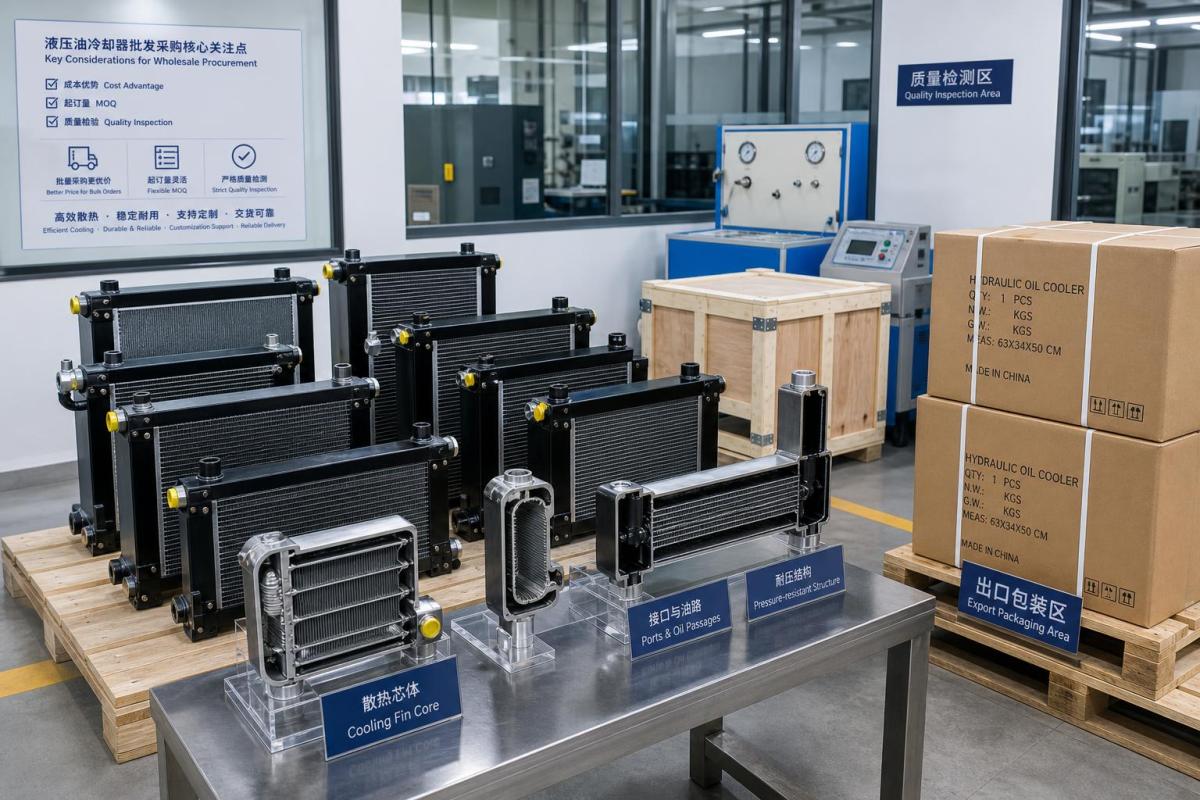
Hydraulic oil cooler wholesale decisions affect more than unit price. They influence uptime, warranty exposure, replacement cycles, and the stability of hydraulic systems under load.
That is why many sourcing teams compare cost, MOQ, and inspection standards together rather than treating them as separate checkpoints.
In practical terms, a cheaper cooler can become expensive if pressure loss is too high, brazing quality is inconsistent, or packaging fails during cross-border shipment.
A more reliable approach is to judge the supplier through performance data, production discipline, and response speed when specifications change.
Within advanced industrial sourcing, this is where benchmarking matters. G-AIE highlights how physical equipment selection now connects with digital traceability, materials validation, and resilient supply planning.
So the common question is not simply, “Who offers the lowest hydraulic oil cooler wholesale quote?” It is, “Which offer holds up after freight, testing, and field use?”
What usually drives hydraulic oil cooler wholesale pricing?
Price is shaped by design complexity first. Tube-fin, plate-fin, and bar-plate structures carry different material and process costs.
Then come the less visible cost drivers. These often explain why two quotations look similar on paper but behave differently in production.
- Core material grade and wall thickness
- Pressure rating and burst test requirements
- Surface treatment for corrosion resistance
- Thread type, fittings, and custom manifold changes
- Fan motor brand, voltage, and protection class for air-cooled units
- Carton strength, pallet standard, and export packaging
Another point is order mix. Hydraulic oil cooler wholesale pricing improves when dimensions, ports, and accessories are standardized across several SKUs.
Custom samples, small design revisions, and non-standard labels tend to raise cost more than many buyers expect.
Freight also changes the real cost picture. Large but lightweight coolers may look economical ex-works yet lose appeal once volumetric shipping charges are added.
A useful comparison method is to request a landed-cost view. That means unit price, tooling, sample fee, packaging, inspection cost, scrap allowance, and logistics in one sheet.
How should MOQ be judged without creating stock pressure?
MOQ is often misunderstood. A high MOQ does not always signal an inflexible supplier, and a low MOQ does not automatically mean better sourcing conditions.
More often, MOQ reflects tooling setup, brazing batch efficiency, raw material purchasing, and packaging economics.
The better question is whether the MOQ matches forecast accuracy, spare-parts strategy, and product lifecycle risk.
For hydraulic oil cooler wholesale orders, these checkpoints help avoid overbuying:
In many cases, MOQ becomes easier to negotiate when drawings are frozen, forecast windows are clearer, and annual volume is visible.
If the supplier refuses every flexible option, that is not always a deal breaker. It may simply mean their process is optimized for stable, repeatable output.
Which quality checks matter before placing a bulk order?
This is where many hydraulic oil cooler wholesale projects either become stable or become costly. Quality cannot be judged by appearance alone.
A polished exterior says little about thermal efficiency, internal cleanliness, or leakage resistance after pressure cycling.
A solid pre-order checklist usually includes document review and physical verification.
- Material certificates for core alloys, seals, and fittings
- Pressure test records and leak test method
- Cleanliness control for internal passages
- Thermal performance data under defined flow and ambient conditions
- Salt spray or coating verification when corrosion is relevant
- Dimensional checks on mounting points and threads
In actual use, two extra checks are often worth the effort. One is vibration resistance. The other is packaging drop resistance for export transit.
Suppliers with stronger process control can usually provide traceable batch data, inspection points, and nonconformance handling procedures.
That aligns well with the G-AIE view of industrial procurement: hardware quality should be measurable, documented, and comparable across sources.
How do you compare suppliers when quotes look similar?
This is a common search question because many hydraulic oil cooler wholesale offers arrive with close pricing and similar lead times.
The difference usually appears when the comparison moves beyond the quotation sheet.
A useful supplier review should cover these areas:
- Responsiveness to technical revisions and drawing clarification
- Consistency between sample quality and production quality
- Ability to support documentation for audits and compliance
- Capacity stability during seasonal demand peaks
- Root-cause handling if field failures appear
There is also value in asking what the supplier measures internally but does not advertise. That answer often reveals process maturity.
For example, do they monitor brazing temperature windows, fan balance, weld porosity, or cleanliness after flushing?
When a supplier can discuss those controls clearly, confidence improves even before the first bulk shipment.
What mistakes increase risk in hydraulic oil cooler wholesale sourcing?
Some sourcing errors repeat across industries because the cooler is treated as a simple accessory rather than a performance-critical component.
One mistake is buying only by external dimensions. Similar size does not guarantee similar heat rejection or pressure tolerance.
Another is approving a sample without confirming test conditions. A good result under one oil viscosity may not hold at another temperature range.
It is also risky to ignore maintenance realities. Fin spacing, cleaning access, and replacement lead time affect service cost after installation.
More subtle problems appear in documentation gaps. Missing revision control can lead to mixed fittings, wrong mounting holes, or inconsistent labels in later batches.
A disciplined hydraulic oil cooler wholesale process usually avoids these issues by locking three things early: application data, acceptance criteria, and change-control rules.
What is the smartest next step before committing to a supplier?
Start by narrowing the decision to a small comparison set, then score each offer on total cost, MOQ fit, quality evidence, and repeat-order reliability.
For hydraulic oil cooler wholesale projects, the strongest decisions usually come from a short but structured review.
- Confirm thermal duty, pressure range, oil type, and installation constraints
- Request a full quotation with tooling, packaging, and inspection terms
- Check whether MOQ can be shared across variants or phased by shipment
- Review test records, material traceability, and defect-response procedure
- Run a pilot order before annual volume release
That sequence keeps the discussion practical. It also reduces the chance of choosing a supplier on price alone.
In a market shaped by efficiency targets, material performance, and smarter industrial data, hydraulic oil cooler wholesale sourcing works best when commercial terms and engineering evidence stay connected.
If the next review focuses on actual operating conditions, order structure, and verifiable quality controls, the final decision is usually easier to defend and easier to scale.
Recommended News
 Sep 19, 2026When can a supply chain LLM reduce time spent finding shipment updates?Supply chain LLMs can cut shipment-update search time by connecting carrier events, ERP data, and documents—giving teams traceable answers and faster exception response.
 Sep 18, 2026How industrial monitoring equipment helps prevent unplanned downtimeIndustrial monitoring equipment helps teams detect early asset issues, prioritize maintenance, and prevent costly unplanned downtime. Explore practical strategies for reliable operations.
 Sep 17, 2026What next-gen harmonic drive research means for robot joint accuracyNext-gen harmonic drive research reveals how backlash, stiffness, thermal drift, and sensing shape robot joint accuracy. Explore smarter validation strategies.
 Sep 16, 2026How Southeast Asian climates affect cylinder seal frictionCylinder seal friction Southeast Asia: learn how humidity, heat, monsoons, and contamination affect motion stability, wear, and seal selection.
 Sep 15, 2026How to size DC gear motors for the required starting torqueGear motors DC sizing made practical: calculate starting torque, account for friction, gravity, inertia and voltage drop, then select a reliable motor with confidence.
 Sep 14, 2026How to verify high purity chemicals compliance before supplier approvalHigh purity chemicals compliance: learn how to verify supplier quality systems, CoAs, traceability, testing, and change control before approval.
 Sep 13, 2026What permits are needed to operate mapping drones in Europe?Mapping drones Europe: discover the permits, EASA categories, airspace approvals, site access, and GDPR checks needed for compliant aerial surveys.
 Sep 12, 2026What lead time should I expect for automatic transmission components? Planetary Gearboxes delivery forecasting for OEM planningWhat lead time should I expect for automatic transmission components? Get dynamic, AI-powered planetary gearbox delivery forecasting—designed for OEMs building next-gen hybrid & commercial powertrains.
 Sep 12, 2026Can polyamide replace metal in load-bearing components? Polymer Pulse structural performance data for 2026 applicationsCan polyamide replace metal in load-bearing components? Discover Polymer Pulse’s 2026 structural data—real-world performance, weight savings, and reliability breakthroughs.
 Sep 12, 2026How to handle a power electronics warranty claim: Harmonic Reducers documentation and escalation pathHow do I handle a power electronics warranty claim? Get a fast, intelligent, evidence-driven resolution for harmonic reducers—no bureaucracy, just precision diagnostics and real-time escalation.
 Sep 12, 2026Which motion control specifications matter most before purchase? Torque Logic selection criteria for automation engineersWhich motion control specifications are most important before purchase? Discover Torque Logic—the 4 non-negotiable, AI-aligned criteria that cut TCO by 27–41% and boost motion system availability to 99.992%.
 Sep 13, 2026Is agentic AI reliable enough for supplier screening? Supply Chain LLM validation framework for procurement teamsIs agentic AI reliable enough for supplier screening? Discover a rigorous LLM validation framework built for procurement teams—grounded in material traceability, regulatory compliance, and real-world operational constraints.
 Sep 14, 2026How to maintain edge AI systems after deployment: Predictive Maint AI operational protocols for field techniciansHow do I maintain edge AI systems after deployment? Discover predictive, physics-aware operational protocols designed for real-world field technicians—sustaining intelligence where silicon meets steel.
 Sep 15, 2026What compliance documents must a bioplastics supplier provide? Bio-Plastics regulatory checklist for procurementWhat compliance documents should a bioplastics supplier provide? Get our actionable regulatory checklist for food, medical & EU-bound applications.
 Sep 16, 2026How to prevent PET film defects during production: Barrier Films process control best practicesHow can I prevent PET film defects during production? Discover physics-driven barrier film process control—thermal precision, dynamic tension management & surface energy optimization.
 Sep 17, 2026Are thermoplastics suitable for long-term outdoor use? Engineering Resins durability assessment in 2026 UV/weather exposureAre thermoplastics suitable for long-term outdoor use? Discover 2026’s engineering resin durability insights — UV/weather resistance ranked, tested & actionable.
 Sep 18, 2026What to do when a servo motor fails during production: A Servo Actuators troubleshooting guide for maintenance teamsWhat should I do if a servo motor fails during production? Get a field-tested, AI-aware troubleshooting guide for maintenance teams—minimize downtime, maximize OEE.
 Sep 12, 2026How to compare wholesale party supplies by minimum order valueCompare wholesale party supplies by minimum order value, freight, SKU flexibility, and stock risk to choose suppliers that protect margins and simplify replenishment.
 Sep 11, 2026How proportional solenoid linearity affects precision motion controlProportional solenoid linearity directly affects precision motion control, valve metering, stability, and calibration. Learn how to evaluate performance for reliable automation.
 Sep 10, 2026When does supplier information platform automation reduce onboarding delays?Supplier information platform automation reduces onboarding delays by streamlining data collection, routing, renewals, and compliance checks—without replacing expert technical review.
 Sep 09, 2026How to size robotic motion systems for AMR payload changesRobotic motion systems for AMR payload changes: learn how to size motors, wheels, gearing, traction, and controls for safer, reliable performance.
 Sep 08, 2026How to perform a cylinder rod buckling calculation for long strokesCylinder rod buckling calculation made practical: learn how to assess effective length, end conditions, rod stiffness, load forces, and safety margins for reliable long-stroke cylinder design.
 Sep 07, 2026How to estimate the cost of industrial mechanical components before orderingIndustrial mechanical components cost: learn how to estimate material, machining, tooling, inspection, logistics, and hidden expenses before ordering. Compare quotes confidently and reduce sourcing risk.
 Sep 07, 2026What Is a Product Standards Database Used For?Product standards database guide: learn how to compare requirements, verify revisions, control specifications, and reduce compliance risks across design, sourcing, and production.