Search News
Industry Portal
Popular Tags
China Halts Heavy Rare Earth Exports to Japan
Author
Time
Click Count
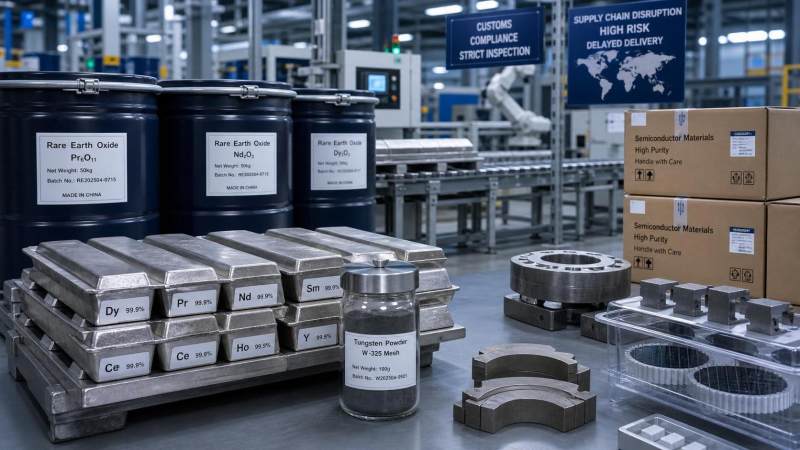
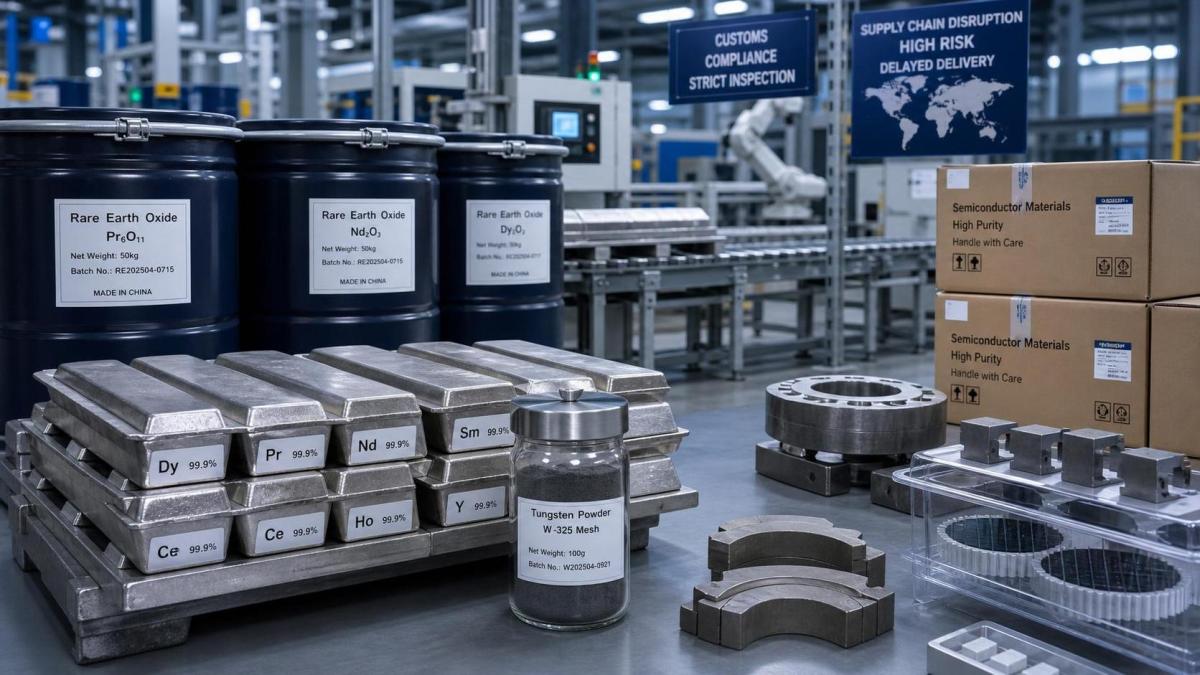
On January 1, 2026, the market focus shifted from supply tightness to rule execution after China applied dual-use export controls to Japan, resulting in three consecutive months of zero exports of heavy rare earths such as dysprosium and terbium, as well as tungsten carbide and tungsten powder. For companies tied to magnet production, semiconductor materials, defense-related manufacturing, cross-border sourcing, and delivery planning, this is not just a trade interruption but a policy-driven compliance and supply-chain event that requires closer review of procurement exposure and execution risk.
What Has Been Confirmed Since January 2026
Confirmed information shows that, starting in January 2026, China lawfully imposed dual-use item export controls on Japan. Under that change, exports to Japan of dysprosium, terbium, other heavy rare earths mentioned in the report context, tungsten carbide, and tungsten powder fell to zero for three straight months.
The confirmed impact described in the input reaches several key industrial chains in Japan, including permanent magnet motors for new energy vehicles, the F-15J upgrade program, and 5 nm chip manufacturing. The same input also states that Shin-Etsu Chemical suspended new magnet orders and that Kanto Denka will permanently stop producing tungsten hexafluoride in July.
Where the Rule Change Is Likely to Be Felt First
Pressure on buyers of controlled raw materials
From an industry perspective, buyers that depend on heavy rare earths, tungsten carbide, or tungsten powder may face the earliest disruption because the change is tied to export control execution rather than ordinary price movement. The immediate concern is whether existing sourcing plans, order allocations, and delivery schedules still match the new trade reality. What deserves closer attention is the documentation chain around controlled items, internal compliance review for destination-specific transactions, and the ability to verify whether substitute sources are commercially and technically viable.
Disruption moving into processing and manufacturing
Manufacturers connected to permanent magnets, advanced materials, and chip-related inputs may see the impact move from raw-material procurement into production scheduling and customer commitments. Analysis shows that once controlled inputs stop moving, the operational issue is no longer limited to purchasing; it can extend to lead times, order acceptance, technical specification matching, and downstream delivery promises. Companies in these positions should pay close attention to whether product specifications, tender documents, or customer qualification files implicitly depend on the affected materials.
New demands on supply-chain and trade service providers
Supply-chain service firms, traders, and cross-border logistics participants may also be affected because rule-based trade changes often shift responsibility toward screening, classification, document accuracy, and transaction traceability. Observably, the practical issue is not only whether goods can be sourced, but whether counterparties can demonstrate compliant handling of controlled categories, destination controls, and contract performance risk. This may increase the need for closer coordination among procurement, legal, compliance, and delivery teams.
What Companies Should Review Now
Check whether controlled materials appear in current orders
Companies with exposure to Japan-facing business or Japan-linked supply chains should first identify whether dysprosium, terbium, tungsten carbide, tungsten powder, or related processed inputs appear in active orders, framework contracts, or technical BOM structures. If they do, the issue should be treated as a transaction and fulfillment review point rather than only a sourcing issue.
Reassess supplier qualification and substitute feasibility
Analysis shows that overseas buyers now need to reassess East Asian supply-chain resilience and the feasibility of alternative sources. At this stage, it is more appropriate to understand substitute-source evaluation as a risk review process, not as a confirmed solution. Companies should therefore focus on supplier qualification records, technical consistency, quality traceability, and whether alternative materials can still satisfy customer or tender requirements.
Watch for shifts in delivery commitments and technical files
Where affected materials are embedded in manufacturing or processing chains, companies should review lead-time assumptions, product specifications, test documentation, and bid or contract language that may become difficult to fulfill under the current export-control environment. Because the input does not provide detailed implementation standards, businesses should avoid assuming a settled enforcement framework and instead keep monitoring execution signals.
Follow later wording, enforcement practice, and market feedback
What deserves closer attention is not only the current interruption itself, but also how future official wording, implementation practice, procurement behavior, and industry responses develop. For many firms, especially overseas purchasers, the key management task is to keep compliance review, sourcing decisions, and customer communication aligned while the rule environment is still being interpreted through market practice.
Why This Looks Like an Execution Signal
Observably, this development is better understood as an executed trade-control signal rather than a theoretical policy discussion, because the input describes a sustained zero-export outcome over three months and names direct industrial consequences already being felt. At the same time, analysis shows that the full commercial and compliance implications are still not fixed, since the detailed downstream treatment of contracts, qualifications, substitutions, and delivery expectations is not provided in the input and may continue to evolve through implementation and market response.
How the Market May Need to Read This Development
A balanced reading is that this event matters less as a short headline and more as a practical test of how export-control rules can reshape procurement continuity, production planning, and supply assurance in East Asia. It is more appropriate to understand the current situation as a landed rule change with continuing implications, rather than as a closed outcome with all consequences already known. For industry participants, the prudent approach is to keep attention on compliance handling, sourcing resilience, and customer-facing execution risks.
Basis of This Article and What Still Needs Verification
This article is generated from the user-provided news title, event date, and event summary. For events of this kind, market participants would usually look to source types such as official notices, regulator releases, customs or trade authority information, industry association updates, standards-related documents, and reporting from authoritative media. No specific official source link was provided in the input, so the exact official reference path still requires further verification. Continued attention is warranted on later policy detail, enforcement interpretation, tender-document changes, certification or compliance practice, industry feedback, and how affected companies implement their responses.
Recommended News
 Sep 22, 2026How to assess a servo motors manufacturer’s quality control processServo motors manufacturer quality control guide: assess traceability, process capability, testing, calibration, and change control to reduce automation risk.
 Sep 21, 2026How bearing friction torque data affects servo actuator sizingBearing friction torque data is essential for accurate servo actuator sizing. Learn how preload, speed, temperature, and friction affect torque, thermal margin, and control stability.
 Sep 20, 2026How to use an electronics product reference to verify component compatibilityUse an electronics product reference to verify component compatibility with confidence. Compare electrical, pin, thermal, mechanical, firmware, and lifecycle requirements before approving replacements.
 Sep 19, 2026When can a supply chain LLM reduce time spent finding shipment updates?Supply chain LLMs can cut shipment-update search time by connecting carrier events, ERP data, and documents—giving teams traceable answers and faster exception response.
 Sep 18, 2026How industrial monitoring equipment helps prevent unplanned downtimeIndustrial monitoring equipment helps teams detect early asset issues, prioritize maintenance, and prevent costly unplanned downtime. Explore practical strategies for reliable operations.
 Sep 17, 2026What next-gen harmonic drive research means for robot joint accuracyNext-gen harmonic drive research reveals how backlash, stiffness, thermal drift, and sensing shape robot joint accuracy. Explore smarter validation strategies.
 Sep 16, 2026How Southeast Asian climates affect cylinder seal frictionCylinder seal friction Southeast Asia: learn how humidity, heat, monsoons, and contamination affect motion stability, wear, and seal selection.
 Sep 15, 2026How to size DC gear motors for the required starting torqueGear motors DC sizing made practical: calculate starting torque, account for friction, gravity, inertia and voltage drop, then select a reliable motor with confidence.
 Sep 14, 2026How to verify high purity chemicals compliance before supplier approvalHigh purity chemicals compliance: learn how to verify supplier quality systems, CoAs, traceability, testing, and change control before approval.
 Sep 13, 2026What permits are needed to operate mapping drones in Europe?Mapping drones Europe: discover the permits, EASA categories, airspace approvals, site access, and GDPR checks needed for compliant aerial surveys.
 Sep 12, 2026What lead time should I expect for automatic transmission components? Planetary Gearboxes delivery forecasting for OEM planningWhat lead time should I expect for automatic transmission components? Get dynamic, AI-powered planetary gearbox delivery forecasting—designed for OEMs building next-gen hybrid & commercial powertrains.
 Sep 12, 2026Can polyamide replace metal in load-bearing components? Polymer Pulse structural performance data for 2026 applicationsCan polyamide replace metal in load-bearing components? Discover Polymer Pulse’s 2026 structural data—real-world performance, weight savings, and reliability breakthroughs.
 Sep 12, 2026How to handle a power electronics warranty claim: Harmonic Reducers documentation and escalation pathHow do I handle a power electronics warranty claim? Get a fast, intelligent, evidence-driven resolution for harmonic reducers—no bureaucracy, just precision diagnostics and real-time escalation.
 Sep 12, 2026Which motion control specifications matter most before purchase? Torque Logic selection criteria for automation engineersWhich motion control specifications are most important before purchase? Discover Torque Logic—the 4 non-negotiable, AI-aligned criteria that cut TCO by 27–41% and boost motion system availability to 99.992%.
 Sep 13, 2026Is agentic AI reliable enough for supplier screening? Supply Chain LLM validation framework for procurement teamsIs agentic AI reliable enough for supplier screening? Discover a rigorous LLM validation framework built for procurement teams—grounded in material traceability, regulatory compliance, and real-world operational constraints.
 Sep 14, 2026How to maintain edge AI systems after deployment: Predictive Maint AI operational protocols for field techniciansHow do I maintain edge AI systems after deployment? Discover predictive, physics-aware operational protocols designed for real-world field technicians—sustaining intelligence where silicon meets steel.
 Sep 15, 2026What compliance documents must a bioplastics supplier provide? Bio-Plastics regulatory checklist for procurementWhat compliance documents should a bioplastics supplier provide? Get our actionable regulatory checklist for food, medical & EU-bound applications.
 Sep 16, 2026How to prevent PET film defects during production: Barrier Films process control best practicesHow can I prevent PET film defects during production? Discover physics-driven barrier film process control—thermal precision, dynamic tension management & surface energy optimization.
 Sep 17, 2026Are thermoplastics suitable for long-term outdoor use? Engineering Resins durability assessment in 2026 UV/weather exposureAre thermoplastics suitable for long-term outdoor use? Discover 2026’s engineering resin durability insights — UV/weather resistance ranked, tested & actionable.
 Sep 18, 2026What to do when a servo motor fails during production: A Servo Actuators troubleshooting guide for maintenance teamsWhat should I do if a servo motor fails during production? Get a field-tested, AI-aware troubleshooting guide for maintenance teams—minimize downtime, maximize OEE.
 Sep 12, 2026How to compare wholesale party supplies by minimum order valueCompare wholesale party supplies by minimum order value, freight, SKU flexibility, and stock risk to choose suppliers that protect margins and simplify replenishment.
 Sep 11, 2026How proportional solenoid linearity affects precision motion controlProportional solenoid linearity directly affects precision motion control, valve metering, stability, and calibration. Learn how to evaluate performance for reliable automation.
 Sep 10, 2026When does supplier information platform automation reduce onboarding delays?Supplier information platform automation reduces onboarding delays by streamlining data collection, routing, renewals, and compliance checks—without replacing expert technical review.
 Sep 09, 2026How to size robotic motion systems for AMR payload changesRobotic motion systems for AMR payload changes: learn how to size motors, wheels, gearing, traction, and controls for safer, reliable performance.