Search News
Industry Portal
Popular Tags
PVC Film Calendering Line Cost, Output and Used Machine Checks
Author
Time
Click Count
A PVC film calendering line is a capital equipment decision, not only a machine purchase. Buyers compare line width, roll count, motor power and price, but the practical value of the line depends on material fit, roll condition, temperature control, gauge accuracy, cooling, winding and the seller's ability to document what has been tested. For companies planning artificial leather, coated fabric, decorative film, barrier film or flexible plastic sheet production, a low headline price can become expensive if the line needs major work after shipment.
This guide explains how buyers should review cost, output and used-machine inspection points before selecting a PVC film calendering line. It also connects the topic to artificial leather production because many buyers reviewing PVC or PU coating equipment are trying to understand whether a line can support coated film, synthetic leather, coated textile or laminated material output. The term artificial leather coating line can describe several process routes, so the buyer should confirm the actual line configuration before comparing offers.
For equipment buyers comparing used coating and calendering options, a supplier page for a synthetic leather coating line can help frame the inspection questions. The buyer still needs to verify whether the offered line is a calendering line, dry coating line, transfer coating line, laminating line or a combined process.
Cost Is More Than the Quoted Machine Price
Used calendering equipment can have very different price levels because condition and scope vary widely. One offer may include only the main calender and winder. Another may include mixer, feeding system, filter, calender, cooling, embossing, trimming, winding, electrical cabinet, spare rolls and technical documents. If the buyer compares those offers by total number only, the cheaper line may appear attractive while hiding missing parts.
The most important cost question is: what must be done before stable production begins? The answer may include roll polishing, bearing replacement, heater repair, gearbox inspection, rewiring, temperature-control work, hydraulic repair, safety upgrades, missing guards, packing and installation support. A good offer separates included work from optional work. A vague offer leaves the buyer guessing.
Buyers should also consider the product mix. PVC film for packaging or decorative use may require different surface and thickness control from artificial leather substrate or coated film applications. If the line must support several materials, the buyer may need extra tooling, recipe control, testing and operator training. Those items belong in the project budget.
Output Claims Need Conditions
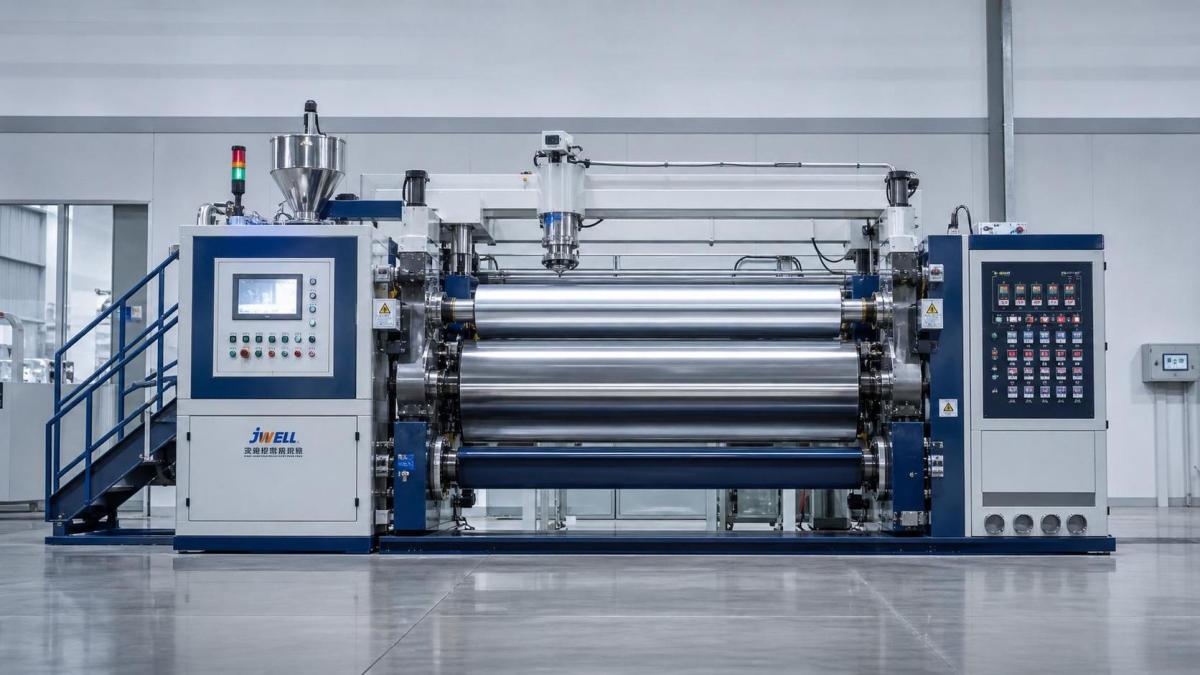
Output is often quoted as a single number, but a single number is not enough. Calendering output depends on compound formula, film thickness, width, roll temperature, cooling capacity, line speed and acceptable defect level. A seller may quote a maximum output achieved under a different material or product condition. Buyers should ask what product was used when the output was measured.
For PVC film, output may be limited by mixing and feeding upstream or by cooling and winding downstream. If the calender can form film faster than the cooling and winding system can handle it, saleable output will be lower than theoretical output. If roll temperature control is unstable, the line may run slowly to avoid surface defects. This is why output review must include the full process, not only the calender stand.
When possible, request a trial run with a formula close to the buyer's intended material. If that is not possible, request video evidence, previous product information and maintenance history. A used line that cannot be tested should be priced as higher risk unless the seller provides strong inspection documentation.
Used Machine Inspection Table
Roll Condition Is a Core Buying Factor
Calender rolls are among the most valuable parts of the line. Their surface condition and geometry directly affect film quality. Scratches, dents, corrosion, uneven wear or poor polishing can leave visible marks on the film. In some cases, roll repair is possible. In other cases, repair cost and downtime can be high enough to change the buying decision.
Buyers should request close photos of roll surfaces and, when possible, inspection records. Ask whether the rolls were used for PVC, rubber, filled compound or other materials. Ask whether any roll was repaired or reground. Ask whether the heating or cooling channels are clear. A line with excellent rolls and older paint may be more valuable than a freshly painted line with damaged rolls.
For artificial leather coating line projects, roll quality also affects lamination, surface uniformity and final feel. If the buyer needs a smooth surface, matte surface or embossed surface, the roll condition and downstream finishing system should be checked together.
Electrical and Control-System Review
Electrical condition can be a hidden cost in used calendering equipment. Old inverters, weak wiring, unmarked cables, obsolete PLC units and unstable temperature controllers can delay installation. Buyers should ask for clear photos of the control cabinet and a list of major electrical components. If the machine will be exported, local voltage, frequency, electrical standards and spare-part access should be reviewed before shipment.
Temperature sensors and control loops deserve special attention. PVC film production is sensitive to heat. If roll temperature is unstable, the material may stick, degrade, shrink, show surface marks or fail to hold gauge. A used line with unreliable sensors should be repaired before trial production or priced with that risk in mind.
Safety systems should also be checked. Calendering equipment has pinch points, hot surfaces and moving rolls. Emergency stops, guards, interlocks and operator controls must be reviewed by qualified personnel before production. Buyers should not assume that an older line meets current plant safety expectations without modification.
How to Compare Used and Rebuilt Options
A used line sold as-is can be suitable for buyers with strong engineering teams. They may prefer a lower purchase price and plan to rebuild locally. A rebuilt line can be better for buyers who need shorter startup time or have limited maintenance support. Neither option is always better. The correct choice depends on budget, deadline, technical staff and risk tolerance.
When comparing offers, list what is included: machine sections, repair work, spare parts, packing, loading, installation guidance, trial run and documentation. Then list what remains unknown. Unknown roll condition, unknown electrical status or missing documentation should not be treated as minor details. They affect startup time and total cost.
Buyers should also evaluate the seller's technical communication. If a seller can answer questions about material history, roll condition, output limits and control-system status, the buyer has a better basis for negotiation. If the seller can only provide a short equipment list, the buyer should ask for more evidence before committing.
Procurement Checklist
- Define target product: PVC film, coated film, artificial leather, laminated material or another application.
- Confirm finished width, thickness range, surface requirement and expected output.
- Ask for the full included equipment list, not only the calender stand.
- Inspect roll surface, roll geometry, bearing condition and heating/cooling channels.
- Review drive system, speed synchronization and gearbox condition.
- Check temperature control, sensors, heater circuits and cooling capacity.
- Ask for electrical cabinet photos and control component brands.
- Separate included refurbishment from optional repair work.
- Confirm dismantling, cable marking, packing and loading responsibilities.
- Budget for trial material, local installation, safety review and startup adjustment.
Application Matching for Coated Film and Leather Materials
PVC film calendering equipment may be used in several product families, but the buyer should match the line to the intended application. Decorative film may require surface consistency and color stability. Barrier film may require thickness control and low defect rates. Artificial leather may require compatibility with coating, laminating, embossing and backing materials. A general-purpose line may need adaptation before it can serve a specific product.
If the buyer's project includes an artificial leather coating line concept, the process route should be clarified. Does the buyer need calendered PVC film first, then lamination? Does the buyer need direct coating on fabric? Does the buyer need drying ovens, stenter handling or embossing? These questions affect line selection, cost and factory layout. Buying a calender without the required downstream process can leave the project incomplete.
Application matching is also important for used-machine valuation. A line that is excellent for one film application may be less useful for another. Buyers should resist broad claims and ask for evidence tied to the exact material and product window.
FAQ
What is the biggest price factor in a used PVC film calendering line?
Roll condition, drive system health, temperature control and included downstream equipment are major factors. Missing parts and unclear repair scope can also change the final project cost.
Can a calendering line support artificial leather production?
It can support certain production routes, especially where calendered PVC film is part of the structure. However, artificial leather production may also require coating, lamination, embossing, drying or stenter sections.
Should buyers ask for a trial run?
Yes, if the line is still assembled. A trial run with similar material gives better evidence than no-load operation or static photos.
Is a rebuilt line always better than an as-is used line?
No. A rebuilt line may reduce startup risk, but an as-is line can be suitable for buyers with strong maintenance capability. The choice depends on repair scope, budget and production deadline.
What should be checked before paying a deposit?
Confirm included equipment, roll condition, electrical status, repair scope, trial-run availability, packing method, documentation and installation support.
Final Buying Advice
A PVC film calendering line should be evaluated by total readiness, not by machine name alone. The buyer should connect the equipment to the intended product, check the condition of high-value components, and understand what work is needed before production. A low-cost line can be useful when the buyer accepts repair work knowingly. It becomes risky when unknowns are hidden behind a simple price quote.
For used equipment buyers, the best outcome comes from clear product requirements, component-level inspection and written repair scope. Whether the project is PVC film, coated film or artificial leather, the buyer should treat cost, output and machine condition as one connected decision.
Editorial Review Note
This article is buyer-facing guidance for evaluating PVC film calendering and related artificial leather equipment. It avoids fabricated prices, unsupported output claims and invented case numbers. Before final upload, the publisher should check the destination portal's house style, category fit and any safety wording required for hot-roll or coating equipment.
Recommended News
 Sep 19, 2026When can a supply chain LLM reduce time spent finding shipment updates?Supply chain LLMs can cut shipment-update search time by connecting carrier events, ERP data, and documents—giving teams traceable answers and faster exception response.
 Sep 18, 2026How industrial monitoring equipment helps prevent unplanned downtimeIndustrial monitoring equipment helps teams detect early asset issues, prioritize maintenance, and prevent costly unplanned downtime. Explore practical strategies for reliable operations.
 Sep 17, 2026What next-gen harmonic drive research means for robot joint accuracyNext-gen harmonic drive research reveals how backlash, stiffness, thermal drift, and sensing shape robot joint accuracy. Explore smarter validation strategies.
 Sep 16, 2026How Southeast Asian climates affect cylinder seal frictionCylinder seal friction Southeast Asia: learn how humidity, heat, monsoons, and contamination affect motion stability, wear, and seal selection.
 Sep 15, 2026How to size DC gear motors for the required starting torqueGear motors DC sizing made practical: calculate starting torque, account for friction, gravity, inertia and voltage drop, then select a reliable motor with confidence.
 Sep 14, 2026How to verify high purity chemicals compliance before supplier approvalHigh purity chemicals compliance: learn how to verify supplier quality systems, CoAs, traceability, testing, and change control before approval.
 Sep 13, 2026What permits are needed to operate mapping drones in Europe?Mapping drones Europe: discover the permits, EASA categories, airspace approvals, site access, and GDPR checks needed for compliant aerial surveys.
 Sep 12, 2026What lead time should I expect for automatic transmission components? Planetary Gearboxes delivery forecasting for OEM planningWhat lead time should I expect for automatic transmission components? Get dynamic, AI-powered planetary gearbox delivery forecasting—designed for OEMs building next-gen hybrid & commercial powertrains.
 Sep 12, 2026Can polyamide replace metal in load-bearing components? Polymer Pulse structural performance data for 2026 applicationsCan polyamide replace metal in load-bearing components? Discover Polymer Pulse’s 2026 structural data—real-world performance, weight savings, and reliability breakthroughs.
 Sep 12, 2026How to handle a power electronics warranty claim: Harmonic Reducers documentation and escalation pathHow do I handle a power electronics warranty claim? Get a fast, intelligent, evidence-driven resolution for harmonic reducers—no bureaucracy, just precision diagnostics and real-time escalation.
 Sep 12, 2026Which motion control specifications matter most before purchase? Torque Logic selection criteria for automation engineersWhich motion control specifications are most important before purchase? Discover Torque Logic—the 4 non-negotiable, AI-aligned criteria that cut TCO by 27–41% and boost motion system availability to 99.992%.
 Sep 13, 2026Is agentic AI reliable enough for supplier screening? Supply Chain LLM validation framework for procurement teamsIs agentic AI reliable enough for supplier screening? Discover a rigorous LLM validation framework built for procurement teams—grounded in material traceability, regulatory compliance, and real-world operational constraints.
 Sep 14, 2026How to maintain edge AI systems after deployment: Predictive Maint AI operational protocols for field techniciansHow do I maintain edge AI systems after deployment? Discover predictive, physics-aware operational protocols designed for real-world field technicians—sustaining intelligence where silicon meets steel.
 Sep 15, 2026What compliance documents must a bioplastics supplier provide? Bio-Plastics regulatory checklist for procurementWhat compliance documents should a bioplastics supplier provide? Get our actionable regulatory checklist for food, medical & EU-bound applications.
 Sep 16, 2026How to prevent PET film defects during production: Barrier Films process control best practicesHow can I prevent PET film defects during production? Discover physics-driven barrier film process control—thermal precision, dynamic tension management & surface energy optimization.
 Sep 17, 2026Are thermoplastics suitable for long-term outdoor use? Engineering Resins durability assessment in 2026 UV/weather exposureAre thermoplastics suitable for long-term outdoor use? Discover 2026’s engineering resin durability insights — UV/weather resistance ranked, tested & actionable.
 Sep 18, 2026What to do when a servo motor fails during production: A Servo Actuators troubleshooting guide for maintenance teamsWhat should I do if a servo motor fails during production? Get a field-tested, AI-aware troubleshooting guide for maintenance teams—minimize downtime, maximize OEE.
 Sep 12, 2026How to compare wholesale party supplies by minimum order valueCompare wholesale party supplies by minimum order value, freight, SKU flexibility, and stock risk to choose suppliers that protect margins and simplify replenishment.
 Sep 11, 2026How proportional solenoid linearity affects precision motion controlProportional solenoid linearity directly affects precision motion control, valve metering, stability, and calibration. Learn how to evaluate performance for reliable automation.
 Sep 10, 2026When does supplier information platform automation reduce onboarding delays?Supplier information platform automation reduces onboarding delays by streamlining data collection, routing, renewals, and compliance checks—without replacing expert technical review.
 Sep 09, 2026How to size robotic motion systems for AMR payload changesRobotic motion systems for AMR payload changes: learn how to size motors, wheels, gearing, traction, and controls for safer, reliable performance.
 Sep 08, 2026How to perform a cylinder rod buckling calculation for long strokesCylinder rod buckling calculation made practical: learn how to assess effective length, end conditions, rod stiffness, load forces, and safety margins for reliable long-stroke cylinder design.
 Sep 07, 2026How to estimate the cost of industrial mechanical components before orderingIndustrial mechanical components cost: learn how to estimate material, machining, tooling, inspection, logistics, and hidden expenses before ordering. Compare quotes confidently and reduce sourcing risk.
 Sep 07, 2026What Is a Product Standards Database Used For?Product standards database guide: learn how to compare requirements, verify revisions, control specifications, and reduce compliance risks across design, sourcing, and production.